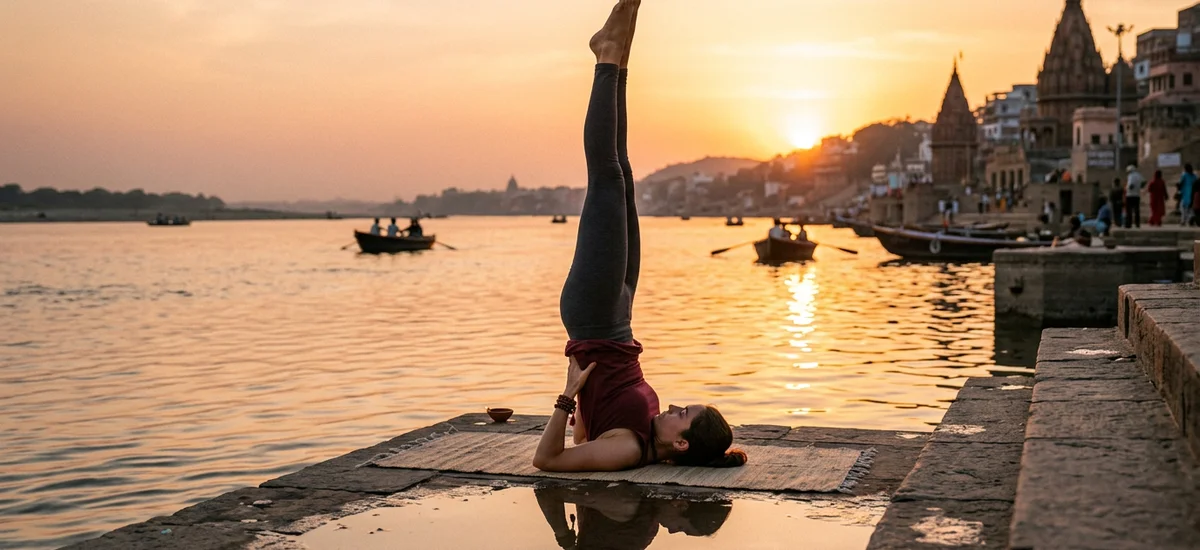
In the tradition of yoga, few asanas receive such a definitive title as Sarvangasana. They call it “the queen of asanas.” This is not poetic exaggeration: it is the unanimous appreciation of classical texts and masters who have studied it for centuries. The reason lies in the name itself.
The shoulder stand has the particularity of working, simultaneously, practically all the systems of the body. Circulation, endocrine system, digestive system, spine, legs, back. Few postures can claim such reach so clearly.
In this article, we will see what its name means, why it receives that title, how to execute it with complete safety for the neck, and why the use of blankets is not an optional accessory but a requirement.
Meaning: “the posture of all parts of the body”
The word Sarvangasana is formed with three Sanskrit roots: sarva (सर्व), “all”; anga (अङ्ग), “part” or “member”; and asana (आसन), “posture”. The literal translation is “the posture of all parts of the body”.
The name is not metaphorical. When the body is inverted over the shoulders, the circulatory system must adapt to the new orientation. Blood flows with gravity instead of against it toward the brain, the abdominal organs are redistributed, the spine extends in a different way, and the thyroid and parathyroid glands receive direct mechanical stimulation.
That is why tradition considers it not just another asana, but a postural medicine capable of influencing the overall well-being of the practitioner when practiced consistently and with correct technique.
Why it is called “the queen of asanas”
The Hatha Yoga Pradipika and the Gheranda Samhita describe Sarvangasana as a pose that rejuvenates the body, reverses the deterioration associated with age, and balances glandular functions. The title “queen” (Sarvangasana) complements that of “king,” which corresponds to Sirsasana (the headstand).
The distinction between the two is subtle but important. Sirsasana is considered more powerful and stimulating; Sarvangasana is more accessible, safer, and with equally profound benefits. That is why teachers often recommend mastering the shoulder stand before attempting the headstand.
In Iyengar, for example, it is taught as a pose that should be held for several minutes to produce all its effects. That prolonged duration is part of the secret: the endocrine and circulatory effects need time to manifest.
Preparation and mandatory use of blankets
Sarvangasana is a safe posture only when practiced with the proper support under the shoulders. Entering directly onto the mat, without folded blankets, subjects the cervical vertebrae to an abnormal flexion that can cause severe long-term injuries.
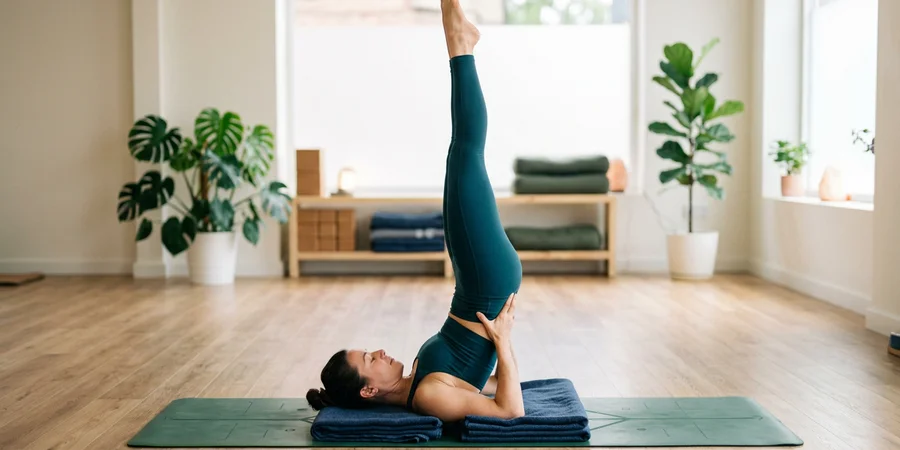
The correct support consists of two or three folded blankets under the shoulders, with the edge of the blankets aligned about two centimeters from the end of the shoulders. The head is supported on the mat, outside the support, with the neck free from vertical pressure.
This is the non-negotiable point of the posture: without blankets, there is no safe Sarvangasana. Direct pressure from the shoulders on the floor flattens the natural cervical curvature, and if practiced regularly, it can cause chronic neck discomfort.
How to do Sarvangasana step by step
The following sequence describes the classic version with blanket support. Do not practice this posture without proper support or without prior warming up, which includes shoulder and spine mobility.
- Prepare the support. Place two or three folded blankets on the mat, with the edges aligned with each other. The mat should extend in front of the blankets so that the head has a support surface outside the support.
- Lie down with your shoulders on the blankets. The top edge of the blankets should be about two centimeters from the top of the shoulders. The head rests on the mat, with the neck naturally curved and free.
- Flex your knees. Bring your feet close to your glutes, resting on the floor. The arms rest at your sides with the palms facing down. This is the starting position.
- Elevate your legs towards the ceiling. With an exhale, gently swing your legs up, bringing your knees towards your forehead. Roll over your spine until your hips are over your shoulders.
- Place your hands on your back. Bring your hands to the lower back, fingers pointing upwards and elbows at a distance no greater than shoulder width. The hands support the back, they do not lift it off the ground.
- Extend your legs towards the ceiling. With the knees still bent, slowly stretch the legs upwards until they are vertical. The toes point to the ceiling, the thighs are active, and the glutes as well.
- Align the body. Look for a vertical line from the shoulders, passing through the hips, to the heels. The hands accompany this alignment without forcing, adjusting to the height of the back every few seconds.
- Activate the feet. Keep the feet active, with the heels pushing upwards. This activation keeps the posture firm and prevents the legs from falling forward or backward.
- breathe and hold. Stay for 1 to 5 minutes, depending on your experience. The breath flows naturally. To come out, bend the knees, place the hands on the ground, and slowly roll down, vertebra by vertebra, without lifting the head.
Correct alignment and cervical safety
The alignment of Sarvangasana hinges on two critical points: proper neck support and the verticality of the whole posture. Both depend on precise placement from the start.
The golden rule of the neck
Throughout the posture, the neck must not turn at all. Looking to the sides, even with minimal movement, subjects the cervical vertebrae to forces for which they are not prepared in that position. This is the most common cause of discomfort after Sarvangasana.
The rule is simple: once in the posture, the gaze goes to the ceiling or the toes, and stays there until you come out. If you need to adjust your hair, clothing, or support, come out of the posture, adjust, and re-enter. Never turn the neck in the posture.
The weight of the body should rest on the shoulders and the upper back, not on the neck. With the proper support of blankets, the head remains free and the neck hardly bears any load. If you feel neck pressure, the support is insufficient: add another blanket.
Elbows, hands, and verticality
The elbows should be shoulder-width apart or slightly closer, never wider. If they separate, the weight of the body falls on the neck instead of the shoulders. Imagine holding a block between the elbows.
The hands on the lower back support the alignment, not holding the weight by themselves. The palms are flat against the back, fingers pointing up. Every so often, adjust the hands closer to the shoulder blades to maintain verticality effortlessly.
The vertical line from the shoulders to the feet is the goal. If the hips fall forward, the back works too hard. If they fall back, they compress the neck. Adjust until you find the exact vertical, where the posture seems almost suspended by itself.
Benefits of Sarvangasana
The nickname “queen” is not unwarranted. Sarvangasana influences so many systems that describing them all would require a separate article. These are the most documented and relevant benefits.
Physical Benefits
The pose directly stimulates the thyroid and parathyroid glands. The gentle mechanical pressure of the chin against the sternum (Jalandhara Bandha) sends blood to this area and is considered therapeutic for mild thyroid function issues. Practiced consistently, it contributes to overall hormonal regulation.
The venous return from the legs improves significantly. By inverting the body, the blood that accumulates in the lower limbs due to gravity flows back to the heart effortlessly. This is why the pose is traditionally recommended for mild varicose veins, heaviness in the legs, and circulatory fatigue.
At the abdominal level, inversion repositions the visceral organs and relieves pressure on the pelvic floor. Many practitioners notice an improvement in digestion and intestinal regularity with regular practice.
The spine stretches and decompresses in the opposite direction to the usual. The vertebrae release the gravitational pressure of the day, the discs hydrate, and the posture when standing up afterward feels lighter and more upright.
Energetic and Mental Benefits
In tradition, Sarvangasana activates Vishuddha, the throat chakra, the center of authentic expression and clear communication. The sustained stimulation of this area is considered transformative for people who have difficulty expressing themselves.
At a mental level, the inversion calms the nervous system by activating the parasympathetic. After holding it for several minutes, a sensation of mental clarity and tranquility appears that other postures hardly produce. This is the reason why it is traditionally practiced at the end of the sequence, before Savasana.
For people with mild insomnia or a racing mind, the regular inclusion of Sarvangasana in the practice has a cumulative soothing effect. It does not produce an immediate result like a sedative, but rather a deep regulation of the nervous system over time.
Variations and Modifications
Sarvangasana accommodates variations that adapt it to different levels and to practitioners who need more support.
For beginners or sensitive necks
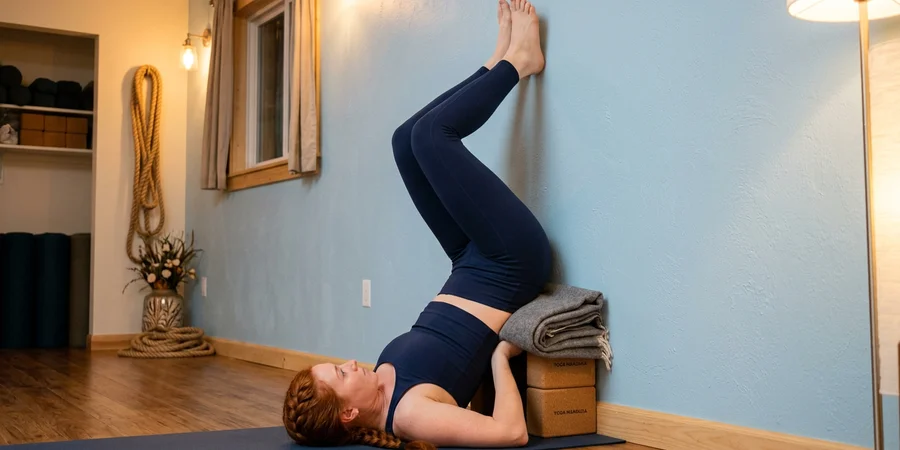
With wall and blankets. Lie down with your legs elevated against a wall and rest your back on folded blankets. Your feet gently push against the wall to help lift the hip. It is the safest version to start familiarizing yourself with the inversion.
With chair support. Using a stable chair placed against a wall, the pelvis rests on the seat while the shoulders remain on the ground with blankets. This allows you to hold the pose for a long time without muscle effort, ideal for therapeutic sessions.
Viparita Karani (legs-up-the-wall pose). Technically, it is not Sarvangasana, but it shares many of its benefits with much less strain. Lying down with the legs resting vertically against a wall, it offers a gentle and deeply relaxing inversion. Excellent as a preparation or as a permanent alternative.
To deepen
Niralamba Sarvangasana. The “unsupported” variant: the hands are brought to the floor instead of supporting the back. It requires considerable abdominal strength and prior mastery of the classical pose. It is a typical progression in the Iyengar tradition.
Padma Sarvangasana. Once in the pose, cross the legs in lotus position. It combines inversion with hip opening. It requires the lotus to be grounded on the floor before attempting it in inversion.
Transition to Halasana. From Sarvangasana, lower the legs over the head to rest the feet behind on the floor. This transition to the plow pose is natural and is commonly practiced in sequence after Sarvangasana.
Matsyasana: the essential counter-pose
After Sarvangasana, the neck and shoulders have sustained a prolonged flexion. Exiting the pose without compensating that flexion with a cervical and thoracic extension leaves residual tension that can cause discomfort.
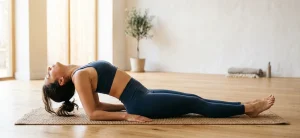
The classic counter-pose is Matsyasana (the fish pose). Lying on your back, the chest is lifted resting on the elbows and the head is allowed to fall back, opening the throat. This extension compensates for the cervical flexion sustained in Sarvangasana and balances the effects on the thyroid gland.
The proportion recommended by tradition is: if you hold Sarvangasana for five minutes, hold Matsyasana for at least two minutes. The total time should be significant for the compensation to be effective. Skipping this phase causes cervical discomfort that could be easily avoided.
Contraindications
Sarvangasana is powerful, and therefore it is also a pose with clear contraindications that must be respected.
If you have cervical injuries, cervical disc disease, herniated disc, or chronic neck pain, avoid this pose. Substitute with Viparita Karani with the legs on the wall, which offers similar circulatory benefits without compromising the neck.
With uncontrolled high blood pressure, glaucoma, retinal detachment, or serious cardiovascular problems, inversions are contraindicated. Consult a medical professional before including them in your practice.
During menstruation, many traditions recommend avoiding inversions. The reason is more respectful of the body’s natural flow than strictly medical, but it’s worth considering based on your personal sensitivity.
During advanced pregnancy, inversions are not recommended. If you practiced Sarvangasana before pregnancy and there are no medical contraindications, you can maintain it in the first trimester with moderation. Afterwards, substitute with wall variations.
With obesity or significant shoulder weakness, entering and exiting the pose can be difficult and compromise the neck. Work first with wall-supported variations until you develop the necessary stability.
The queen who teaches to hold serenity
Sarvangasana is a pose that asks for time. It is not meant to be practiced for three breaths and then move on to something else. It is to be held long enough for the body to adapt to the new orientation and for the nervous system to find the stillness that the inversion invites.
That is why it is traditionally a final pose in practice. After working the spine with extensions like Chakrasana and after strengthening the core with Navasana, the candle pose offers a space for integration: the body inverted, the mind calm, the breath long.
Consistency is the secret. Practiced once in isolation, its effects are limited. Practiced three or four times a week for several minutes, its impact on circulation, the endocrine system, and overall well-being is profound and cumulative.
If you want to learn how to safely incorporate inversions into your classes, to set up the appropriate support, and to teach the preparatory progressions, our 200h Yoga Teacher Training Course includes comprehensive modules on inversions and on the specific pedagogy of inverted yoga poses.