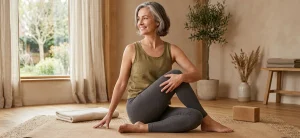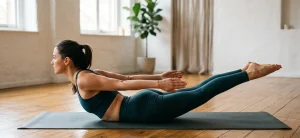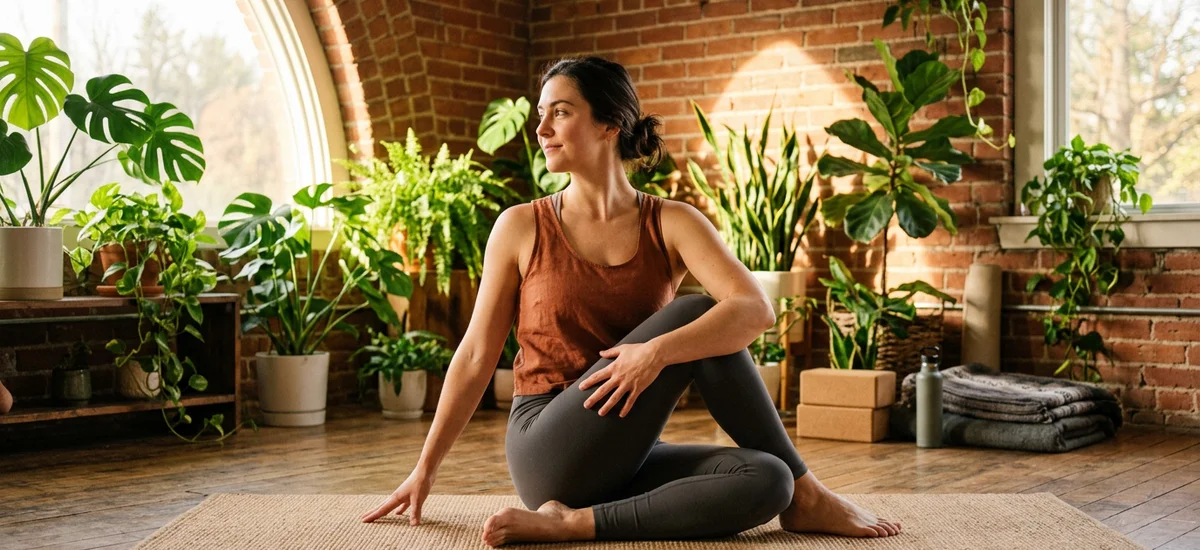
Few yoga postures combine so many elements in a single gesture. Ardha Matsyendrasana is a seated twist that mobilizes the spine from the base to the cervical area, massages the abdominal organs, and requires a mindfulness that turns each repetition into active meditation.
Its name honors the sage Matsyendra, considered the first human master of Hatha Yoga. The story surrounding its origin is one of the most beautiful legends in the yogic tradition, and it deserves to be told before bringing the posture into the body.
In this article, you will discover the step-by-step technique, the mistakes you should avoid, the benefits that science and tradition attribute to it, and how to integrate this deep twist into your daily practice.
The wise Matsyendra: the fisherman who listened to the secrets of yoga
The word Ardha Matsyendrasana breaks down into four Sanskrit roots: ardha (half), matsya (fish), indra (lord), and asana (posture). The literal translation is “the half posture of the lord of fishes.” That lord is Matsyendra, a character whose legend connects the animal world with spiritual awakening.
Tradition says that Matsyendra was a humble fisherman who one day was swallowed by a huge fish. In the belly of the animal, carried by the ocean currents, the fish stopped next to an underwater cave where the god Shiva was imparting the secret teachings of yoga to his wife Parvati.
Matsyendra, trapped inside the fish, listened to every word. For years he silently absorbed the techniques of pranayama, meditation, and asanas that Shiva revealed. When he was finally released from the belly of the animal, he emerged transformed: he was no longer a fisherman but an enlightened yogi.
The tradition recognizes him as the first human disciple of yoga and founder of the Nath lineage, one of the most influential schools of Hatha Yoga. His story teaches that transformation can occur in the most unexpected circumstances, as long as there is a willingness to listen.
How to do Ardha Matsyendrasana step by step
The following description corresponds to the classic version of the pose, accessible for practitioners with basic experience. Adaptations for beginners are detailed later.
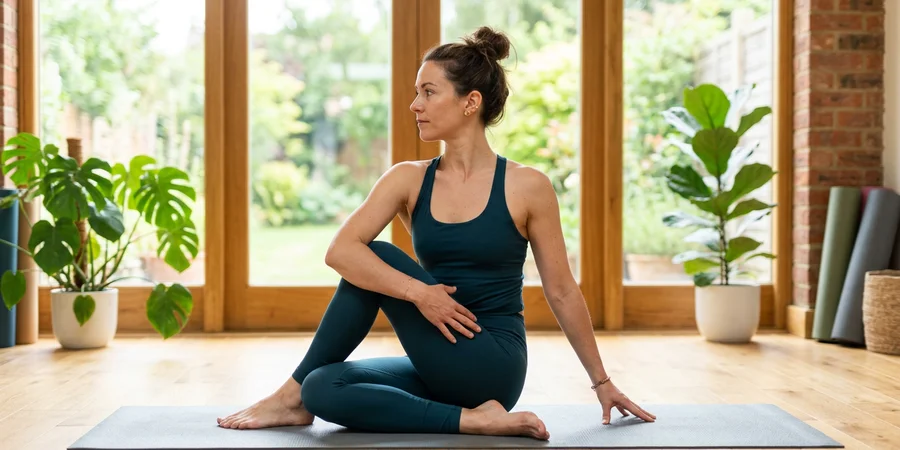
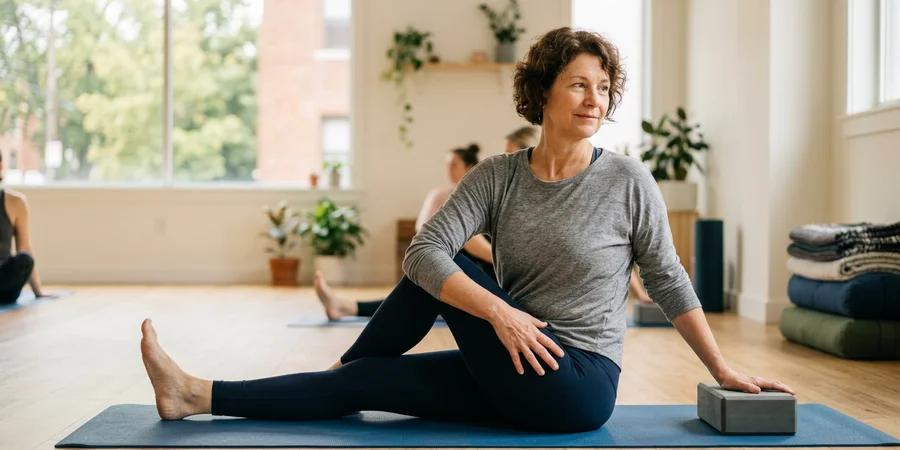
1. Sit in Dandasana. With your legs stretched out in front and your spine erect, press your sit bones against the ground. Engage your quadriceps and slightly flex your feet towards you. This stable base is the starting point.
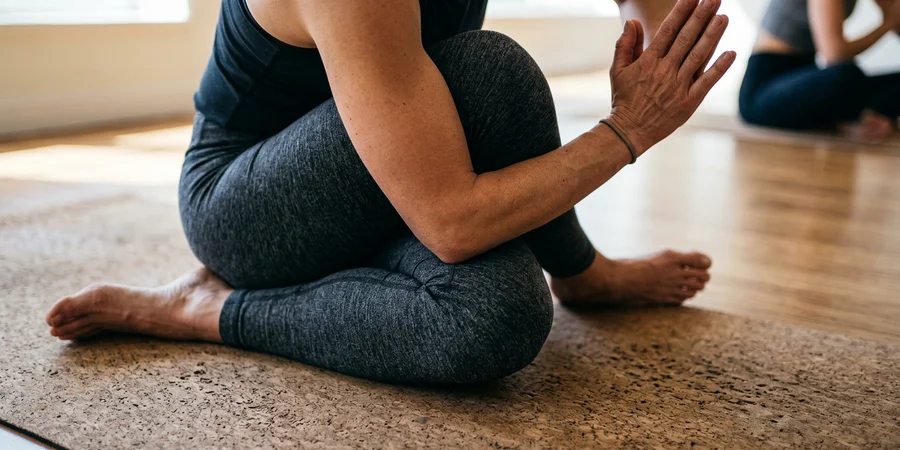
2. Bend your right knee and cross your foot. Bend your right knee and place the sole of your right foot on the ground, outside your left thigh. The sole of your foot should be fully grounded, with your toes facing forward.
3. Bend your left leg. Bend your left knee and bring your left heel next to your right glute. If this position feels uncomfortable for your knee, keep your left leg extended in front.
4. Lengthen the spine before twisting. Inhale deeply and grow from the crown of your head. Imagine a thread pulling you up from the top of your head. This prior lengthening is essential: without it, the twist compresses the discs instead of mobilizing them.
5. Twist the torso to the right. As you exhale, rotate the torso towards the crossed leg. Bring the left elbow outside the right knee. The arm acts as a gentle lever, not a brute force. The right hand rests on the ground behind your back, with the fingers pointing backward.
6. Breathe and deepen. With each inhalation, lengthen the spine a little more. With each exhalation, deepen the rotation by one degree more. Hold the pose for 5 to 10 complete breaths. To exit, inhale while lengthening the spine and exhale while gently unwinding the twist. Repeat on the other side.
Common mistakes to avoid
Twisting from the shoulders without moving the spine. The most common mistake is to rotate only the upper part of the body, bringing the shoulders back without the thoracic and lumbar spine participating. The twist should originate from the base of the spine and rise vertebra by vertebra. If you feel that you are only twisting from the chest up, reduce the range and focus on initiating the movement from the abdomen.
Round your back when twisting. When the spine loses its verticality, the twist becomes compression. Before each twist, remember the previous step: inhale and lengthen. If your back rounds when you twist, you’ve gone too far. Step back until you find the maximum rotation you can maintain with an upright spine.
Force with the arm. The elbow resting against the knee is a guide, not a crane. Using brute arm strength to push yourself beyond your natural range can overload the lower back and floating ribs. Depth should come from breathing and core muscle work, not from arm pressure.
Lift the sit bone off the floor. When twisting, it’s common for the glute on the opposite side to lift off the ground. When this happens, the pelvis becomes destabilized, and the twist is distributed asymmetrically. Keep both sit bones firmly grounded, even if it means twisting less.
Hold the breath. The natural tendency when entering an intense twist is to block the diaphragm. However, breathing is precisely the engine of the pose. Each inhalation creates space between the vertebrae, and each exhalation allows for a deeper rotation. Without fluid breathing, the pose loses half of its effect.
Benefits of Ardha Matsyendrasana
Spinal twists are one of the families of postures most supported both in yogic tradition and in modern research on joint mobility and visceral health.
Improves spinal mobility. Axial rotation is one of the movements that is most lost with a sedentary lifestyle. Ardha Matsyendrasana works on rotation safely and in a controlled manner, mobilizing each vertebral segment. When practiced regularly, it restores to the spine a range of motion that many people lose after the age of thirty.
Stimulates digestion and the abdominal organs. By twisting the torso, the abdominal organs receive a gentle compression followed by a release. This “squeeze and release” mechanism increases blood flow to the liver, spleen, kidneys, and intestine. Ayurvedic tradition specifically recommends twists to improve agni, the digestive fire.
Relieves tension in the back. Spinal rotation releases the paravertebral muscles, deep rotators, and intercostal muscles. People who spend many hours in front of the computer find in this posture a remarkable relief from back stiffness and accumulated tension between the shoulder blades.
Opens the shoulders and chest. The position of the back arm and torso rotation stretch the minor pectorals and anterior deltoids. For those who tend toward a kyphotic posture (shoulders rounded forward), this opening is particularly valuable.
Tones the deep abdominal muscles. The internal and external obliques, along with the transverse muscles of the abdomen, actively work to support and deepen the twist. It is not a superficial “six-pack” job, but a deep activation of the muscular corset that stabilizes the spine.
Calms the nervous system. Gentle twists activate the vagus nerve through pressure on the abdominal area, promoting the parasympathetic response. Many practitioners report a sense of calm and mental clarity when coming out of the pose.
Contraindications and adaptations
Lumbar or thoracic disc herniations. Rotation under load can aggravate an existing protrusion or hernia. If you have a diagnosis of this kind, consult with your physical therapist before practicing. In many cases, a very gentle version without deepening is safe, but requires professional supervision.
Knee injuries. The position of the bent leg underneath the body can create pressure on compromised menisci or ligaments. If you feel discomfort in the lower knee, keep that leg fully extended in front. It is a valid adaptation that does not detract from the effectiveness of the twist.
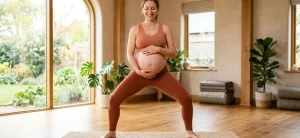
Pregnancy. Starting from the second trimester, deep twists compress the abdomen and are not recommended. Replace them with open twists (turning towards the side of the open leg) that do not press on the belly.
Acute digestive issues. Although the posture improves long-term digestion, practicing it during a crisis of gastritis, severe reflux, or acute irritable bowel syndrome can be counterproductive. Wait for the acute phase to subside before including intense twists.
Adaptation with a chair. For people with limited mobility or pain when sitting on the floor, Ardha Matsyendrasana can be practiced sitting on a chair. One leg is crossed over the other, and the torso is twisted using the backrest for support. The benefits of spinal rotation are almost completely maintained.
Variants to explore the twist
Gentle version without crossing the leg. Instead of placing the foot outside the opposite thigh, rest it next to the inside of the opposite knee. This variant reduces the intensity of the twist and is ideal for beginners or for the first few minutes of warming up. It allows you to focus on the mechanics of breathing without the joint complexity of the full version.
Complete Matsyendrasana (Purna Matsyendrasana). It is the advanced version that names the pose without the prefix “ardha.” The lower leg is placed in half lotus and the arm that wraps around the knee goes behind the back to grasp the foot. It requires considerable flexibility in the hips, shoulders, and spine. It is found in the intermediate series of Ashtanga Yoga and is a long-term goal, not a starting point.
Twist with arm extension. Instead of resting the elbow against the knee, fully extend the arm and bring the hand to the opposite foot. This variation increases leverage and deepens the rotation, but requires greater arm length and thoracic flexibility. It is an intermediate step before the full version.
The twist as a practice of inner listening
Twists hold a special place in the practice of yoga. Unlike forward bends or back extensions, which follow clear and predictable lines, the twist asks the body to reorganize itself in an unconventional plane. That internal reorganization is what makes it such a powerful tool.
Ardha Matsyendrasana does not allow for automation. Each breath modifies the depth of the twist. Every day, the body reaches a different point. There’s no way to force it without immediate consequences: the back protests, the breath locks, and the posture collapses.
This demand for constant attention is what makes it a practice of real listening. It is not enough to just position oneself and wait. One must negotiate with the body in real time, accept what it offers each day, and work honestly within that range.
In tradition, it is said that twists “wring out” the tensions of the body like wringing out a wet towel. Those who practice Ardha Matsyendrasana regularly discover that this metaphor is not just poetic: there is a real physical and emotional release that occurs when the spine regains its ability to twist freely.
Integrating this twist into your regular routine, combining it with forward bends and extensions, gives the spine the full range of motion it needs to stay healthy.
If you want to learn how to properly sequence twists within a class and understand the anatomy that supports them, the 200h Yoga Teacher Training from Kavaalya offers a comprehensive training online, backed by the tradition and pedagogy that each yoga pose deserves.