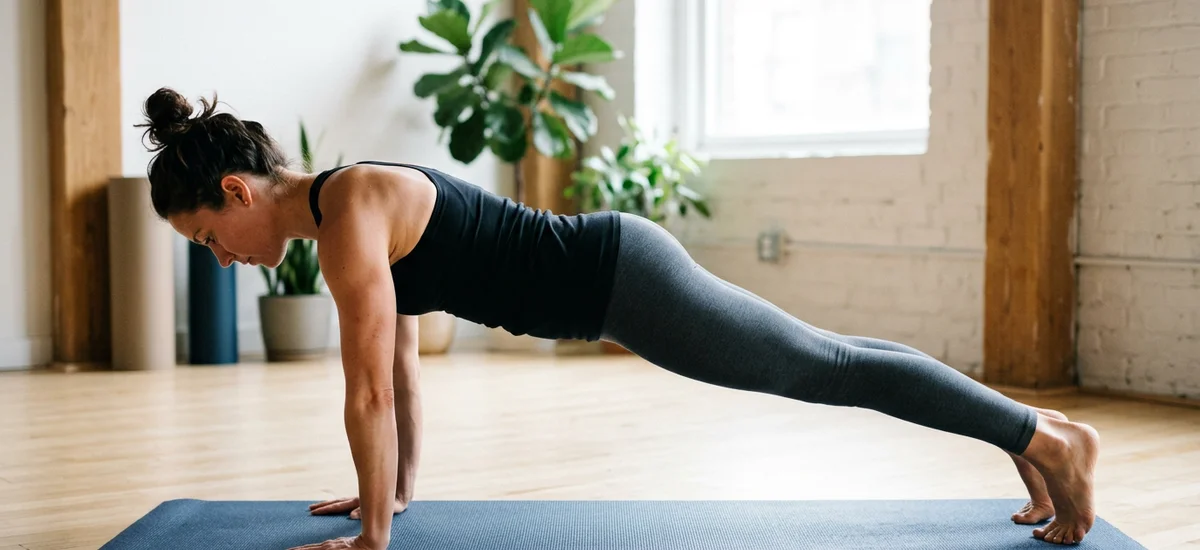
Plank pose, popularly known as the plank position, is one of the most fundamental asanas in any yoga practice. At first glance, it seems simple: holding yourself in a horizontal position supported by your hands and feet.
However, in that apparent simplicity lies one of the most powerful tools for strengthening your body and developing mental endurance.
This pose acts as an indispensable bridge between many dynamic sequences, particularly in Surya Namaskar and in vinyasa practices. Its mastery is essential for both beginners and advanced practitioners.
Meaning and Etymology of Santolanasana
The term “Santolanasana” comes from Sanskrit. “Santolana” means balance, rocking, or support, while “asana” refers to posture. Together they describe the essence of this asana: the art of maintaining a horizontal balance.
In the classical yogic tradition of India, Santolanasana represents more than just a physical exercise. It is a metaphor for the balance we seek to cultivate in life: the ability to remain steadfast and centered in the face of pressures, to find stability in adversity.
The posture teaches the body to become a firm board, without weaknesses or frailties. This quality of solidity and determination is precisely what we develop when we practice Santolanasana with awareness and dedication.
How to do Santolanasana: Step by step technique
To perform Santolanasana correctly, follow these steps with mindfulness. Every detail matters.
Starting position: Begin in Adho Mukha Svanasana (downward-facing dog). From here, shift your body forward until your shoulders are directly above your wrists. Your feet should be hip-width apart.
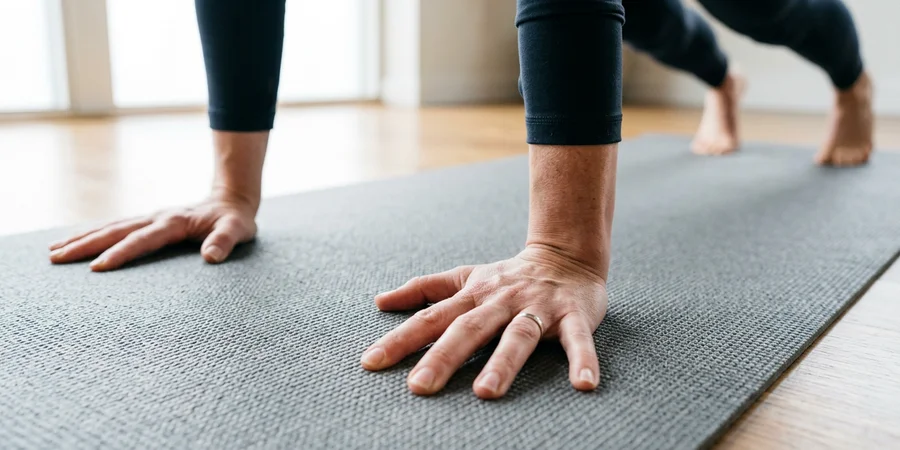
Hand alignment: Your fingers should be well spread and pressing firmly against the ground. Distribute weight evenly between your palm and fingers. Your hands should be directly under your shoulders, not forward. This alignment is crucial to avoid unnecessary tension in the wrists and elbows.
Core Activation: Here lies the secret to an effective plank. Tighten your abdomen as if someone were about to punch you in the stomach. Activate the transverse abdominis, the obliques, and the rectus abdominis.
The core must be strong and held throughout the posture. This contraction not only protects your lower back but also multiplies the benefit of every second.
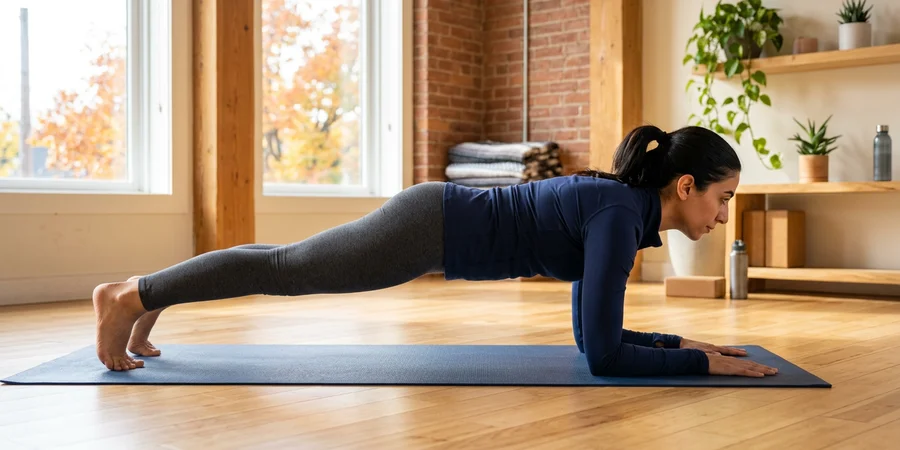
Full Body Alignment: Form a perfect straight line from the crown of your head to your heels. The hips should not sag or rise too high. This neutral position is what you define as “plank.” Slightly relax the glutes (do not overactivate them) and activate the thighs by pressing inward.
Head Position: Keep your head in a neutral position, looking down at the ground. Do not lift your chin or tilt your forehead too far back. Your gaze should be fixed on a point approximately 30 centimeters in front of you.
Conscious Breathing: Breathe slowly and deeply. Many beginners hold their breath without realizing it. In Santolanasana, breathing is essential. Exhale and inhale consistently, drawing the air into your core to maintain activation.
Common Mistakes in Plank Pose
Hips too high: When the hips are raised excessively, you lose the benefit of core activation and transfer the work to the shoulders. This can create tension in the neck and destabilize the posture. Keep your hips at the same level as your back.
Hips too low: The opposite mistake is also common. If you let your hips drop towards the floor, you compress the lumbar area and deactivate the core. Your lower back suffers unnecessarily. Feel your pubis slightly lifting towards your navel.
Hands Forward: Placing your hands too far forward shifts your weight out of alignment, increasing the load on your shoulders. Make sure your wrists are directly under your shoulders. If you notice discomfort, your hands are likely positioned incorrectly.
Tight Neck or Dropped Head: Do not lower your head forcefully or lift your chin. This chronic tension in the neck can cause pain and prevent you from breathing properly. Keep your gaze relaxed towards the floor.
Held Breath: This is the most subtle yet harmful mistake. Many practitioners believe they must hold their breath to “maintain” the pose. Nothing could be further from the truth. Conscious breathing oxygenates your body and keeps it stronger for longer.
Benefits of Santolanasana
The benefits of Santolanasana go far beyond physical strengthening, although that is undoubtedly its most evident effect.
Core strengthening: This is the star benefit. Santolanasana activates the deep abdominals, the obliques, and the rectus abdominis. A strong core is the foundation of any advanced practice, from Navasana to arm balances.
It also improves your posture in daily life. Recent studies have shown that an activated core improves concentration and reduces anxiety.
Strengthening of arms, wrists, and shoulders: By pressing firmly against the ground, you strengthen triceps, front deltoids, and the stabilizing muscles of the shoulders. Your wrists also gradually strengthen, preparing you for more complex asanas like Adho Mukha Vrksasana (inverted tree) or Pincha Mayurasana (feather of the peacock).
Scapular stability: Regular practice of Santolanasana develops the stability of your shoulder blades, essential for any arm balance posture. This stability is what distinguishes practitioners with body control from those who only have brute strength.
Preparation for advanced postures: Santolanasana is the fundamental step to access Chaturanga Dandasana and arm balance postures. Without mastery of the plank, those asanas become unsafe.
Development of mental resilience: Maintaining Santolanasana requires determination. Your mind learns to persist, to tolerate discomfort without collapsing, to cultivate tapas (discipline and inner fire). This quality transforms your practice and, gradually, your entire relationship with challenges.
Contraindications and adaptations for injuries
Although Santolanasana is generally safe and accessible, there are some conditions that require adaptations or avoidance of the pose in its classic form.
Carpal tunnel syndrome and wrist pain: If you suffer from this condition, the pressure on the wrists may exacerbate the symptoms. Practice Santolanasana on your forearms to better distribute the load.
You can also use blocks under your hands to slightly elevate your body and reduce wrist flexion.
Shoulder injuries: If you have rotator cuff tendinitis or other shoulder injuries, consult your instructor and possibly a physical therapist first. You may need to modify your arm width or, in some cases, temporarily avoid the classic plank pose.
Advanced Pregnancy: During the third trimester, avoid Santolanasana in its classical form. Practice the version with knees down to maintain activation without unnecessary abdominal pressure.
Lower Back Injuries: If you have lower back issues, start with the plank on knees. Your body may tolerate it better as you develop sufficient core strength for the full version.
Variations of Santolanasana
There are multiple variations that allow you to adapt to your current level or challenge your practice once you master the basic version.
Forearm plank: Lower from the classic plank to rest your forearms on the ground, elbows under the shoulders. Reduce the load on the wrists and develop core strength without joint stress.
Many practitioners find it mentally more challenging because it’s harder to “escape” from it. Hold for 30-45 seconds to notice the effect.
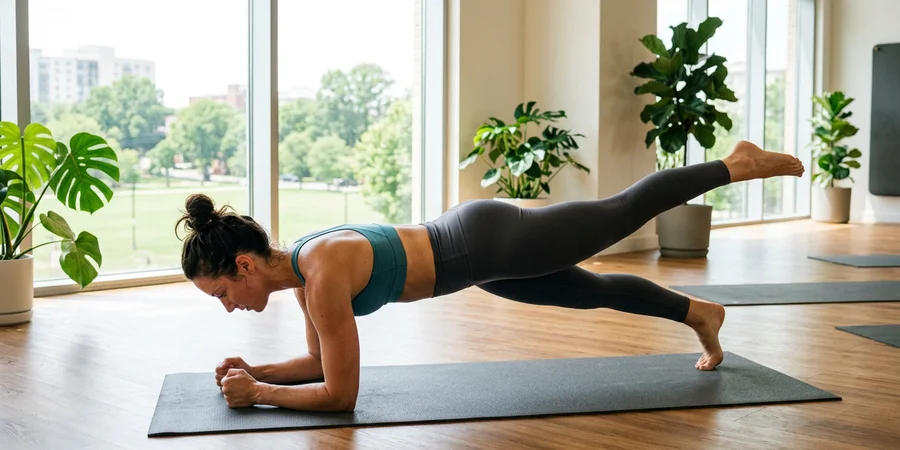
Plank with leg lift: From the classic position, alternate lifting one leg back, keeping it in line with your body. This variation activates the glutes and hip stabilizers more, as well as increasing the demand on the core.
Side plank (Preparatory Vasisthasana): From the classic position, rotate your body to one side, resting on the outer part of one foot and one forearm. Your body forms a diagonal line. This pose strengthens the obliques and hip abductors, preparing you for more advanced side poses.
Dynamic Plank (Chaturanga Dandasana): From Santolanasana, bend your elbows and lower your body towards the ground, keeping it close to your sides. Then push back to the starting position. This dynamic, repeated several times, multiplies the strengthening benefits and is perfect for developing muscular endurance.
Santolanasana in Surya Namaskar
To understand the true importance of Santolanasana, it is essential to know its role in the Surya Namaskar (sun salutation), the most sacred sequence of traditional Indian yoga.
In the 12-step Surya Namaskar, Santolanasana appears as a transition after Uttanasana. From here, the body moves to Chaturanga Dandasana and then to Bhujangasana.
Without mastery of the plank, the flow of Surya Namaskar loses power. It is the anchor that stabilizes the transition between postures, the place where your energy focuses before the next movements.
In the yogic traditions of India, even the most experienced teachers spend time perfecting Santolanasana. True mastery lies in the details of seemingly simple postures.
Many students of the Kavaalya RYT-200 program find that Santolanasana is much more than muscular strengthening: it is a training of presence and connection between body and mind.
How to integrate Santolanasana into your daily practice
Consistency is key. Practice Santolanasana at least 3-4 times a week within your yoga sequence or as dedicated strengthening work. Start by holding the pose for 20 to 30 seconds, then gradually increase to 60-90 seconds based on your ability.
If you practice vinyasa yoga regularly, Santolanasana will naturally appear in each cycle of Surya Namaskar. Here, each repetition is an opportunity to perfect your alignment. It is not a moment to “rush through,” but to cultivate total awareness.
When you understand the deep details of plank, you can adapt it for students with different conditions. It is the pose that teaches you to be an observant and versatile teacher.
Remember: in yoga, it’s not about how long you can hold a pose, but about how much awareness you can bring to it. A plank held for 20 seconds with total presence and correct alignment will transform you much more than five minutes of misaligned and breathless plank.