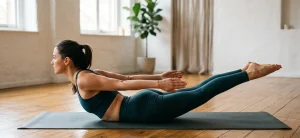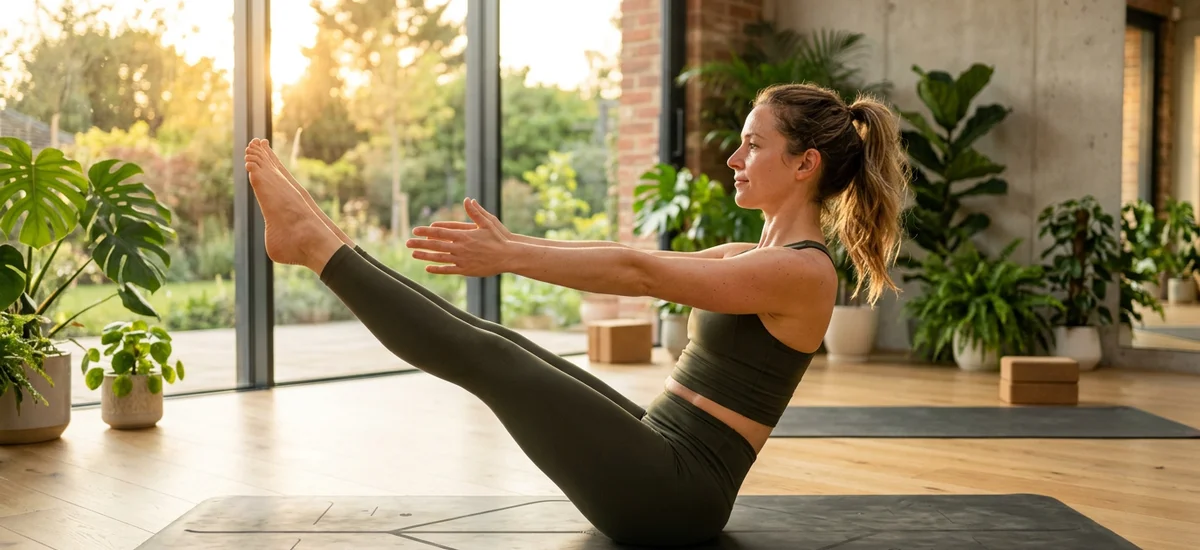
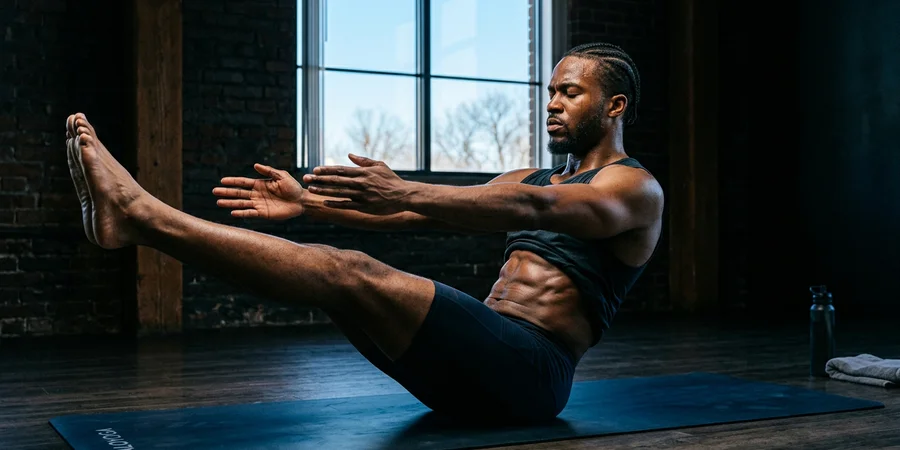
When someone asks which yoga pose works the abdomen, the answer is almost always the same: Navasana. The boat pose is the one that turns yoga into a pure core workout, and it also quickly reveals whether the abdomen is truly connected to the breath or simply tightening.
The boat pose appears in almost all contemporary styles. In Ashtanga, it is held five times in the primary series. In Vinyasa, it is used as a dynamic transition. In classical Hatha, it is practiced as a strengthening of the manipura chakra, the center of the solar plexus.
In this article, we will see what its name means, how to execute it without rounding the back, how it differs from conventional abdominal exercises, and why the core in yoga has a very different quality than brute strength.
Meaning: the boat that sails in inland waters
The word Navasana comes from the Sanskrit nava (नाव), “boat” or “vessel,” and asana (आसन), “posture.” The literal translation is “boat posture.” The name describes the visible shape of the body: legs and torso forming a V that resembles the hull and sails of a vessel.
But the symbolism goes beyond physical resemblance. In Indian tradition, the boat is a metaphor for journey: crossing the waters of samsara, navigating the current of the agitated mind, staying afloat among desires and fears. The pose demands just that: to hold the center while everything around urges to let go.
That is why Navasana is often practiced as a form of mental training as much as physical. Holding the posture for five breaths with a long spine and calm breath is, for many practitioners, one of the most revealing tests of balance between effort and tranquility.
Navasana in Ashtanga and Hatha
In Ashtanga, Navasana is repeated five times in the primary series, interspersed with small lifts (Lolasana) between each repetition. It is one of the most demanding sequences for the core and hip flexors. Anyone who completes it with stable breathing has a considerable level of core strength.
In classic Hatha, one holds a pose only once for an extended time, integrated into a calmer seated sequence. The goal changes: it is not to develop maximum strength, but to cultivate agni, the digestive fire, and to strengthen the solar plexus as the center of will.
How to do Navasana step by step
The following sequence describes the complete version. If the hip flexors or abdomen cannot maintain the shape without rounding the back, move on to the beginner variations described later.
- Sit in Dandasana. Legs extended forward, spine vertical, hands at the sides of the hips. From here, prepare for the entry, do not enter the pose abruptly.
- Bend the knees. Bring the feet towards the buttocks, flat on the ground. The thighs and shins remain in a resting position as you prepare the placement of the torso.
- Lengthen the spine before bending. Inhale and grow from the crown of your head. Open the chest, separate the ribs from the abdomen. This initial lengthening is what prevents the pose from becoming a curve in the lower back.
- Lean the torso slightly back. With the long column, shift the weight towards the back of the sit bones. Balance on them, not on the sacrum. If you fall on the sacrum, the spine rounds and you lose the posture before starting.
- Lift the shins parallel to the floor. Without losing the height of the chest, raise your feet off the floor until the shins are horizontal. This is Ardha Navasana or half boat: the posture before the full version.
- Extend the legs if you can. Stretch the knees until the legs form an angle of 45 to 60 degrees with the floor. If extending makes your back round, return to the version with bent knees.
- Extend your arms forward. Keep your arms parallel to the ground, at shoulder height, with palms facing each other. Active arms help keep the chest open and act as a counterbalance.
- Keep your chest lifted. From the sternum upwards, never let the chest collapse towards the knees. This is the detail that distinguishes a well-executed Navasana from an injurious Navasana.
- Breathe and hold. Stay for 5 to 10 complete breaths. The breath should flow, even if it’s short. If it gets blocked, it indicates that the core is working under excessive tension. To come out, lower your feet with control and rest in Dandasana for a few breaths.
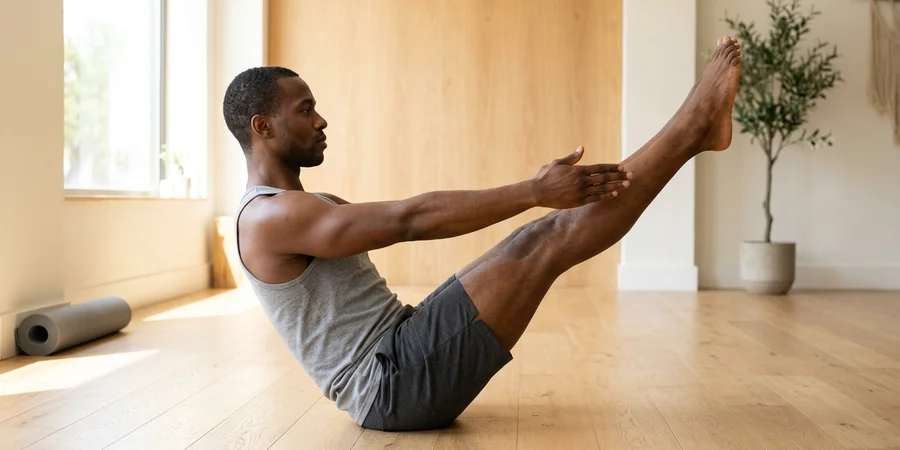
Correct alignment: straight back before extended legs
The most common mistake in Navasana is wanting to extend the legs before the spine can support itself in length. When this happens, the back rounds in a C shape, the chest collapses, the belly pushes forward, and the pose loses all its therapeutic value.
The priority in Navasana is the straight back and open chest. When the spine is kept long and the sternum lifts, any version of the pose, with bent or extended knees, is valid and produces the desired benefits.
Ishia, navel, and chest
Balance relies on the ischia, those two bones that you feel when sitting. If the pose rests on the sacrum, the spine loses its natural curve and all the work concentrates on the lower back area, at the cost that it poses for the discs.
The navel should draw inward and upward, not push forward. This activation of the transverse abdominal muscles protects the lower back and connects with the rest of the deep core. It is a subtle yet decisive action for ensuring the posture is safe.
The chest remains open and lifted, with the shoulder blades sliding down the back. If the shoulders rise towards the ears and the chest sinks, the arms lose strength and the posture collapses quickly.
Neck and gaze
Many practitioners make the mistake of tightening the neck forward, as if trying to “help” the core hold the position. The neck should follow the natural line of the spine, with the gaze directed forward or slightly towards the toes, without effort.
If the neck tightens, you will notice it in the form of cervical contracture hours later. The true strength comes from the center of the body, not from the cervical muscles. Relax the face, jaw, and neck. If your face gets distorted while holding the position, you are working with too much residual tension.
Navasana versus conventional abdominal exercises
Traditional crunches, sit-ups, and other popular abdominal exercises primarily strengthen the rectus abdominis, the superficial muscle that gives the “six pack” appearance. Navasana works a distinct and deeper muscular system.
In Navasana, the sustained isometric contraction activates not only the rectus abdominis but also the transverse abdominis, the obliques, the hip flexors (psoas and iliacus), the quadriceps, and the spinal erectors. It’s a holistic workout that strengthens the core as a unit, not as an isolated muscle group.
Additionally, the posture trains the core in its primary function: stabilizing the spine. Crunches teach the abdomen to bend the spine; Navasana teaches it to keep it stable under load. The second function is much more useful for daily life and for preventing lower back injuries.
Benefits of Navasana
Few postures offer such a specific and comprehensive benefit at the same time. Navasana combines strengthening, visceral stimulation, and mental effects that make it a key component of any balanced practice.
Physical benefits
The pose strengthens the core deeply, activating the deep musculature that supports the spine. It is one of the best natural preventions for chronic lower back pain, especially for sedentary individuals or those with office jobs.
At a visceral level, the sustained contraction of the abdomen massages the digestive organs. That is why tradition associates it with an improvement in digestive fire and metabolism. In practice, many practitioners notice better digestion on the days they include Navasana in their sequence.
The hip flexors (psoas and iliacus) are the main beneficiaries of the pose. These muscles, which connect the lumbar spine to the femurs, are essential for posture and gait. Navasana strengthens them with a very specific isometric contraction.
Balancing on the ischiums improves pelvic proprioception and awareness of the pelvic floor. With regular practice, posture throughout the day, while walking and sitting, gains stability and presence.
Energetic and Mental Benefits
In yogic tradition, Navasana stimulates Manipura chakra, the center of the solar plexus associated with willpower, self-confidence, and personal power. Therefore, after a series of well-executed Navasanas, a sense of clarity and determination often emerges.
At the mental level, the posture trains tolerance to sustained effort. The legs want to drop, the mind suggests giving up, the breath wants to speed up. Staying breathing at that point is the real practice. It is a training of conscious will that is as useful outside the mat as it is inside.
Many practitioners with difficulties concentrating or with a scattered mind find in Navasana a concrete tool. The intensity of the effort forces attention to focus on the present. There is no way to hold the posture while thinking about something else.
Variations and Modifications
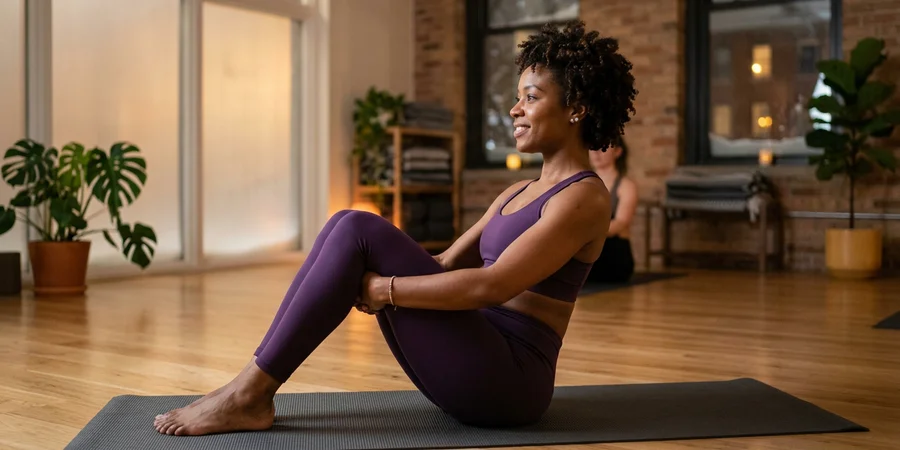
Navasana adapts well to different levels. With the right adjustments, the pose can be practiced from day one without the need to wait to have “enough strength.”
For beginners or bodies without developed core strength
With the knees bent. Keep the shins parallel to the floor without extending the legs. The pose maintains all its essence and significantly reduces the demand on the hip flexors. It is the recommended variation until the back can be kept straight with the legs extended.
With hands holding the thighs. Place your hands behind your thighs, close to your knees. Use the support of your arms to keep your spine long and your chest lifted. Work on balance and alignment without maxing out your core.
Leaning against a wall. Sit with your back to a wall, with your sacrum supported. The wall acts as a reference to keep the spine long. It allows you to hold the posture for a longer time without risking rounding your back.
To deepen
Navasana Series (Ashtanga style). Five repetitions of Navasana, separated by brief raises with the hands (Lolasana). It is a demanding sequence that develops endurance and reactive strength.
Paripurna Navasana with arms raised. A variant in which the arms are extended above the head, increasing the difficulty of balance and the demand on the hip flexors. It is practiced after consolidating the classic version.
Navasana transitioning to Halasana. From Navasana, lean back and bring the legs over the head to enter the plow pose. It is a dynamic transition typical of advanced Vinyasa that requires considerable strength and abdominal control.
Contraindications
Navasana is generally a safe posture, but there are situations where it requires adaptation or avoidance.
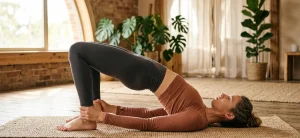
If you have lumbar disc herniation or acute lower back pain, avoid the full version. Anterior compression and the effort of the psoas can exacerbate symptoms. Practice the variation with your back against the wall or temporarily substitute it with Setu Bandhasana (bridge).
In case of rectus diastasis (postpartum abdominal separation), Navasana is not suitable until the separation has closed. Use specific transverse activation exercises before returning to the full posture.
With low blood pressure, the posture can cause dizziness in sensitive individuals. Shorten the hold time and exit slowly. During pregnancy, avoid this posture starting from the first trimester and substitute it with variations that do not compress the abdomen.
If you suffer from cervical issues, make sure not to tense your neck forward. Keep your gaze relaxed and your neck in line with your spine. If discomfort arises, return to the version with bent knees.
The boat that teaches to navigate intensity
Navasana is not a pose that is easily loved. The legs burn, the core trembles, the mind wants to give up. And yet, when practice is regular, something unexpected arises: the pose becomes an anchor. A place where the mind stops scattering because it cannot.
This quality connects it with other postures of sustained effort, such as Utkatasana. But while the chair works the legs, the boat works the center. And the center, in yogic tradition, is the core of being: where will, digestion, and the ability to sustain one’s life originate.
That is why Navasana pairs well with heart-opening postures and with bends that integrate the abdomen in the opposite direction. A balanced practice alternates core strength with posterior release, building a strong but not rigid core, supported but not tense.
If you want to learn to sequence abdominal series with anatomical criteria and to adapt Navasana to different bodies, our 200h Yoga Teacher Training includes modules on core anatomy applied to yoga and on the pedagogy of the fundamental yoga postures.