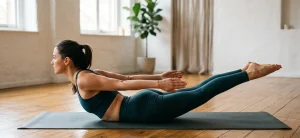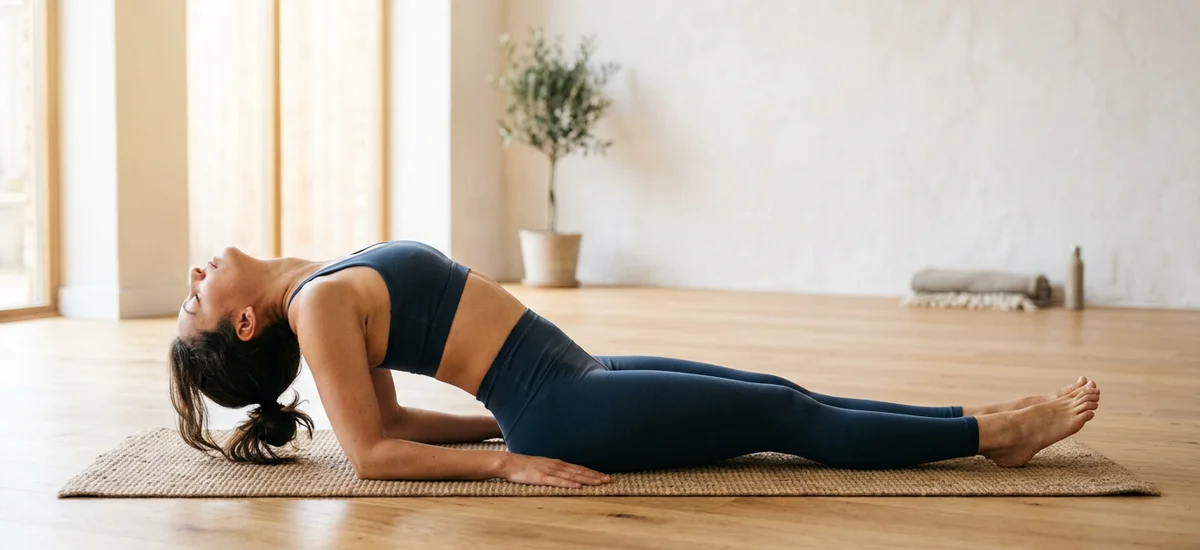
There are postures that close the body and there are postures that open it. Matsyasana belongs to the latter. Lying on your back, the chest rises in a broad arc and the throat unfolds toward the sky, as if the entire body wants to breathe deeper than usual.
It is a gentle extension of the spine in a supine position, where the ribcage expands and the crown of the head rests just above the ground. The sensation is one of openness and buoyancy, not of effort. That is why many practitioners describe it as a physical sigh that dissolves the accumulated tension in the chest.
In this article, you will discover the mythological origin of its name, the step-by-step technique, the mistakes to avoid, the benefits recognized by tradition and anatomy, and the variations that will allow you to adapt it to your body.
Matsya, the fish that saved the world from the flood
The word Matsyasana comes from two Sanskrit roots: matsya, which means “fish,” and asana, which means “posture.” The literal translation is simply “the posture of the fish.” But behind that name lies one of the foundational legends of Indian mythology.
The tradition says that Vishnu, the preserver god of the universe, descended to Earth in the form of a gigantic fish named Matsya. It was his first avatar, the first of the ten with which he would protect creation throughout the eras.
At that time, a great flood threatened to cover the entire world. The wise Manu, the ancestor of all humanity, was warned by the fish and built a vessel. Matsya, pulling the boat with a horn, guided it through the turbulent waters to safety, thus preserving the seeds of life.
Those who practice this asana evoke that image of buoyancy: a body that sustains itself above the water, open and receptive. In fact, tradition holds that in Matsyasana the body takes a form that would allow it to float easily if performed over water, with the chest raised and the breath expanded.
How to do Matsyasana step by step
The following description corresponds to the classical version with the legs stretched out, accessible for practitioners with basic experience. Adaptations for sensitive cervical areas are detailed later.
1. Lie on your back in a supine position. Stretch your legs and bring them together, with your feet relaxed. Let your arms rest at your sides and feel your entire back in contact with the ground. This starting position is the same as the one you would enter for Savasana, the relaxation pose.
2. Slide your hands under your glutes. Bring your hands, palms down, underneath your thighs and glutes. Keep your elbows as close together as possible, drawing them towards the center of your back. These hands will serve as a cushion and protect the lower back during the arch.
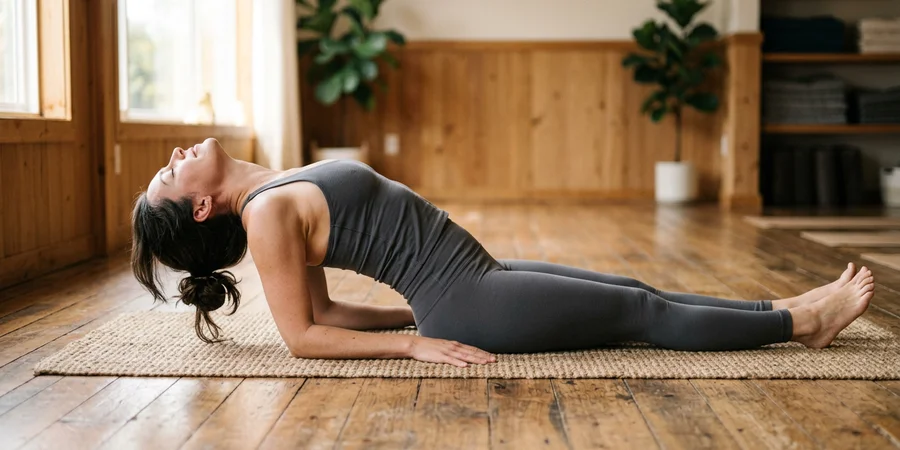
3. Support the forearms and elbows. Firmly press the forearms and elbows against the ground. This support is the true foundation of the pose: it is the elbows, not the head, that bear the weight of the torso as it rises.
4. Lift the chest creating the thoracic arch. Inhale deeply and, pushing from the elbows, lift the chest toward the ceiling. The thoracic spine arches, the shoulder blades come together, and the rib cage opens. Imagine a thread pulling your sternum upwards, expanding the space between each rib.
5. Gently support the crown. Bring the top of the head toward the ground and let the crown rest, but without putting weight on it. The head only lightly touches the ground; the support remains in the elbows. The neck lengthens instead of compressing.
6. Breathe and hold the openness. Maintain the posture for 5 to 10 slow, deep breaths, taking advantage of the chest expansion to inhale fully. To exit, press the elbows back, lift the head slightly, lower the back to the ground with control, and rest.
Common mistakes to avoid
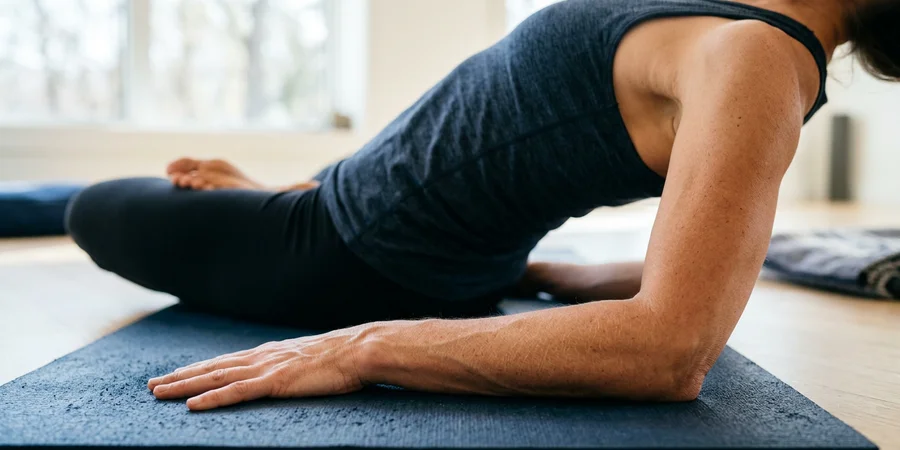
Placing weight on the head and neck. This is the most widespread and risky mistake. If you let the weight of the trunk fall on the crown of the head, you compress the cervical vertebrae and can cause serious discomfort. The head only touches the ground symbolically: the real work is done by the elbows and forearms pushing.
Not using the elbows to support the arch. Many practitioners try to lift the chest using the strength of the neck or abdomen, forgetting that the elbows are the foundation. Without that firm support against the ground, the arch collapses and the pressure shifts to vulnerable areas. Press your elbows down as if you want to sink them into the mat.
Lift the hips and lose contact with the ground. The pelvis and glutes must remain supported throughout the pose. When the hips lift, the arch shifts to the lower back and the chest opening is lost. Keep the pelvis anchored so that the extension occurs where it should: in the dorsal chest.
Compress the cervical spine in search of more arch. Overforcing the head back to “reach further” does not deepen the pose; it only crushes the neck. The goal is not the extreme angle, but the opening of the chest. If you feel tension in the back of the neck, reduce the arch and check the support of the elbows.
Hold your breath. It is paradoxical to hold the breath in a pose whose great gift is precisely the breathing expansion. By lifting the chest, the space for the lungs increases; take advantage of it. Each inhalation should expand the rib cage and each exhalation should release tension, maintaining a constant breathing flow.
Benefits of Matsyasana
Chest-opening postures hold a privileged place both in yogic tradition and in modern respiratory physiology, and Matsyasana is one of the most comprehensive in its family.
Opens the chest and throat. The elevation of the sternum and extension of the neck unfold the entire anterior side of the body. This openness releases the area where we accumulate the most emotional tension and provides an immediate sense of spaciousness and lightness. In the tradition of chakras, it is associated with the activation of the heart center (Anahata) and the throat (Vishuddha).
Expands the chest and improves respiratory capacity. By lifting the chest, the ribs separate, and the diaphragm gains movement. This allows for deeper and more complete breaths. That is why Matsyasana is an excellent preparation for pranayama practices, where thoracic expansion is fundamental.
Counteracts the hunched posture. Hours in front of the computer and mobile close the shoulders forward and sink the chest. Matsyasana performs the exact opposite movement: it brings the scapulae towards the center and opens the thorax, restoring an extension to the thoracic spine that sedentarism takes away.
Stretch the neck and abdominal flexors. Neck extension elongates the muscles of the throat and the front of the torso, including the rectus abdominis. It is a stretch that we rarely give to that area and helps relieve the stiffness accumulated in the neck and abdomen.
Stimulate the thyroid and parathyroids. According to yogic tradition, throat extension exerts a gentle stimulus on the thyroid and parathyroid glands, located in the neck. This effect is classically associated with regulating metabolism and vital energy.
Revitalize and uplift your spirits. Chest openers have a stimulating effect on the nervous system and mood. Many practitioners turn to Matsyasana as a natural antidote to discouragement, fatigue, or feelings of heaviness, as physical openness translates into emotional openness.
Contraindications and adaptations
Cervical or lumbar injuries. Involving an extension of the spine and neck, Matsyasana is not recommended for those with active cervical or lumbar injuries. If this is your case, practice only the restorative variant with support and under professional supervision.
Migraines, hypertension, and hypotension. Individuals suffering from migraines or those with altered blood pressure, whether high or low, should approach this posture with caution or avoid it. The head position and chest opening can alter the perception of pressure and trigger dizziness.
Pregnancy. During pregnancy, especially in the last trimesters, the classic posture on the floor is neither comfortable nor advisable. It is replaced by very gentle versions with ample cushion support under the back, always with guidance from a qualified teacher.
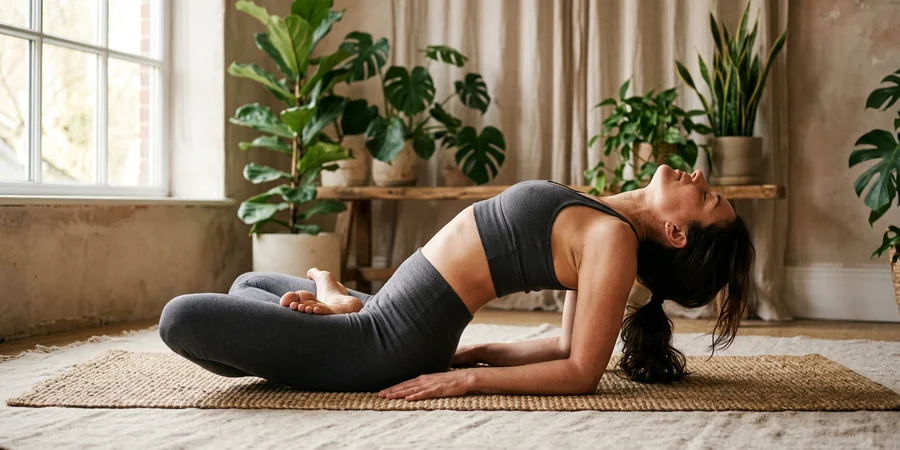
Restorative variation with a block or blanket. For those seeking the benefits without the demand of active arching, there is the restorative Matsyasana: a block or a rolled blanket is placed under the dorsal region of the back, at the height of the shoulder blades, and the chest is allowed to open passively through simple support. It is a delightful way to achieve chest opening without straining the neck.
Legs extended or knees bent. If the lumbar region complains with the legs extended, bend the knees and place the soles of the feet on the ground. This reduces lumbar curvature and makes the pose more accessible without giving up the opening of the chest.
Variations to explore opening
Classic Matsyasana with extended legs. It is the version described in the technique, with both legs extended and together on the ground. It provides a firm anchoring of the pelvis and allows for focusing all attention on the thoracic arch and throat opening. It is the ideal starting point for most practitioners.
Variant with legs in Padmasana. The more advanced traditional version is performed with the legs crossed in Padmasana, the lotus flower. Once in lotus, the practitioner lies back, raises the chest, and in its full expression, holds the feet with the hands. It requires considerable hip opening and should only be approached when Padmasana is comfortable and stable.
Restorative version with support. With a bolster, a block, or a rolled blanket under the upper back, the posture is held without muscular effort. The body surrenders to the support, and the opening occurs by gravity. It is perfect for the end of practice or for gentle yoga sessions and deep relaxation.
The fish as a counterpose and balance of the body
Matsyasana occupies a very specific place within the traditional sequence: it is the classic counterpose of Sarvangasana, the shoulder stand or posture on the shoulders. Where Sarvangasana flexes the neck forward, Matsyasana extends it backward, returning balance to the cervical vertebrae.
This principle of compensation is one of the great treasures of the Hatha Yoga: each movement in one direction asks for its opposite. After the deep bend of the candle, the fish restores the natural curve of the neck and releases the tension that the inverted pose may have generated.
The same logic connects Matsyasana with other poses. After an intense arch like that of Ustrasana, the camel pose, or after the cervical bend of Halasana, the plow pose, the body appreciates the gentle and restorative opening of the fish.
Learning to sequence these relationships, understanding which posture compensates which and how to protect the neck in each extension is part of the deep knowledge that distinguishes a good teacher. That’s why chest opening is not just a physical matter: it’s an invitation to breathe deeper, to hold more life in each inhalation.
If you wish to understand the anatomy and sequencing that underpin each gesture, the Yoga Teacher Training from Kavaalya offers comprehensive training online, backed by the tradition and pedagogy that each yoga posture deserves.