Stress is not an enemy, but a survival response that the body activates to protect you. The problem appears when that response stays turned on for weeks and stops shutting off. That is where yoga for stress offers something unique.
Unlike many techniques that only work on the mind, yoga intervenes directly on the nervous system through the body and breathing. It doesn’t ask you to “think positive,” but rather to send specific safety signals to your physiology.
In this article, you will see what happens inside you when you are stressed, why certain practices truly calm you down, and a simple sequence to integrate into your daily life, even if you only have a few minutes.
What happens in your body when you are stressed
Inside you, two branches of the autonomic nervous system coexist, working like an accelerator and a brake. The sympathetic nervous system activates, mobilizes, and prepares for action. The parasympathetic nervous system calms, restores, and allows for resting and digesting.
When you perceive a threat, real or imagined, the fight-or-flight response is triggered. The brain orders the release of adrenaline and cortisol, the heart accelerates, breathing becomes shallow, and muscles tense. Your entire organism prepares to run or fight.
That mechanism is brilliant in the face of a specific danger. The problem is that today it is activated by an email, a traffic jam, or a recurring worry, and it rarely finds a physical discharge to close the cycle. The alarm continues to ring in the background.
Cortisol and the cost of sustained stress
Cortisol is a necessary hormone: it regulates metabolism, energy, and inflammation. In brief peaks, it is useful. The problem arises when it remains chronically elevated, something common in professionals under continuous pressure.
Persistently high cortisol is associated with insomnia, difficulty concentrating, muscle tension, digestive problems, and a weakened immune system. The body, designed to alternate activation and rest, becomes trapped in permanent alert mode.
Here is the key that makes yoga such a valuable tool. We cannot order cortisol to go down through willpower, but we can activate the parasympathetic brake through the body and breathing. And when that brake comes into play, the physiology of stress begins to reverse.
Vagal tone and breathing as a switch for calm
The protagonist of this story is the vagus nerve, the main pathway of the parasympathetic system. It runs from the brainstem to the heart, lungs, and abdomen, and it is the great messenger of calm in the body.
We speak of vagal tone to describe the capacity of your system to shift from a state of alert to one of rest effectively. Good vagal tone means recovering quickly after a shock. Low tone leaves the body stuck in tension.
The good news is that vagal tone can be trained, and the most direct tool is breathing. Breathing is the only autonomic process that we can also govern consciously, a doorway between the voluntary and the automatic that yoga has been using for millennia.
Why lengthening the exhalation changes your state
When you inhale, the heart accelerates slightly; when you exhale, it slows down. This swing reflects the activity of the vagus nerve. If you make exhalations longer than inhalations, you stimulate the parasympathetic branch and signal to the body that it can lower its guard.
That is why a guideline as simple as inhaling for a count of four and exhaling for a count of six or eight has a measurable physiological effect. It is not suggestion: it is biology applied through the breath.
This is the essence of pranayama, the yogic art of regulating vital energy through breathing. What Indian tradition described as mastery of prana, science confirms today as modulation of the autonomic nervous system.
Gentle and restorative poses to release tension
Not all yoga calms in the same way. Dynamic and intense practices have their place, but to regulate stress it is advisable to prioritize gentle, sustained, and comfortable poses that invite the nervous system to let go.
This is the basis of restorative yoga, an approach in which the body is supported by blankets, cushions, and bolsters to maintain each pose for several minutes without muscular effort. Sustained stillness is what activates the relaxation response.
Some of the most effective poses for discharging accumulated stress are accessible to any level and do not require special flexibility. What matters is not the perfect shape, but the feeling of safety and rest they generate.
Legs up the wall and child’s pose
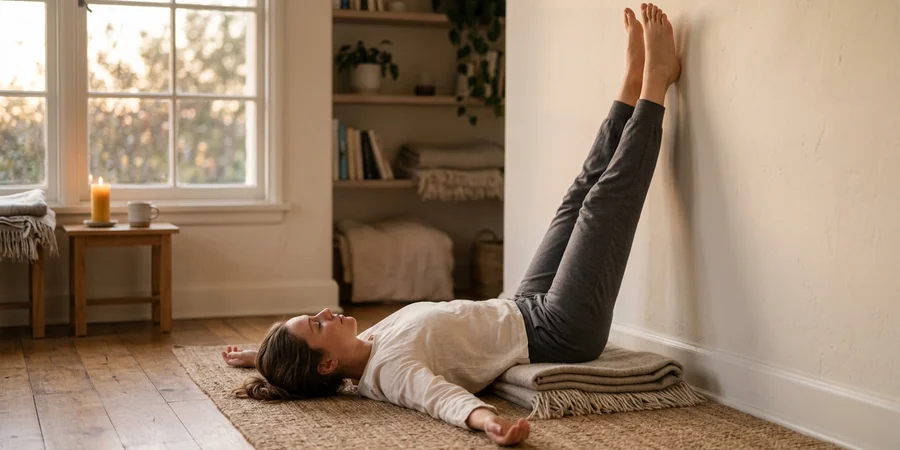
Legs up the wall (Viparita Karani) consists of lying on your back with your legs elevated resting against a wall. This gentle inversion favors venous return, decongests tired legs, and sends a clear signal of rest to the brain.
Stay for three to ten minutes breathing calmly, with arms relaxed at your sides. It is one of the most restorative poses in existence and is ideal at the end of a long day in front of the computer.
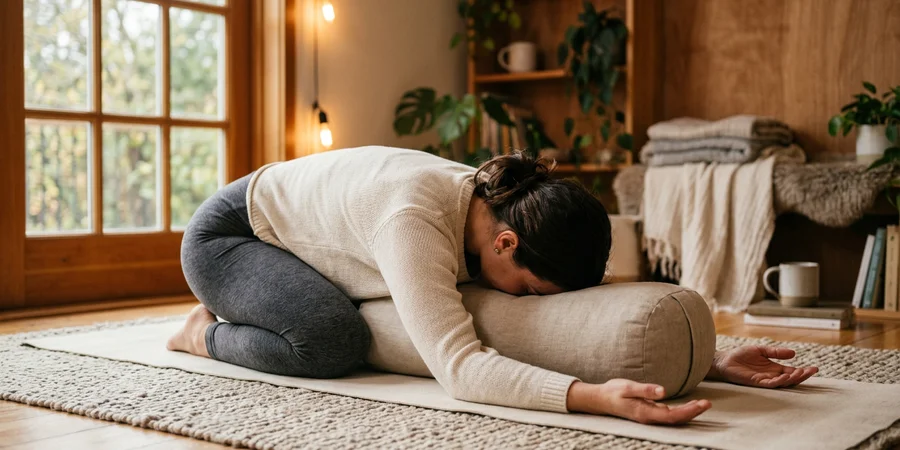
Child’s pose (Balasana) folds you inward: knees bent, torso forward, forehead resting on the floor or on a cushion. This withdrawal, almost fetal, conveys protection and allows the back and shoulders to surrender little by little.
Forward fold and gentle reclining twist
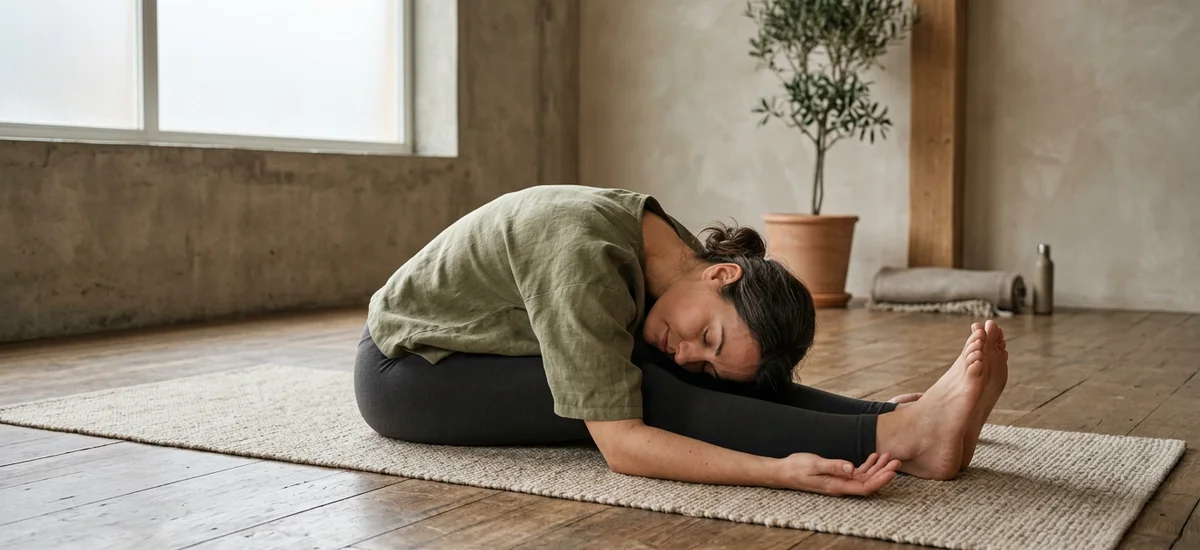
A seated forward fold, with legs stretched out and the torso falling without force, directs the gaze inward and quiets the mind. Do not seek to touch your feet: let gravity do the work and breathe into your back.
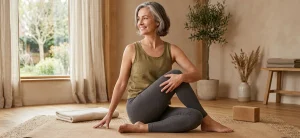
The gentle reclining twist is done on your back, letting the bent knees fall to one side while the gaze goes to the opposite side. It releases the muscles of the spine, gently massages the abdomen, and feels like a sigh for the entire back.
Hold each side for several slow breaths, without rushing to change. These poses are not “achieved,” they are inhabited. Their power lies precisely in the pause, not in the achievement.
Conscious breathing to regulate the nervous system
If you could only keep one tool from this article, it would be breathing. It is always available, needs no mat or space, and acts within seconds on your internal state.
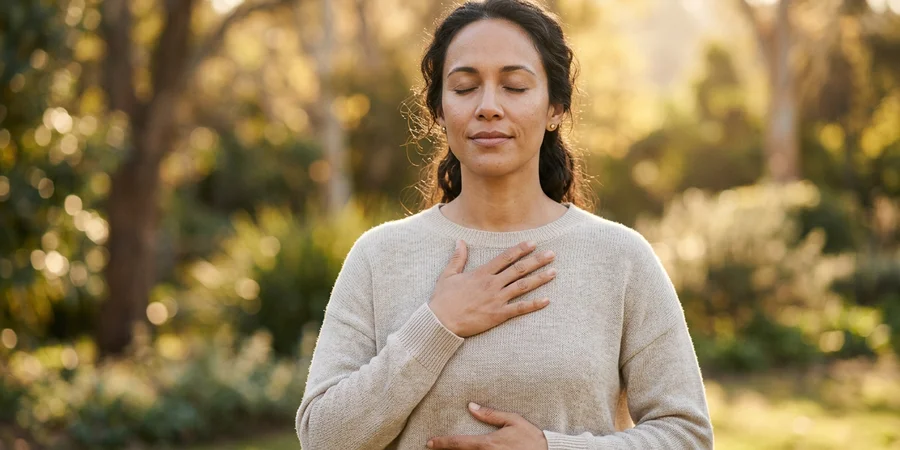
Diaphragmatic breathing is the starting point. Place one hand on the belly and the other on the chest, and breathe in a way that primarily the hand on the abdomen moves. This deep pattern activates the diaphragm, massages the organs, and directly stimulates the vagus nerve.
Many stressed people breathe in a high and shallow way, using only the upper part of the chest. Recovering low and broad breathing is, in itself, an act of regulation that the body appreciates immediately.
Nadi shodhana, alternate nostril breathing
Nadi shodhana is alternate nostril breathing, a classic yoga technique to balance and serene the mind. One nostril is gently closed, you inhale through the other, change, and exhale, alternating with a slow and comfortable rhythm.
Beyond its symbolism of balance between the ida and pingala energy channels, this practice forces the mind to focus on a simple sequence, which anchors the attention and slows the flow of ruminating thoughts.
A few minutes are enough to notice a decrease in agitation. Practiced regularly, it becomes a reliable resource for those moments of the day when the head is going too fast and you need to find your center again.
Mindfulness and meditation: training the stress response
Poses and breathing calm the body in the moment. Meditation and mindfulness work in the longer term: they change your relationship with the very thoughts and emotions that trigger stress.
Much of our tension is not born from what happens, but from how we interpret it and how much we get entangled in anticipating or ruminating. Mindfulness teaches how to observe those thoughts without identifying with them, creating a space between the stimulus and the reaction.
There is no need to meditate for an hour. Ten minutes daily of serene observation of the breath is enough to start noticing changes. The key is consistency: meditation is training, and like all training, it yields results with repetition.
To sustain the practice comfortably, it is advisable to take care of the body’s foundation. Knowing the best meditation poses will help you find a stable position in which the spine is supported without effort and the mind can settle.
A mini anti-stress sequence for daily life
What follows is a short routine, about fifteen minutes long, designed for busy days. You need nothing more than a quiet corner, a mat, and, if you have them, a couple of cushions. Do it at night or during any break the body asks for.
Proceed without haste and always breathing through the nose, lengthening the exhalations. If one day you can only do two of these steps, it also counts. Regularity matters more than duration.
- Diaphragmatic breathing (2 minutes). Seated or lying down, with one hand on the belly, lengthen the exhalation until it lasts longer than the inhalation.
- Child’s pose (2 minutes). Fold forward and let the back soften with each exhalation.
- Seated forward fold (2 minutes). Release the torso without forcing and bring the attention inward.
- Gentle reclining twist (2 minutes per side). Let the knees fall to one side and then the other, breathing deeply.
- Legs up the wall (3 minutes). Elevate the legs and let the body empty of tension.
- Savasana (2 minutes). Finish lying down, completely still, letting the effect settle.
Always closing in Savasana and its benefits is not a minor detail. That final stillness is where the nervous system integrates all the previous work and where the relaxation response is consolidated in the body.
When yoga helps and when to seek more support
Yoga is a powerful ally for managing daily stress, improving sleep, and regaining a sense of control over one’s own body. Its regular practice builds, over time, a more resilient and flexible nervous system.
It is worth remembering, honestly, that yoga complements but does not replace psychological or medical care. If the distress is intense, persistent, or seriously interferes with your daily life, seek the support of a mental health professional.
Far from being mutually exclusive, both paths enhance each other. Many people discover that physical practice supports and reinforces their therapeutic process, offering the body what words sometimes cannot reach.
An ancient wisdom that science confirms
The most fascinating thing about yoga for stress is that we are not inventing anything new. The yogis of India described thousands of years ago how breath, posture, and attention transform the inner state. They did it in their own language, speaking of prana, nadis, and balance.
Today, neuroscience and physiology confirm a large part of those intuitions, translating them into vagus nerve, cortisol, and the parasympathetic system. Two different languages describing the same reality: that we have in our hands, and in our breath, deep resources to regulate how we feel.
Starting is simple. You can explore a yoga pose guide to familiarize yourself with the practices and build your own routine step by step, listening to what your body needs each day.
And if this connection between body, breath, and mind awakens your curiosity to go further, the online yoga teacher training from Kavaalya offers complete training online, where authentic tradition and physiological knowledge meet to teach you how to calm the nervous system from the root.