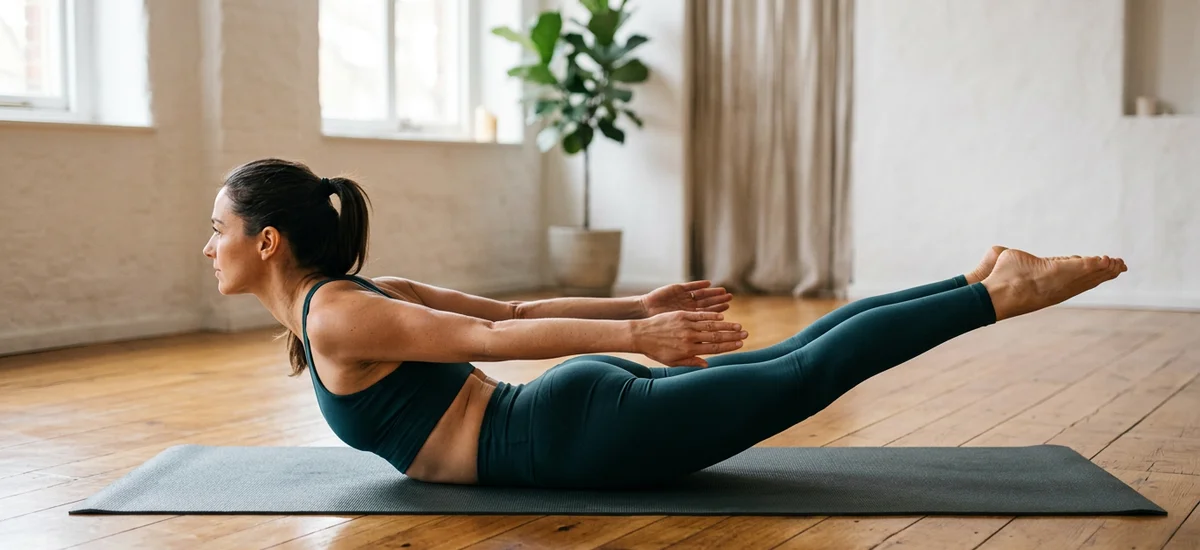
Lying face down, the body seems to rest. And then, without support and without momentum, the chest and legs lift off the ground in a single gesture. Shalabhasana, the locust pose, is one of the most honest extensions of yoga: there is no way to fake strength where there is none.
It is a backbend in a prone position that awakens the entire posterior chain of the body, from the muscles that support the lower back to the glutes and hamstrings. An apparently simple pose that reveals, with surgical precision, how much real strength resides in our back.
In this article, you will discover the meaning of its name, the step-by-step technique, the mistakes you should avoid, the benefits recognized by tradition and anatomy, and the variations that allow you to adapt it to your level.
The name of the grasshopper: strength in apparent stillness
The word Shalabhasana is composed of two Sanskrit roots: shalabha (grasshopper or locust) and asana (posture). The literal translation is “the posture of the grasshopper,” referring to the shape the body takes when the back rises, reminiscent of the raised abdomen of this insect at rest.
The lobster is an animal of humble appearance but extraordinary strength. Its hind legs, folded and seemingly inert, hide the ability to propel the insect distances many times greater than its body size. That contained strength, invisible until it is released, is exactly what this pose cultivates.
In the tradition of Hatha Yoga, extensions in the prone position belong to the family of poses that awaken energy along the spine. Shalabhasana, along with cobra and bow, works the back side of the body, that which we rarely see but which supports our entire vertical axis.
The symbolism is eloquent. The posterior chain is, literally, what keeps us upright against gravity. Strengthening it is not just an aesthetic or muscular matter: it is reclaiming the postural dignity that the human body was designed to uphold.
How to do Shalabhasana step by step
The following description corresponds to the classic version of the pose, accessible for practitioners with basic experience. Adaptations for beginners and more demanding variations are detailed later.
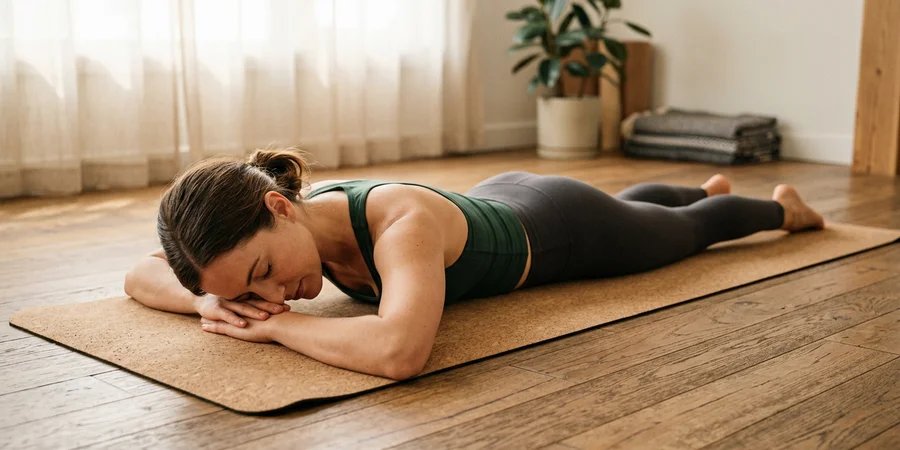
1. Lie face down. Place your body in a prone position on the mat, with your legs together and extended back. Rest your forehead or chin on the ground, whichever feels more comfortable to keep your neck long and neutral.
2. Place your arms at your sides. Bring your arms alongside the torso, with palms facing down or up as you prefer. Some practitioners slide their hands slightly under their thighs for more stability, although in the classic version the arms simply rest on the ground.
3. Stretch before lifting. Inhale deeply and stretch the body in both directions: the crown forward and the toes backward. This prior elongation is essential. Without it, the lift compresses the lower back instead of mobilizing the entire spine.
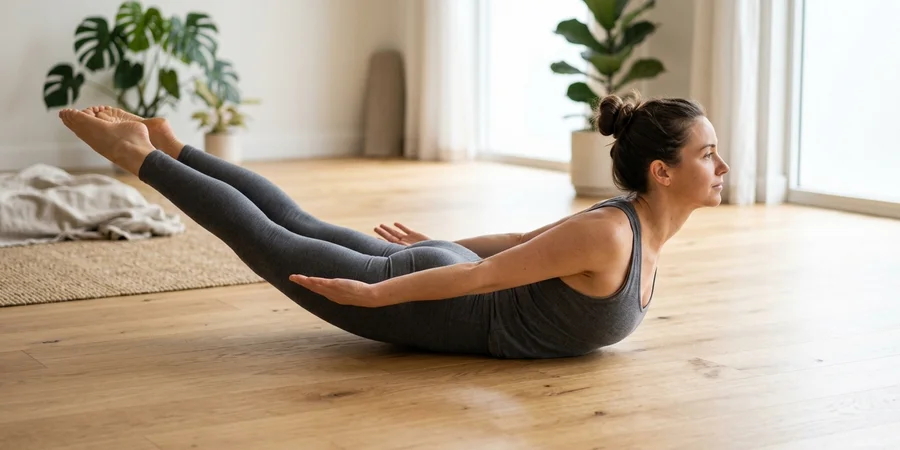
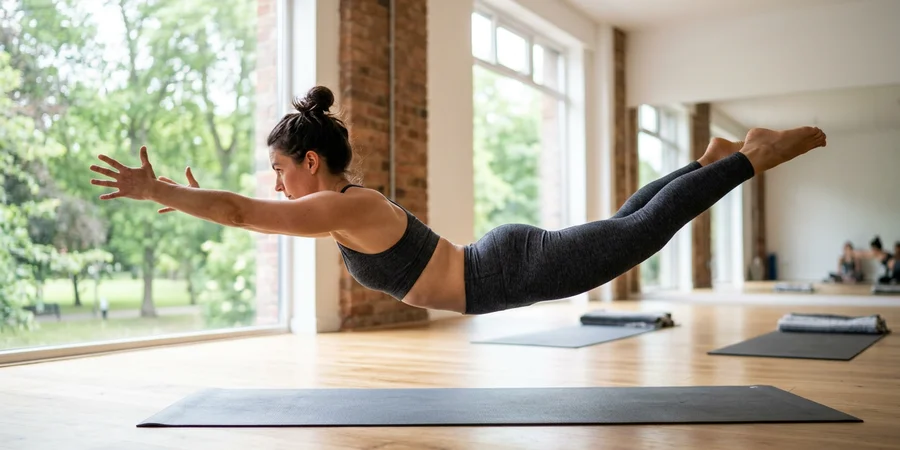
4. Lift the chest and arms. As you exhale, lift the chest, head, and arms off the ground. The gaze is directed forward and slightly downward, keeping the neck long. The movement originates from the back muscles, not from a pull of the neck.
5. Lift the legs. Without separating them too much, lift both legs off the ground by activating the glutes and hamstrings. Keep the legs straight and the feet relaxed. The pelvis remains anchored, acting as the support point for the entire extension.
6. Breathe and hold. Maintain the posture for 5 to 8 full breaths, without holding the breath. Each inhalation creates length, each exhalation maintains the elevation. To exit, exhale while lowering the chest and legs with control. Rest by turning the head to one side and repeat one or two more times.
Common mistakes to avoid
Pull the neck back. The most visible mistake is tilting the head back in an attempt to gain height, which overloads the cervical spine and breaks the line of the column. The nape should remain long and the gaze should be down. Imagine that the crown is moving forward while the chest rises, not that the face is looking at the ceiling.
Lift with momentum. Throwing the body up with a sharp movement creates the illusion of height, but it does not build strength or protect the back. The locust does not jump up from the ground: it rises with sustained muscle control. Rise slowly, feeling how each fiber of the posterior chain activates.
Separating the legs too much. Opening the legs reduces the demand, but it also unloads the work of the glutes and hamstrings and can pinch the lower back. Keep the legs together or, at most, hip-width apart. The strength should be distributed symmetrically on both sides of the spine.
Hold your breath. The natural tendency when straining is to block the diaphragm. However, holding the air raises internal pressure and tires the posture faster. Fluid breathing is what allows you to maintain elevation calmly. Connect the breathing rhythm with the effort, just like in any conscious pranayama practice.
Overload the lower back. When the extension focuses solely on the lower back, a pinching sensation arises. The key is to distribute the curve throughout the spine and to activate the glutes firmly, which protect the sacrum and relieve pressure on the lower back. If you feel localized discomfort in the lower area, reduce the height.
Benefits of Shalabhasana
Extensions in the prone position are one of the most valued families of postures to counteract the effects of modern sedentary lifestyle, which keeps us hunched over in front of a screen for hours.
Strengthens the spinal erectors. The muscles that run along the spine on both sides, responsible for keeping us upright, are intensely activated in Shalabhasana. Practiced regularly, this posture builds a strong and resilient back, capable of sustaining verticality without fatigue throughout the day.
Tones glutes and hamstrings. Leg raises require a deep contraction of the glutes and the posterior thigh muscles. It is a functional exercise that we rarely activate in daily life and is crucial for pelvic stability and lower back health.
Improves posture and combats kyphosis. Office work tends to round the shoulders forward and curve the upper back. Shalabhasana acts as an antidote: it opens the chest, strengthens the muscles that pull the shoulders back, and retrains the body towards a more upright and open posture.
Relieves mild lower back pain. Although it may seem contradictory, strengthening the lower back is one of the most effective strategies against functional lumbar pain. Toned muscles better protect the discs and distribute the loads. It is part of the recommended sequences in many yoga practices for back pain.
Stimulates the abdominal organs. The pressure of the abdomen against the ground during the pose exerts a gentle massage on the digestive organs. This stimulation promotes blood flow to the area and, according to yogic tradition, contributes to improving digestive function and overall vitality.
Counteracts sedentary behavior. We spend too many hours hunched over desks and devices. Shalabhasana reverses that pattern by bringing the body into active extension. It is a compensatory movement that restores the balance between flexion and extension that the spine needs to stay healthy.
Contraindications and Adaptations
Lumbar Injuries. If you have a diagnosis of herniated disc, protrusion, or acute lower back pain, extension under load may worsen the situation. In these cases, practice only the version that elevates the torso alone, without the legs, and always under professional supervision. The half-lobster, which we detail below, is usually a safer option.
Pregnancy. The pose relies on the abdomen, so it is completely discouraged during gestation. There are alternative extensions, performed on all fours or standing, that offer similar benefits without putting pressure on the belly.
Abdominal hernias. The pressure that the pose exerts on the abdominal wall can be counterproductive in the case of inguinal or umbilical hernia. Consult with your doctor before including Shalabhasana in your practice if you have this type of diagnosis.
Recent abdominal surgery. After an abdominal surgery, the tissues need time to heal. Wait for full medical clearance before lying face down and applying pressure to the operated area.
Adaptation with a blanket. If pressure on the pelvis or pubic area is uncomfortable, place a folded blanket under the hips. This small adjustment cushions the contact with the floor and allows focus on muscular work without painful distractions.
Variations to explore the locust pose
Ardha Shalabhasana (half locust). It is the ideal variation for beginners and for those who take care of the lower back. Instead of lifting both legs at the same time, one is lifted while the other remains on the ground with the torso on the floor. Legs are alternated one after the other, allowing for gradual and symmetrical strength building, without overloading the lumbar area.
Full Shalabhasana. It is the advanced version. The hands are placed under the body, at the sides, or intertwined under the pelvis, and the legs are raised very high, even shifting the weight towards the shoulders. It requires considerable strength in the posterior chain and a well-prepared spine. It is a long-term goal, not a starting point.
Superman variation. Instead of keeping the arms at the sides, they are extended forward at ear level, as if the body is flying. This position increases the leverage and demands more from the spinal erectors and shoulders. It is an excellent intermediate step that prepares the body for deeper extensions like Dhanurasana, the bow pose.
The grasshopper as a teacher of patient strength
Shalabhasana teaches a lesson that the rest of the practice also whispers, but which here becomes impossible to ignore: true strength is not demonstrated with showiness. It is built in silence, repetition after repetition, in those few centimeters of elevation that seem insignificant and that, in reality, change everything.
There is no glamour in the grasshopper pose. It is not an asana that looks good in a photograph or that elicits admiration. It is intimate, almost austere. And precisely for that reason, it is so revealing: it confronts us with the truth of our posterior chain, that part of the body that we do not see but that carries all our weight.
Indian tradition understands the body as a temple that is supported from its axis. Cultivating the strength of the back is not vanity, but respect for the structure that allows us to stand, walk, and sit to meditate. Each elevation of the grasshopper is an act of care towards that axis.
Integrated into a balanced practice, along with other extensions such as Bhujangasana, the cobra, and complemented by gentle bends, Shalabhasana offers the spine the full range of motion it needs to remain strong and free for years.
If you want to learn how to properly sequence extensions within a class and understand the anatomy that supports them, the Yoga Teacher Training from Kavaalya offers comprehensive training online, backed by the tradition and pedagogy that each yoga posture deserves.