If Sarvangasana is the queen of asanas, Halasana is its inseparable partner. While the candle raises the legs towards the sky, the plow lowers them behind the head. Together, they form one of the most powerful duos in classical yoga, almost always practiced in sequence.
The plow pose combines two qualities that rarely appear together: inversion (with all its effects on circulation and the nervous system) and deep spinal flexion. This combination makes it a distinctly introspective posture, but also an asana that requires technical respect and proper preparation.
In this article we will explore what its name means, why it is practiced after Sarvangasana, how to execute it without compromising the neck or the lower back, and how to adapt it when the hamstrings limit the range.
Meaning: the plow that prepares the land
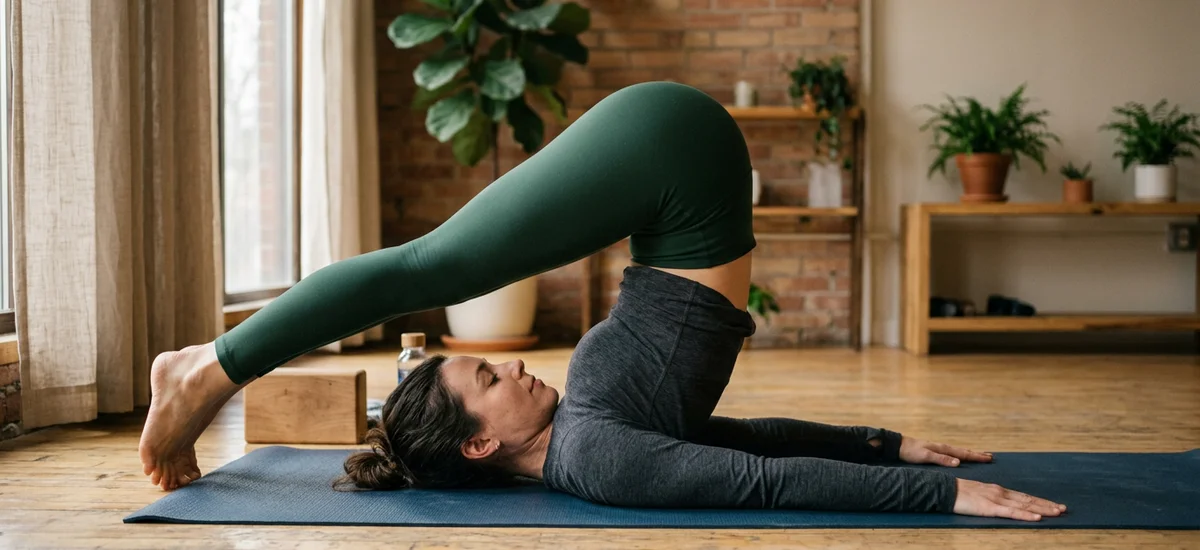
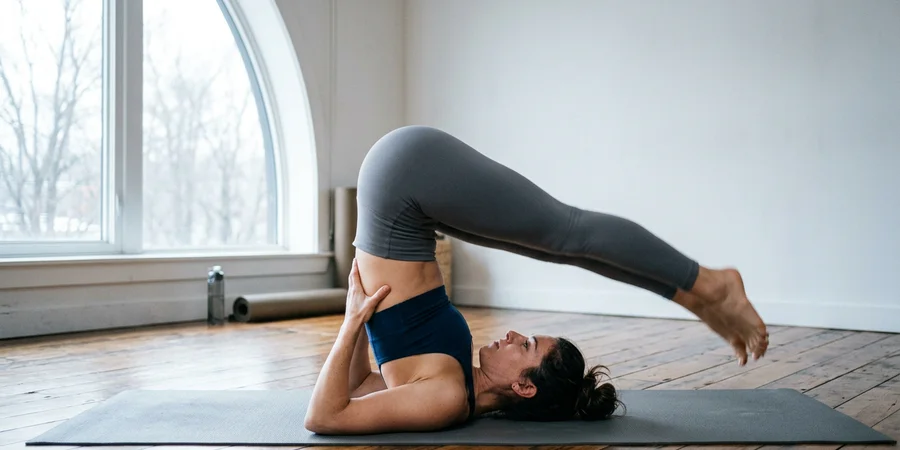
The word Halasana comes from the Sanskrit hala (हल), “plow,” and asana (आसन), “posture.” The name describes the visible shape of the body: the vertical torso and the legs extended above the head draw the silhouette of a traditional Indian plow, with the blade penetrating the ground and the handle protruding.
The symbolism of the plow in Indian tradition is rich. The plow is the instrument that prepares the soil for sowing. It breaks, aerates, renews. It does not plant, but without it, sowing is not possible. In the body, Halasana does something similar: it prepares the nervous system and the spine for the stillness of meditation that often follows.
That is why many teachers include it in the final part of the practice, just before Savasana. The pose plows through the old, releases the accumulated, and leaves the body in the receptive state that the final relaxation requires.
Halasana and Sarvangasana: the natural sequence
In tradition, Halasana is practiced immediately after Sarvangasana. The transition is biomechanically logical: from vertical, you only need to let the legs drop back over the head to enter the plow. It does not require coming down to the floor or reconfiguring the position.
This continuity has an energetic meaning in addition to the technical one. The candle stimulates the upward flow; the plow allows that stimulus to settle into a more introspective posture. Together, they complete an energetic cycle: ascending and then folding, activating and then absorbing.
That is why the total time for both postures is usually similar. If you hold Sarvangasana for five minutes, Halasana is held for between two and five minutes, depending on the level. And then there is always a counter posture in cervical extension, like Matsyasana.
Preparation and Warm-Up
Halasana is not entered cold. The full bend of the spine with the pelvis above the head requires that the hamstrings, lower back, and neck have been warmed up beforehand.
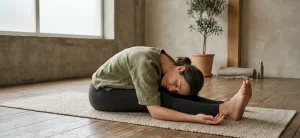
A typical preparatory sequence includes cat-cow to mobilize the spine, gentle Paschimottanasana to stretch the posterior chain, and sustained Sarvangasana before descending into Halasana. Without this progression, the posture asks the body for more than it can safely provide.
The blanket support on the shoulders, mandatory in Sarvangasana, is also required in Halasana. The neck remains free, the head outside the support, resting on the mat. This detail protects the cervical vertebrae during the duration of the pose.
How to do Halasana step by step
The following description starts from Sarvangasana as a natural entry. If you practice Halasana independently, make sure to place the blanket support under the shoulders as well.
- Part of Sarvangasana. With the blanket support under the shoulders and the body vertical, stabilize yourself for a few breaths before beginning the descent. The legs are active, the thighs firm, the hands on the lower back.
- Start the descent with control. As you exhale, lower your legs back over your head. The movement is slow, controlled by the core and the breath, not by gravity. Never let your legs drop without muscular resistance.
- Place your toes on the ground. When your legs reach the ground behind your head, place your flexed toes down. The feet gently push back to keep the legs extended.
- Activate the legs. The thighs remain active, the quadriceps lift the kneecaps, the legs push towards the wall behind you. This activation prevents the weight from falling on the cervical area.
- Release the hands. If the pose is held without strain in the neck, you can release your hands from the lower back and extend your arms on the floor, palms down. If you prefer, interlace your fingers and push your arms into the ground to open the shoulders more.
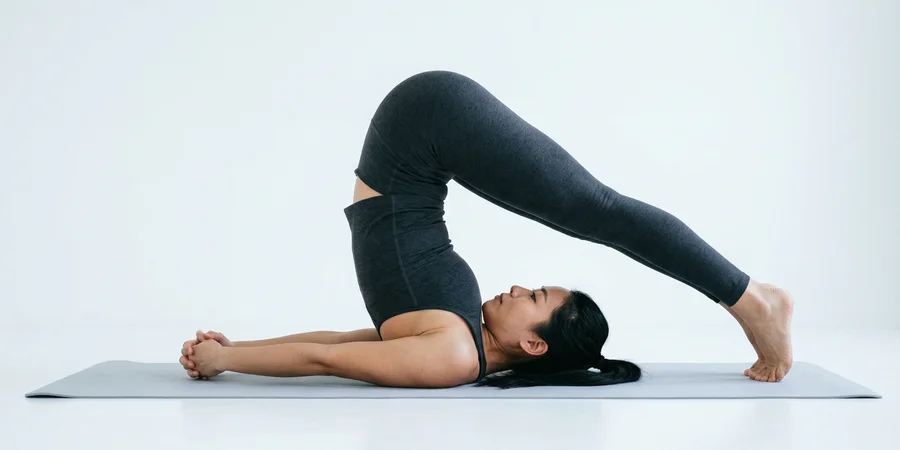
- Align the pelvis over the shoulders. The vertical line should extend from the shoulders to the pelvis, and from there the legs extend horizontally back. If the hips fall forward, the weight shifts to the neck.
- Push your sternum towards your chin. This is the active gesture: the chest moves closer to the chin. This action (Jalandhara Bandha) keeps the cervical area safe and increases the circulatory benefit on the thyroid gland.
- Breathe and hold. Stay for 1 to 5 minutes. Breathing continues to flow, even if it is short. Do not force depth if the diaphragm feels compressed.
- Exit with control. To exit, bring your hands back to your lower back, return to Sarvangasana or, if you’re finishing here, roll down vertebra by vertebra to the floor with your knees bent and your abdomen active.
Correct alignment and cervical safety
Safety in Halasana depends on two critical factors: correct weight distribution and sustained activation of the legs. Both aspects are inseparable.
The weight goes to the shoulders, not to the neck
Just like in Sarvangasana, the weight of the body should rest on the shoulders and upper back, not on the cervical vertebrae. The support of blankets allows exactly this distribution: the shoulders are elevated, the head is out, and the neck maintains its natural curvature.
If you feel pressure in your neck or the urge to move your head, exit the pose immediately. Adjust the support (adding blankets if necessary) and re-enter. Ignoring this signal can lead to cervical injuries that are easily avoided with attention from the start.
The gaze remains fixed throughout the pose, without turning the neck in any direction. If you need to adjust, exit first. This rule is repeated over and over because it is the most violated by impatient practitioners and the one that causes the most injuries.
Active legs and aligned pelvis
Active legs are the ones that protect posture. If the thighs relax and the legs hang over the head, the weight transfers to the neck. The quadriceps must be engaged, the knees extended without locking, the heels pushing back as if you want to lengthen the legs away from the head.
The pelvis must remain over the shoulders, aligned vertically. If it shifts forward (towards the feet), the weight of the trunk falls on the neck. To correct it, pull the pelvis back as if you want to lift it above the point of support.
If your feet do not reach the ground with your legs extended, do not force. Keep your legs slightly bent or, better yet, use a chair behind to support your feet at a height that allows you to maintain a long spine. Reaching the ground with a rounded back nullifies the benefits of the posture and increases the risk.
Benefits of Halasana
Halasana combines the effects of an inversion with those of a complete forward bend. This duality makes it one of the most integrative asanas in the entire classical repertoire.
Physical benefits
The posture stretches the spine along its entire length, especially the cervical and thoracic areas that rarely extend in daily life. The hydration of the intervertebral discs in this inverted position is one of the mechanisms that explains its regenerative effect.
The hamstrings and the entire posterior chain receive a deep stretch. Those who practice Halasana regularly gain flexibility in the back of the legs at a speed that is difficult to match in standing or seated postures.
At the endocrine level, Halasana shares with Sarvangasana the stimulation of the thyroid gland. The pressure of the sternum against the chin (Jalandhara Bandha) sends blood to the area, and the inversion enhances that effect. This is one of the reasons why tradition considers it rejuvenating.
Abdominal compression actively engages the digestive system. Many practitioners experience improvements in digestion and bowel regularity with consistent practice. In Ayurveda tradition, it is recommended for mild digestive issues such as occasional constipation or bloating.
Energetic and mental benefits
On an energetic level, Halasana inverts the flow of prana and stimulates the upper chakras. Vishuddha (throat) is activated by chin compression; Ajna (third eye) is stimulated by the blood flow to the brain during inversion.
At the mental level, few postures produce such a pronounced calming effect. The combination of inversion, flexion, and abdominal compression intensely activates the parasympathetic system, inducing a state of deep stillness. Many practitioners use it as preparation for meditation.
For individuals with anxiety, an overactive mind, or difficulty sleeping, Halasana practiced at the end of the day has a natural sedative effect. It does not produce immediate drowsiness, but rather a deactivation of sympathetic tone that facilitates subsequent rest.
[IMAGEN halasana-variacion-karnapidasana AQUI ALT=”Variante de Halasana con las rodillas flexionadas cerca de la cabeza, aproximación a Karnapidasana, practicada en un estudio luminoso”]
Variations and Modifications
Halasana is a demanding pose and allows for variations based on the flexibility and experience level of the practitioner.
For bodies with tight hamstrings
With the feet on a chair. Place a chair behind the head, with the seat at the appropriate height. The feet rest on the chair instead of reaching for the ground. The pose retains its essence and allows the back to stay long without forcing the backward bend.
With the knees bent. If you can’t sit comfortably even on a chair, bend your knees and let your shins rest on a support or on your forehead. The variation retains the effects on the spine and neck.
Short time and progressive maintenance. Start with brief holds, from 30 seconds to one minute, and progress gradually. The necessary flexibility is not built by forcing the time but by regularly repeating the posture over weeks and months.
Advanced Variations
Karnapidasana (ear pressure pose). From Halasana, bend the knees and let them descend to the sides of the head, resting close to the ears. Intensify the backward bend and increase abdominal compression. It is only safe when the spine and hamstrings are very prepared.
Parsva Halasana. Once in the classic pose, walk the feet to one side, twisting the torso in a twist. It combines inversion, flexion, and twist in a single gesture. It requires previous consolidation of the basic pose.
Supta Konasana. From Halasana, separate the legs as much as possible, forming an inverted triangle with the feet on the ground. It adds a deep hip opening to the base of Halasana. It is practiced as a transition in some styles of Ashtanga.
Mandatory Counterpose: Cervical Extension
Just like Sarvangasana, Halasana requires a counterpose in extension after maintenance. The neck and the thoracic spine have held a deep flexion for minutes; compensating for that flexion is an integral part of the practice.
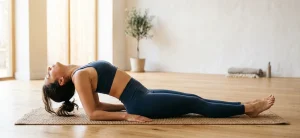
The classic counterpose is Matsyasana (Fish Pose), just like in Sarvangasana. Lying on your back, the chest rises supported by the elbows, and the head falls back. The cervical extension compensates for the previous flexion and balances the system.
A gentler alternative is lying on your back with your knees bent and taking several breaths, allowing the spine to return to its neutral position before continuing with the sequence or moving to Savasana. Never jump directly from Halasana to an active pose.
Contraindications
Halasana has contraindications similar to Sarvangasana, exacerbated in some cases by the added bend.
If you have cervical injuries, cervical disc herniation, or chronic neck pain, this pose is contraindicated. Deep flexion puts the neck under loads that can worsen any existing pathology.
In the case of lumbar disc herniation, the pose can also exacerbate symptoms if the descent is not controlled with abdominal strength. If in doubt, skip it and practice only Viparita Karani against the wall, which offers circulatory benefits without the mechanical risks.
With high blood pressure, glaucoma, or retinal detachment, inversions are contraindicated. The same applies to serious cardiovascular problems. Consult with a professional before including it.
During menstruation, many traditions recommend avoiding inversions, including Halasana. During pregnancy, the pose is contraindicated from the first trimester due to abdominal compression.
If you suffer from asthma or breathing difficulties, the compression of the diaphragm in Halasana may make breathing difficult. Practice the chair version, which reduces compression, or replace it with less demanding alternatives.
The plow that prepares the inner earth
Halasana is a posture that reveals. Unlike other asanas, which can be practiced at any time of the day, the plow requires a warmed body and a mind willing to fold. It is not a starting or transitional posture: it is a posture of maturity within the session.
Its introspective quality makes it inseparable from the preparation for meditation. Many practitioners include Halasana, followed by its counter posture, as the final step before Savasana. It is the furrow that opens the inner earth so that silence can be sown.
Practiced regularly and with technical respect, Halasana is one of the most powerful tools that yoga offers to balance an overactive nervous system. It is not a flashy posture or popular on social media, but the teachers who have studied it consider it essential in a complete program.
If you want to learn how to teach inversions confidently, to arrange the necessary supports, and to adapt Halasana to bodies with different mobility, our 200h Yoga Teacher Training Course includes specific modules on inversions and on the safe pedagogy of classic yoga postures.