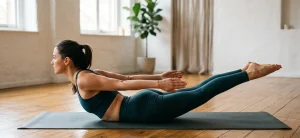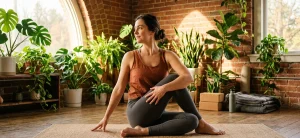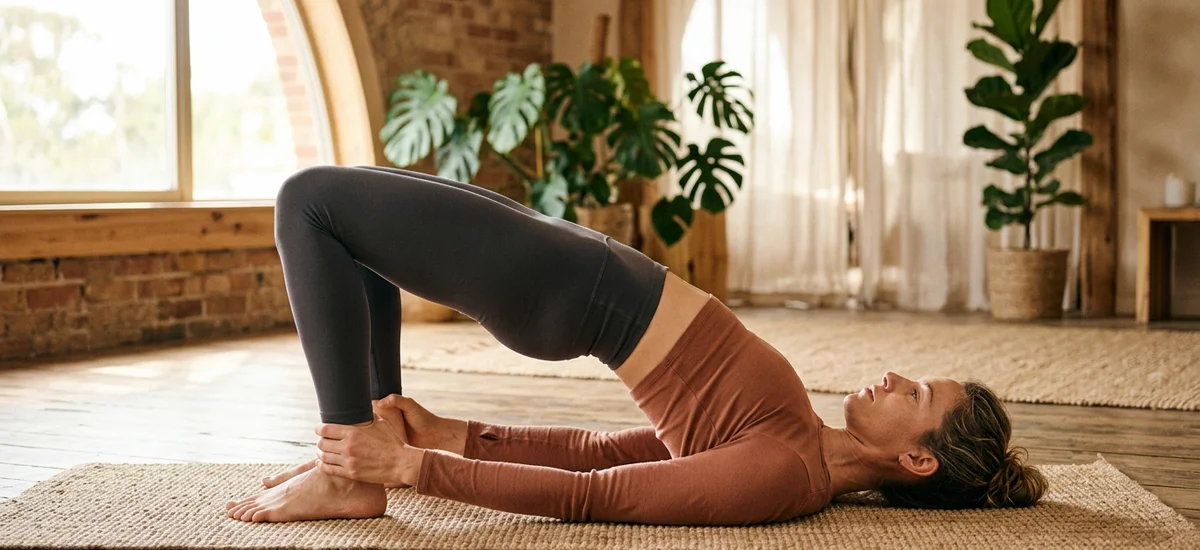
Lie on your back, bend your knees, and lift your hips toward the sky: few postures are as accessible and yet as complete as Kandharasana. The body draws a serene bridge between the shoulders resting on the ground and the feet firmly against the earth, and in that gentle arch resides one of the most valuable extensions for the modern spine.
Kandharasana is the bridge posture in its traditional version, as taught in the Bihar School of Yoga. It is an extension in a supine position that strengthens the back of the body, opens the chest, and counteracts the hours we spend hunched over screens.
In this article, you will discover the meaning of its name, the step-by-step technique, the mistakes to avoid, its benefits, and the variations that will allow you to adapt it to any level of practice.
 What does Kandharasana mean and where does its name come from
 What does Kandharasana mean and where does its name come from
The word Kandharasana is composed of two Sanskrit roots: kandhara, which means “shoulders” or “neck,” and asana, which means “posture.” The literal translation is “the posture of the shoulders,” a name that accurately describes where the weight of the body lies when the hips are elevated.
As the pelvis and chest are lifted, the support is distributed between the feet and the shoulder and nape regions. It is the shoulders that support the arch of the bridge, and hence the name. The head remains relaxed, without pressure, while the shoulder girdle works as a stable foundation.
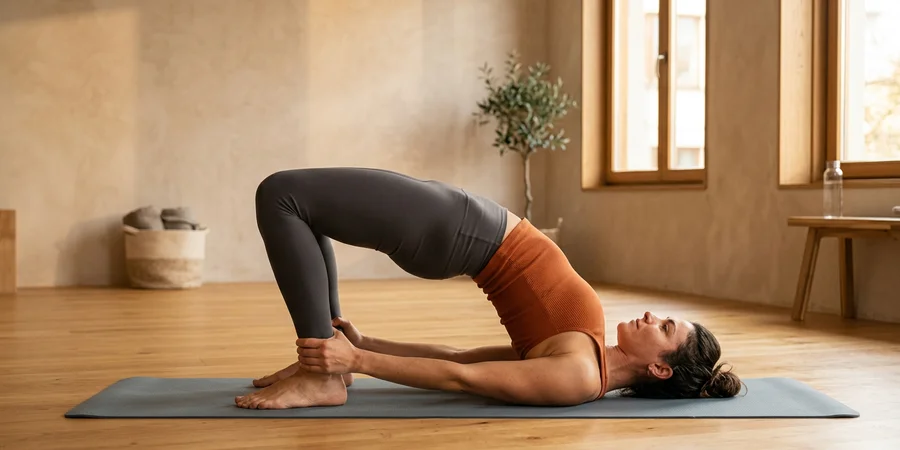
It is important to distinguish Kandharasana from the generic Setu Bandhasana or Setu Bandha Sarvangasana, the bridge most commonly known in the West. In the tradition of the Bihar School of Yoga, founded by Swami Satyananda Saraswati, Kandharasana has a hallmark: the hands hold the ankles during the lift.
This grip changes the dynamics of the pose. By holding the ankles, the arms create a traction that further opens the chest and roots the feet, while the classic bridge usually leaves the arms extended to the sides or interlaced beneath the body. Both belong to the family of gentle extensions of Hatha Yoga, but Kandharasana imparts its own stamp.
How to do Kandharasana step by step
The following description corresponds to the traditional version with ankle grip. Adaptations for those who are unable to grip their ankles are detailed later. Always work from comfort, never from strength.
1. Lie on your back. Lie supine on the mat, with your back supported and arms relaxed at your sides. Take a few seconds to feel the contact of your spine with the floor and breathe calmly before starting.
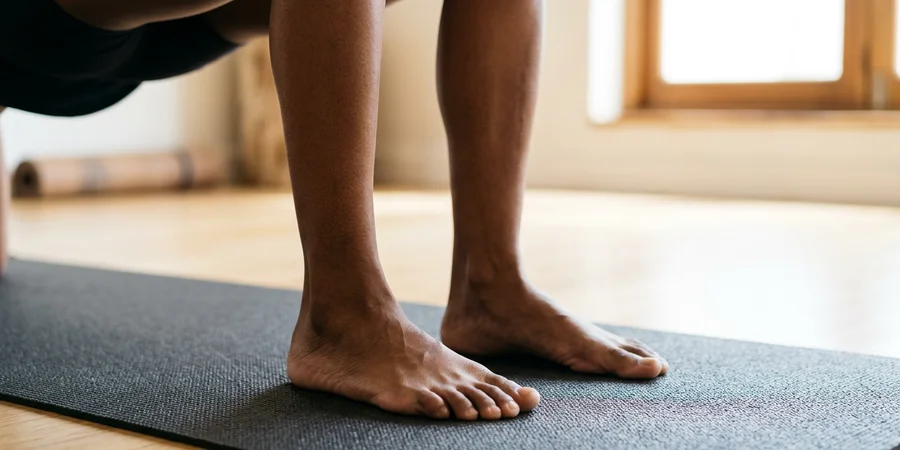
2. Bend your knees and bring your feet closer. Bend both knees and slide your feet toward your glutes, placing the soles completely on the floor, hip-width apart. The closer the heels are to the glutes, the easier the grip will be and the greater the opening of the chest.
3. Hold your ankles with your hands. Extend your arms towards your feet and grasp each ankle with the hand on the same side. If you can’t reach, don’t force your shoulder: later you will find the variation with arms at the sides. This grip is the hallmark of Kandharasana.
4. Press your feet and lift your hips. Inhale and firmly push the soles of your feet against the ground. From that root, lift the pelvis upwards activating the glutes. The hips rise first, and the chest follows them in a continuous and harmonious arc.
5. Open your chest and distribute the support. Bring the sternum towards the chin without pressing the neck. The weight rests on the feet and on the shoulders, never on the nape. Imagine that the chest expands towards the ceiling while the thighs remain parallel.
6. Breathe and hold with awareness. Maintain the posture for 5 to 10 complete breaths, lengthening the spine with each inhalation and rooting the feet with each exhalation. To come out, exhale and lower the spine vertebra by vertebra, from the upper back to the sacrum. Rest and repeat if you wish.
Common mistakes to avoid
Let the knees open outward. This is the most common mistake. When the knees separate, the thighs rotate outward and the force escapes from the glutes. Keep the knees aligned with the ankles and hips, as if holding a block between them. The thighs should remain parallel throughout the lift.
Pushing with the neck. The temptation to look between the legs or lift the head puts dangerous pressure on the cervical spine. The head and neck should be completely relaxed on the ground. The gaze is directed toward the ceiling and the throat remains soft and tension-free.
Lift the shoulders off the ground. The shoulders are the foundation of the bridge and should be firmly supported. If the shoulders rise or roll forward, the arch loses stability and the pressure shifts to the neck. Tuck them down and back before raising the hips.
Lift from the lower back instead of the glutes. If you push the pelvis up by arching the lower back, you compress the lumbar vertebrae instead of mobilizing the hip. The lift comes from the work of the glutes and hamstrings. First, activate the glutes and let them raise the pelvis, thus protecting the lower back.
Hold your breath. When holding an active pose, it is common to inadvertently block the diaphragm. However, fluid breathing is what keeps the chest open and the mind serene. Each inhalation creates space in the chest; each exhalation grounds the pose. Working on breath control transforms the bridge into a conscious practice.
Benefits of Kandharasana
The bridge belongs to the family of gentle extensions, a category of postures especially therapeutic for the contemporary body, marked by sedentary behavior and closed forward positions.
Strengthens glutes, hamstrings, and back. The sustained elevation intensely activates the entire posterior chain of the body. The glutes, hamstrings, and paravertebral muscles work together to maintain the arch. It is one of the most effective and safest exercises to tone this area without the need for external weights.
Opens the chest and hip flexors. By elevating the pelvis, the hip flexors and psoas are stretched, while the chest expands upward. This opening directly counteracts the hunched posture we adopt when sitting in front of the computer or mobile for hours.
Relieves lower back tension. Although it may seem paradoxical, a posture that extends the spine can alleviate accumulated lumbar stiffness. The bridge strengthens the muscles that support the lower back and gently decompresses it. That’s why it is part of many sequences of yoga for back pain, always with the correct technique.
Stimulates the abdominal organs and the thyroid. The slight pressure of the chin towards the chest and the stretching of the abdomen gently massage the internal organs and stimulate the thyroid gland. Yogic tradition considers the bridge a beneficial posture for metabolism and digestion.
Counters sedentarism. We spend too many hours sitting, with hips flexed and chest closed. Kandharasana exactly reverses that pattern: it extends the hips, activates the dormant glutes, and reopens the thorax. It is a simple and everyday antidote against the effects of a sedentary life.
Calms and energizes at the same time. One of the most beautiful qualities of this posture is its double effect. The opening of the chest brings energy and vitality, while the supine position and conscious breathing calm the nervous system. Practiced calmly, it leaves a feeling of balance between activation and stillness.
Contraindications and adaptations
Neck injuries. Since part of the weight falls on the shoulder and nape region, individuals with cervical injuries, neck hernias, or discomfort in that area should avoid the full version or practice it only under supervision. Never turn the head while in the pose.
Shoulder injuries. Grabbing the ankles requires openness and stability in the shoulders. If there is a rotator cuff injury or limited mobility, it is most prudent to practice the variation with arms at the sides, without holding the ankles. This way, all benefits are maintained without compromising the joint.
Back injuries. Anyone with a lumbar disc herniation or a delicate back diagnosis should consult their physiotherapist before practicing. In many cases, a moderate lift activating the glutes properly is safe, but it requires professional attention and careful progression.
Advanced pregnancy. From the second trimester onward, staying on the back for prolonged periods can be uncomfortable and is not recommended. There are more suitable alternatives for this stage, and it is always advisable to have the guidance of a professional specialized in prenatal yoga.
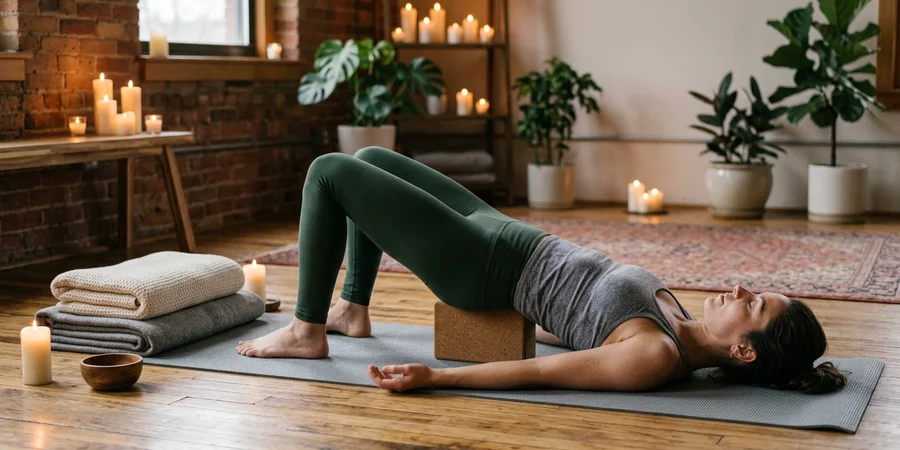
Supported variation with a block. For a gentle and restorative practice, elevate the pelvis and slide a block under the sacrum. The pose is held without muscle effort, allowing gravity to open the chest. This supported version is a valuable resource within restorative yoga, ideal for resting the back at the end of the day.
Variation without grabbing the ankles. If you can’t reach the ankles or want to reduce the effort, simply let your arms extend to the sides of the body, with palms facing down, and press the forearms into the ground to help lift the hips. It’s the most accessible way to start.
Variants to explore the bridge
Setu Bandha Sarvangasana with arms interlaced. In this classic version of the bridge, the arms do not hold the ankles but are interlaced underneath the body. The fingers are crossed, and the shoulders roll inward, allowing the chest to lift even higher. It is the most common variant in contemporary yoga classes and deepens the thoracic opening.
Bridge on one leg (Eka Pada Setu Bandhasana). From the held bridge, extend one leg toward the ceiling while keeping the pelvis level. This variant intensifies the work of the glute and hamstring of the supporting leg, in addition to requiring stability and control. It is a challenge that should be approached only when the basic bridge is comfortably mastered.
Path to Deep Extensions. Kandharasana is the gateway to a world of broader extensions. It prepares the spine and shoulders for poses such as the cobra or the camel, and in the long term, it paves the way to the wheel, its more advanced progression. The bridge teaches the movement pattern that they all share: root to rise, open without compressing.
The bridge as a gesture of daily openness
There is something deeply symbolic in the shape of the bridge. The body becomes an arch that connects two shores, the feet and the shoulders, supporting itself over the void. In that simple gesture, much of what yoga proposes is condensed: stability and openness at the same time.
Kandharasana does not require extraordinary flexibility or years of practice. Anyone can lie down, bend their knees, and lift their hips. And yet, within that simplicity, there are infinite nuances: the precise activation of the glutes, the honest opening of the chest, the breath that sustains the arch effortlessly.
Due to its accessibility and benefits, the bridge deserves a fixed place in the daily routine. Practiced upon awakening, it invigorates the body; practiced at dusk, in its supported version, it prepares for rest and connects with the stillness of Savasana.
If you want to understand the anatomy that supports extensions and learn to sequence them safely within a class, the Yoga Teacher Training from Kavaalya offers a comprehensive program online, backed by the tradition and pedagogy that each yoga posture deserves.