There are postures that are better understood with the history that accompanies them. Natarajasana is one of them. It is not just an elegant balance: it is the bodily representation of one of the most powerful images in Indian tradition, the dance of Shiva as the lord of the cosmos.
The dancer’s posture combines balance, strength, flexibility, and chest opening in a single gesture. Practiced with presence, it is one of the most beautiful asanas in the repertoire, capable of conveying both concentration and joy. That is why it is a perfect closure: it calls for the best of the body and the best of the mind at the same time.
In this article, we will see who Nataraja was, what his dance symbolizes, how to safely execute the posture, what the progression is from simple versions to the complete one, and why this asana closes the month so brightly.
Meaning: Nataraja, the lord of dance
The word Natarajasana is formed from three Sanskrit roots: nata (नट), “dance”; raja (राज), “king” or “lord”; and asana (आसन), “posture”. The literal translation is “the posture of the lord of dance”. That lord is Shiva in his dancing form, traditionally known as Nataraja.
The figure of Nataraja is one of the most venerated iconographic representations in Hinduism. A four-armed Shiva dances within a ring of fire over a dwarf demon symbolizing ignorance. Each element of the image has a meaning: the drum in one hand represents the pulse of creation, the flame in another symbolizes destruction, one hand offers protection, and the last points to the raised foot as refuge.
The dance of Nataraja represents the cosmic rhythm of existence: creation, preservation, destruction, concealment, and liberation. All simultaneous, all in motion. The entire universe is Shiva’s choreography.
The symbolism of the cosmic dance
In tradition, the dance of Shiva is not entertainment but the maintenance of the universe. Its movement sustains existence. When it stops dancing, the cosmos dissolves; when it begins to dance again, it is recreated. The dance is, literally, the engine of being.
Natarajasana invites the practitioner to embody that same energy. It is not a static and rigid pose, but a vibrant balance sustained by breath. The complete posture, with the back foot raised near the head, evokes Shiva with the leg lifted, ready to continue dancing.
This symbolic dimension is not decorative: it transforms the practice. Holding Natarajasana while thinking of the cosmic dance completely changes the experience of the pose. It is not just balance: it is participation in something much greater than oneself.
Necessary preparation before Natarajasana
Natarajasana requires three qualities at the same time: balance on one leg, shoulder openness, and quadriceps flexibility. None of the three comes by chance. Specific preparation is what allows access to the posture without forcing it.
The balance is trained with standing poses on one leg like Vrikshasana (the tree) or Garudasana (the eagle). A few minutes of work on one leg awaken the ankle stabilizers and proprioceptive awareness.
The shoulder opening is prepared with variations of Gomukhasana (cow face) and with stretches of the latissimus dorsi. Without this mobility, reaching the arm back to grab the foot is impossible without compromising the cervical or lumbar area.
The quadriceps flexibility is worked with Ustrasana and with variations on the floor like the knight pose with stretching. Without it, bringing the foot close to the head is impossible.
How to do Natarajasana step by step
The following description corresponds to the intermediate version, accessible for most practitioners with a few months of experience. The more advanced versions are described later.
- Part of Tadasana. Standing, with feet together or slightly apart, activate the quadriceps and root the feet into the ground. Inhale and grow from the crown, preparing a stable base.
- Transfer the weight to the right leg. Slowly shift the weight completely onto the right foot. The four corners of the foot press equally into the ground. The right knee remains slightly bent, never locked.
- Bend the left knee. Bring the left heel towards the glute of the same side. Hold the instep or ankle with your left hand from the inside of the foot. The knee points downwards, not opening outwards.
- Lengthen the spine. Before initiating any forward or backward movement, lengthen the spine vertically. Open the chest, lower the shoulder blades down the back. This prior alignment is what allows the pose to open afterwards.
- Extend the right arm forward. Raise the right arm parallel to the ground, as if pointing to a distant spot. This arm is the counterbalance for the movement that follows.
- Lift the left foot back and up. With an inhalation, push the left foot back and up with the hand, moving it away from the glute. The thigh lifts, the hip opens. The pelvis tilts slightly forward.
- Bend the torso forward. Accompany the lift of the foot with a forward bend of the torso. The movement is fluid and simultaneous: the higher the foot goes, the more the torso leans. The center of gravity remains over the supporting foot.
- Fix your gaze. The drishti (point of visual focus) is directed at a fixed point ahead, at eye level. This visual fixation is what stabilizes balance. If the gaze shifts, the posture falls.
- Breathe and hold. Remain for 5 to 10 full breaths. The breath should flow freely, without any holding back. To exit, lower the foot with control, release the arm, and return to Tadasana. Repeat on the other side.

Proper alignment: the secret lies in the gaze and the counterbalance
Natarajasana is not just about flexibility. There are two technical elements that differentiate a stable and elegant posture from one that wobbles and collapses: the fixation of the drishti and the management of the counterbalance between the extended arm and the lifted leg.
The drishti: the gaze that holds
Every balance posture on one leg depends on the gaze. The vestibular system, proprioception, and vision work together to keep the body stable. If two of the three systems are compromised, the posture falls.
In Natarajasana, the gaze must be fixed on a motionless point in front, at eye level or slightly below. Not a mirror, not another person, not a window with movement. A fixed point: a mark on the wall, a groove in the floor, a static detail.
If the practitioner looks down, the posture loses height and tends to become unbalanced forward. If they look up, the neck becomes tense and balance is lost backward. The horizontal, fixed, and gentle gaze is the anchor of balance.
The counterbalance between arm and leg
The backward movement of the raised foot must be compensated with the extension of the opposite arm forward. Both movements occur simultaneously and in proportion. If one leads the other, the posture becomes unbalanced.
The extended arm acts like a rudder. When the foot moves further back, the arm tilts more forward. This relationship is dynamic: the posture is never completely static, but rather an active balance that continuously adjusts the two levers.
The supporting leg remains active at all times. The quadriceps contract, the glute stabilizes the hip, the ankle is constantly propriocepting. If the leg relaxes, the posture collapses in seconds.
Benefits of Natarajasana
Like all balance poses integrated with extension and opening, Natarajasana offers benefits that go far beyond the aesthetic aspect of the final shape.
Physical Benefits
The posture strengthens the supporting leg as a whole. Ankle, calf, quadriceps, glute, and hip stabilizers work together to support the full weight of the body on a changing plane. It is one of the most complete functional strength exercises in yoga.
The quadriceps of the elevated leg receives a deep stretch, counterbalanced by the action of the hand holding the foot. This combination of traction and resistance lengthens the muscle in a way that is difficult to replicate outside of the posture.
At the thoracic level, the posture opens the chest and improves the mobility of the dorsal spine. The trunk inclination combined with the extension of the arm and leg stretches the pectorals and hip flexors, counteracting the closed posture patterns that are so common.
The balance and proprioception significantly improve with regular practice. The stabilizing muscles, vestibular system, and coordination are trained with each repetition. Older adults or those at risk of falls find in this family of postures an excellent natural prevention.
Energetic and mental benefits
In tradition, Natarajasana stimulates Anahata (heart) and Ajna (third eye). The open chest frees the heart area, while sustained concentration on the drishti activates the focused attention associated with the third eye.
On a mental level, the pose demands total concentration. There is no way to hold it while thinking of something else. This quality makes it an active meditation practice, where the mind naturally gathers because it has no option to disperse.
Many practitioners report a feeling of joy after Natarajasana. The combination of chest opening, deep concentration, and achieving balance produces an observable uplift in mood. It is a pose that leaves a positive emotional mark.
Progression: from accessible versions to the full one
The complete Natarajasana is not accessible from the first day for most bodies. But there is a clear progression that allows working on the pose safely from the beginning.
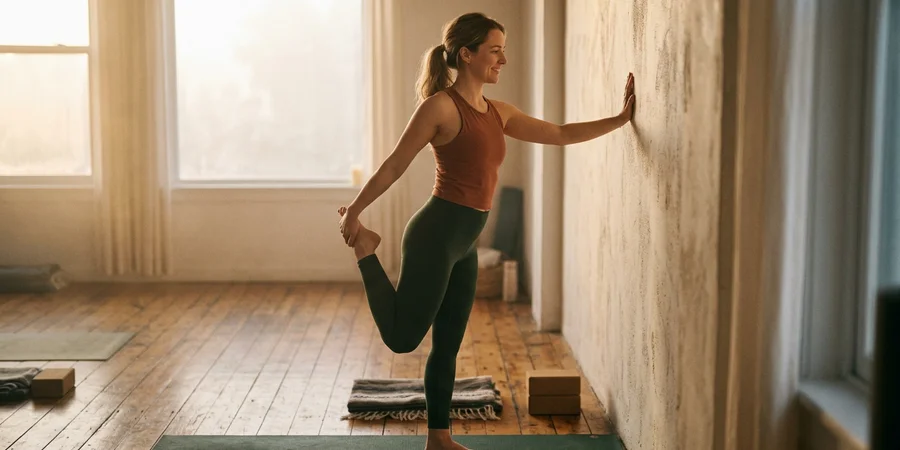
Level 1: Natarajasana with wall support
Stand in front of a wall and place the opposite hand (the hand on the same side as the raised leg) against the wall to maintain balance. This variation removes the challenge of balance and allows focusing on opening the quadriceps and raising the leg.
This is the ideal version for beginners and for progressively working on flexibility without frustration. Practiced several times a week for several weeks, it sets the stage for the unsupported version.
Level 2: Natarajasana without support, with foot close to the glute
Without a wall, but without bringing the foot too high. The heel moves away from the gluteus by just a few centimeters, the opposite arm extends forward, and the torso leans moderately. It is the intermediate version that allows working on the complete posture without the extreme demands of flexibility.
Most practitioners can hold this version with several weeks of preparation. It is perfectly valid as a final posture and produces all the essential benefits of the asana.
Level 3: Complete Natarajasana with the foot near the head
This is the full version of the posture: the raised foot is taken very high, near the head, with both hands holding it in some variations. It requires considerable quadriceps flexibility and shoulder opening. It is not a goal that can be achieved in just a few months.
Those who have the mobility to express it fully practice it occasionally, as an advanced expression. For most, level 2 is the reasonable and sufficient destination.
Contraindications
Natarajasana is a challenging pose that requires caution in several situations.
If you have knee injuries (ligaments, menisci, patellofemoral syndromes), keep the supporting knee slightly bent and avoid the pose if pain occurs. The knee of the raised leg can also be affected if the bending is forced.
With lumbar problems or a herniated disc, bending the trunk forward combined with the extension of the leg can worsen symptoms. Practice only the version with support against a wall and with little trunk inclination.
In case of balance issues, vertigo, vestibular problems, or peripheral neuropathy, always practice close to a wall or with supervision. Falling from a balance pose can cause more serious injuries than the pose itself.
With shoulder injuries that limit arm flexion backward, do not force the classic position. Hold the foot from the inside with the elbow flexed or practice the wall version.
During advanced pregnancy, the changing center of gravity makes balancing on one leg less stable. Practice with wall support or substitute with more stable balancing poses.

The dancer that completes the cycle
Natarajasana is the perfect conclusion to a practice, to a sequence, and, in this case, to a month dedicated to foundational poses. It is for several reasons. It demands what the rest of the asanas have built: the strength of Trikonasana, the thoracic opening of the extensions, the concentration of balance, and the presence cultivated in sustained poses.
But it does so with an essential difference: from joy. Natarajasana is not a severe posture. It is festive. Shiva’s dance is not a punishment; it is a celebration of the movement of the universe. Those who practice with that disposition discover that yoga is not just discipline: it is also, in its fullest expression, celebration.
That is why it ends the month brightly. After weeks of work on the fundamental postures, the dancer’s figure integrates all that has been learned and offers it in a gesture that does not demand perfection, but participation. The drishti fixed, the chest open, the breath free, and the leg raised towards the sky.
If you want to continue deepening your practice of yoga postures with anatomical awareness, respect for tradition, and modern pedagogy, our 200h Yoga Teacher Training Course offers a comprehensive training that integrates philosophy, anatomy, and the practice of essential yoga postures.