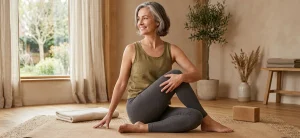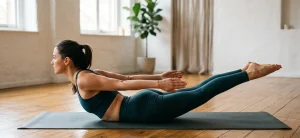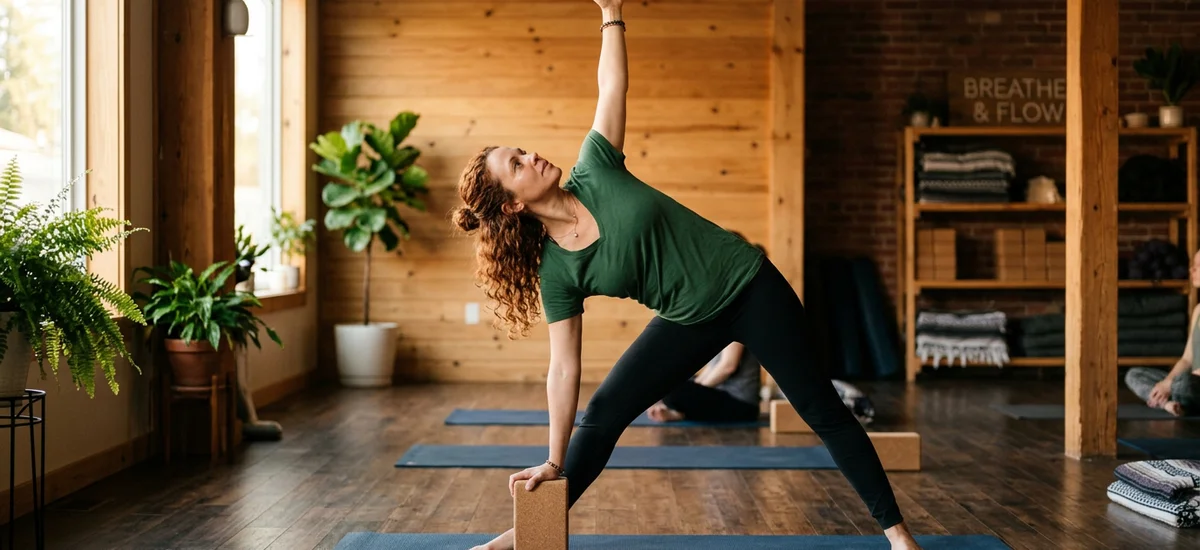
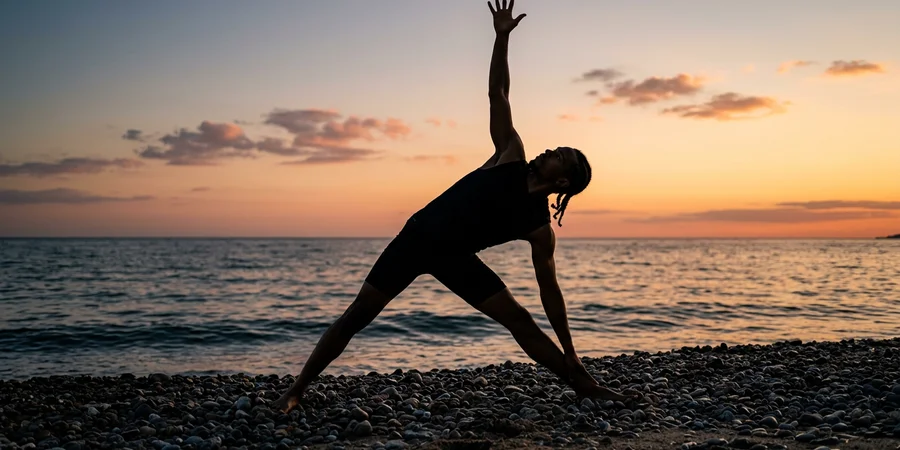
There are postures that are understood better with the eyes than with words. Triangle Pose is one of them. Observed from the outside, the body draws a clear figure: three triangles that support each other, one between the legs, another between the arm and the torso, another between the ground and the gaze.
The triangle posture appears in nearly all modern yoga traditions. In Iyengar, it is taught with precise accuracy. In Ashtanga, it opens the primary standing series. In classical Hatha, it marks the transition from linear postures to deep lateral extension postures.
In this article, we will see what its name means, how to execute it without collapsing the torso, why the goal is not to “touch the ground,” and how it relates to other key yoga postures.
Meaning of the name and place in tradition
The word Trikonasana comes from the Sanskrit tri (त्रि), “three”; kona (कोण), “angle” or “corner”; and asana (आसन), “posture”. Literally: the posture of the three angles, the posture of the triangle.
The name is not a poetic metaphor: it describes a geometric reality. When the body is well aligned, with the legs spread apart and the upper arm extended, several triangles appear simultaneously. The most visible one is formed by the legs and the ground.
In Indian tradition, the triangle trikona is a recurring symbol. In tantra, the triangle pointing downwards represents Shakti, the feminine energy. The one pointing upwards represents Shiva. The union of both forms the six-pointed star, a symbol of harmony between strength and receptivity.
Trikonasana integrates that polarity in the body. One leg pushes, the other stretches. One arm lowers, the other raises. The torso does not bend: it extends between both ends. The pose is, in a way, a way of embodying the balance of opposites.
Trikonasana in Modern Traditions
Although the triangle appears in classic texts such as the Gheranda Samhita, the version we practice today owes much to Tirumalai Krishnamacharya and his disciples B.K.S. Iyengar and Pattabhi Jois. They systematized modern alignment and gave it the place it holds today.
In Ashtanga, Trikonasana opens the standing sequence of the primary series, right after the Sun Salutation. In Iyengar, it is one of the first poses taught, as it clearly reveals the patterns of alignment and compensation of each body.
This privileged position is not casual. Trikonasana is an instant diagnosis: it shows if the hip opens, if the torso lengthens, if the chest rotates, and if the breath can continue to flow when the body works in lateral extension.
How to do Trikonasana step by step
The following description corresponds to Utthita Trikonasana (extended triangle), the most common version. Read the entire sequence before practicing and apply it calmly, prioritizing the length of the trunk over the proximity to the ground.
- Open your legs. Standing on the mat, separate your feet about one meter apart. The correct distance allows your ankles to be under your wrists when you extend your arms out to the sides.
- Orient your feet. Turn your right foot 90 degrees outward so that it points to the short edge of the mat. Slightly turn your left foot inward, about 15 degrees. The right heel should align with the arch of the left foot.
- Activate your legs. Engage your quadriceps, lift your kneecaps, and press both feet into the ground. The legs are strong and extended, without locking the knees. Feel the back leg pushing towards the back wall.
- Extend the arms. Raise the arms to shoulder height, parallel to the ground, palms facing down. Actively stretch from the tip of one finger to the other, as if two strings were pulling you in opposite directions.
- Lengthen the torso to the right. From the hip, not from the waist, shift the pelvis to the left while the torso extends to the right. The movement is horizontal, as if an invisible wall was preventing you from falling forward.
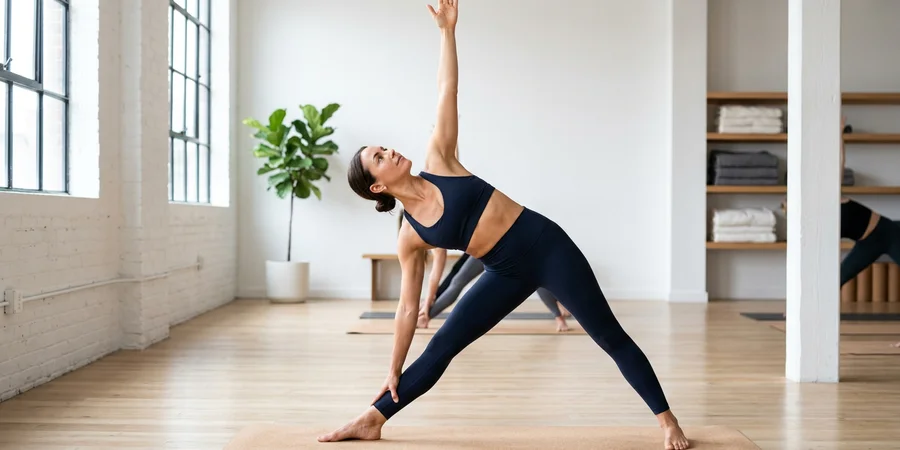
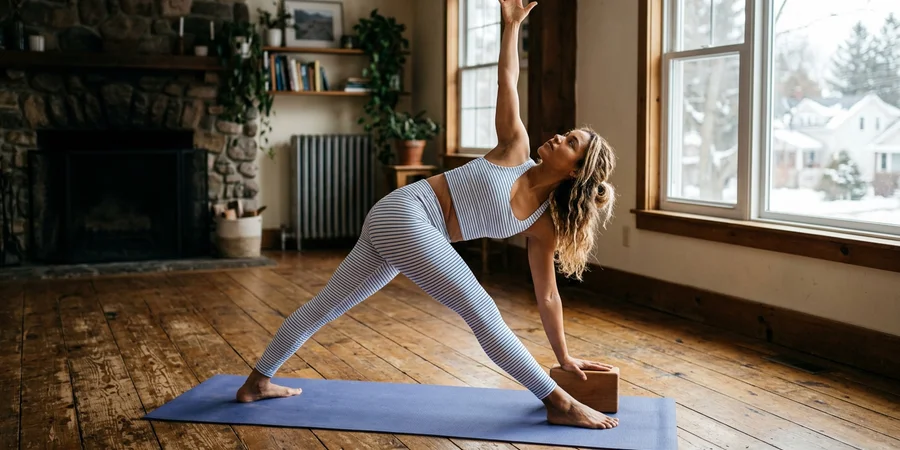
- Lower the front hand. When the torso has reached its maximum lateral extension, lower the right hand to the shin, ankle, a block, or the ground. The support point depends on your range, not on an idea of “reaching”.
- Raise the upper arm. Extend the left arm towards the ceiling, in vertical alignment with the right. Both shoulders stack one over the other. The chest rotates towards the side, not towards the ground.
- Turn your gaze. If the neck allows, direct your eyes towards the thumb of the upper hand. If you feel cervical tension, look straight ahead or down. The gaze is firm, not forced.
- Breathe and hold. Stay for 5 to 8 deep breaths. With each inhalation, lengthen the torso; with each exhalation, open the chest wider. Then, return to center gently and repeat on the other side.
Correct alignment: the collapsed torso error
The most common mistake in Trikonasana is wanting to touch the floor before the body is prepared. This search creates the most typical compensation: the torso collapses forward, the spine rounds, and the pose loses its reason for being.
Trikonasana is not a flexion. It is a lateral extension. The goal is to lengthen the upper side and keep both sides of the torso long, not to shorten one to reach the floor with the hand.
The long side test
There is a simple way to check if the posture is well organized. Look down and observe the lower side, the one close to the front thigh. If that side appears wrinkled, shortened, or “folded,” the torso has fallen forward.
In a good Trikonasana, both sides have the same length. The lower does not collapse, and the upper does not overextend. The torso remains in a single plane, as if you were between two panes of glass.
If you don’t achieve that line, it’s simple: lift the supporting hand. Place a block underneath. If the block is high and the side is still crumpled, put it higher. The point of support is a service to alignment, not a test of flexibility.
Hip, knee, and chest
The front hip tends to rotate forward, as in Warrior I. In Trikonasana, it should open to the side: imagine the upper hip stacking over the lower, both facing the long side of the mat.
The front knee must remain active, never hyperextended or locked. A small micro-adjustment, a barely visible mini flex, protects the joint and better activates the quadriceps and the gluteus medius.
Finally, the chest must rotate towards the sky, not looking at the ground. The torsional rotation is an essential part of the posture: it opens the upper intercostals and frees the breath in the diaphragm.
Benefits of Trikonasana
Trikonasana works the entire body in one gesture. It combines strength, flexibility, and openness. Its benefits appear quickly when practiced regularly.
Physical Benefits
The triangle stretches the lateral trunk muscles, the intercostals, the serratus anterior, and the latissimus dorsi. This elongation is unusual in day-to-day life: few everyday activities require us to fully stretch the side.
In the legs, activate quadriceps, hamstrings, adductors, and gluteus medius at the same time. The back leg works in isometric push; the front leg stretches along its entire back and inner side. The result is overall strengthening with a deep stretch.
The rotation of the chest towards the sky opens the thoracic cavity and improves respiratory capacity. In people with a kyphotic posture or prolonged work in front of the computer, Trikonasana compensates for the anterior closure of the chest.
At a visceral level, the lateral extension massages the abdominal organs, especially the liver, kidneys, and spleen on the upper side. Therefore, tradition attributes positive effects on digestion and elimination.
Energetic and Mental Benefits
The wide and stable base connects with Muladhara, the root chakra. The grounded legs, active feet, and oriented pelvis create a sense of security that rises from the earth upwards.
The opening of the chest and the lifting of the arm stimulate Anahata, the heart chakra. There is an expansive quality in Trikonasana: the chest looks to the sky while the feet push into the ground. It is a pose that teaches that opening and grounding are not opposites.
On a mental level, maintaining the posture requires simultaneous attention to many points of the body. This distributed concentration cultivates dharana, the ability to keep the mind present on several focuses without becoming scattered. It is a form of active meditation.
Variations and Modifications
Trikonasana allows for multiple adaptations depending on the level, flexibility, and goal of the practice. These are the most useful.
For beginners or rigid bodies
With a block under the hand. This is the most useful and least used modification. A yoga block at the height you need, placed outside the front foot, allows you to maintain a long torso without straining to reach the ground. The posture gains precision and the lower side is released.
Hand on the shin. If no block is available, resting the hand on the shin above the ankle is a perfectly valid option. The important thing is not where the hand is, but that both sides of the torso remain equally long.
Back against the wall. Practicing with your back touching a wall provides immediate feedback. If the torso leans forward, you will lose contact with the wall and will notice it instantly. It is an excellent pedagogical tool for learning pure lateral extension.
To delve deeper
Parivrtta Trikonasana (revolved triangle). By inverting the side from which the hand drops, the torso rotates into a deep twist while the legs remain extended. It is a much more demanding pose for balance and hip mobility. It requires having previously consolidated the classic triangle.
Trikonasana with full support. In Iyengar style, it is practiced by resting the entire side on a chair or a long support. This variant allows for discovering optimal alignment without the pressure of balancing and is ideal for older students or those with limitations.
Baddha Trikonasana (bound triangle). The upper arm is taken behind the back and the lower arm passes underneath the front thigh, linking both hands. It adds a shoulder-opening component and abdominal compression. It is considered a preparation for more complex bound poses.
Contraindications and precautions
Trikonasana is an accessible pose, but it is not universally safe. Some situations require modification or avoidance.
If you have cervical injuries, do not turn your head up to look at the upper hand. Keep your neck in a neutral line with your spine, looking straight ahead or down. It is not worth forcing a gaze that compresses the neck.
In case of lumbar issues, sciatica or disc herniation, make sure not to collapse the torso forward. Use a high block and keep both sides long. If pain appears in the lower back, come out of the pose and check your pelvic alignment.
With low blood pressure, getting out of the pose quickly can cause dizziness. Return to center gently, passing through a halfway position with arms extended before standing up completely.
During menstruation, some traditions suggest avoiding or softening deep lateral poses. Listen to your body: a shorter version, with the hand raised, is often perfectly acceptable.
In advanced pregnancy, open your legs more and reduce the lateral inclination. A high block and looking straight ahead are safe adaptations. Avoid the twisted version.
The triangle as a revealing pose
Trikonasana has a pedagogical quality that few asanas match. It is hardly “faked.” Either the side is long or it is not. Either the hip stacks or it closes. Either the chest rotates or looks at the ground. The posture is its own evaluation.
That’s why teachers use it so much to observe their students. Seeing someone in Trikonasana for five breaths reveals their compensation patterns, their dominant sides, and their relationship with effort and precision.
Practiced with attention, it teaches something essential: that the outer form matters less than the quality of the inner extension. A triangle with the hand halfway up the thigh and the torso long is worth more than a triangle with the hand on the floor and the side collapsed.
If you want to learn to work with these alignments thoughtfully and integrate them into anatomically meaningful sequences, our 200h Yoga Teacher Training Course dedicates complete modules to the study of the fundamental yoga postures and their safe teaching.