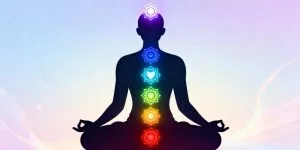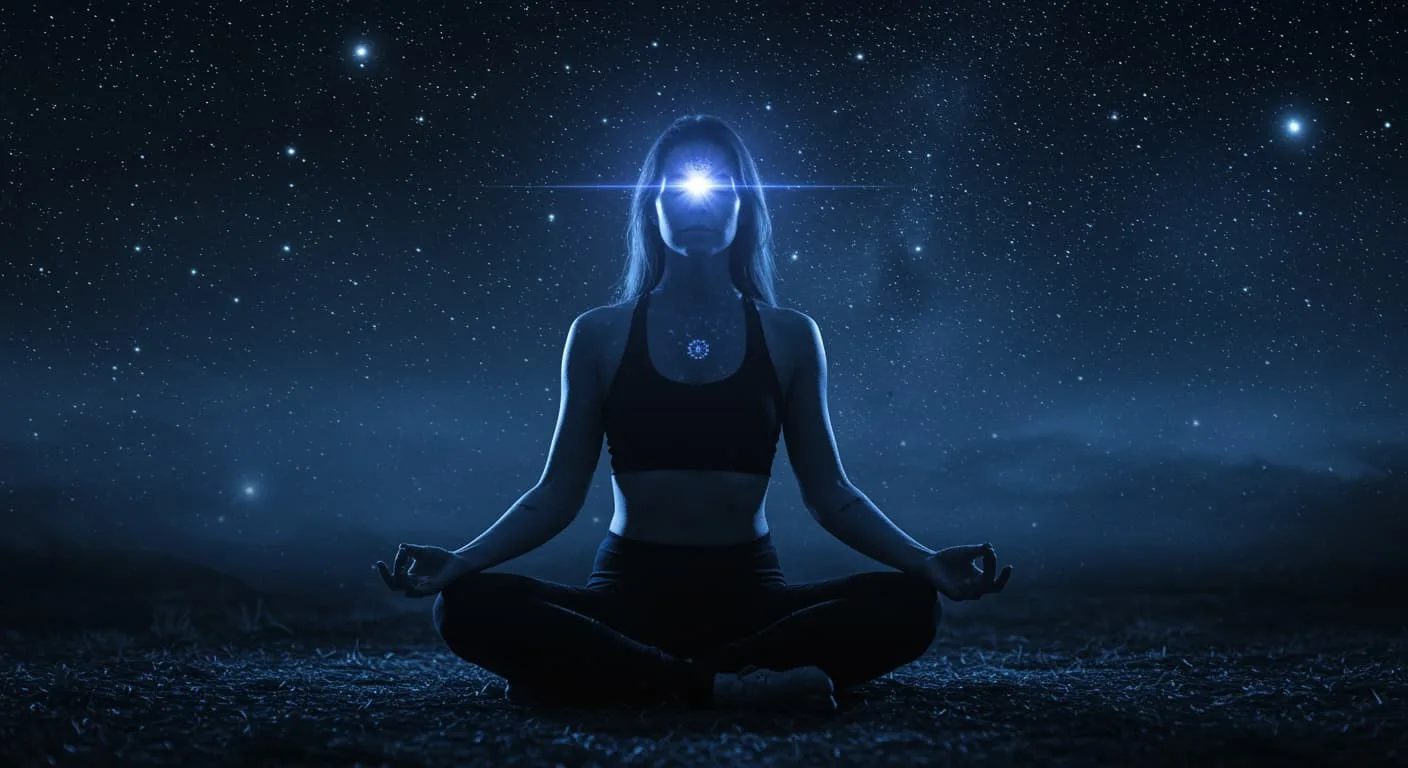
The third eye is the popular name for the Ajna chakra, the sixth of the seven main chakras in yoga. It sits between the eyebrows, and tradition links it to intuition and inner vision. It is not a physical organ but a point of attention you work on through meditation and breathing.
In practice, “opening the third eye” means training the mind to hold its attention inward. Here you’ll see how to do it with five concrete, safe practices, what you might feel, and what science really says about the pineal gland.
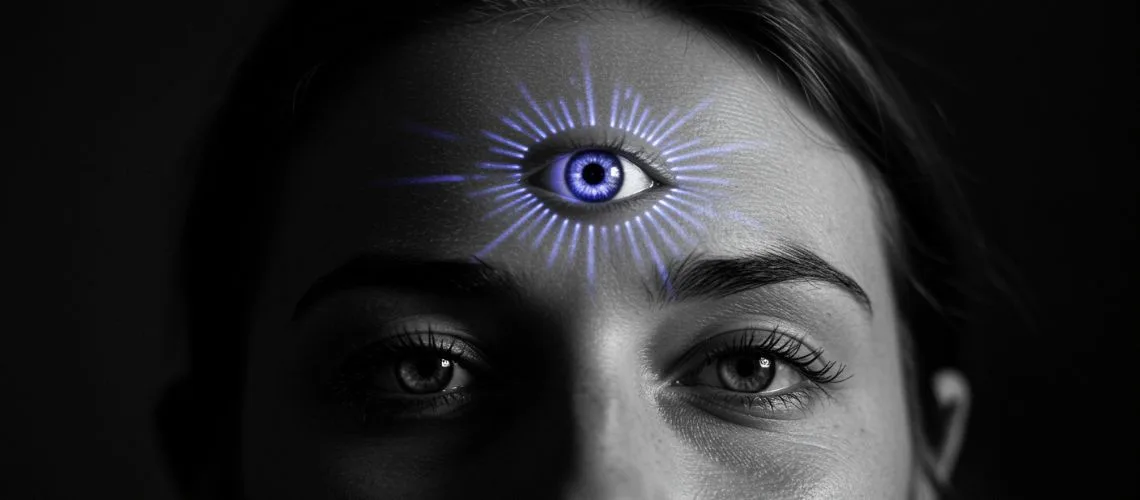
What is the third eye?
In yoga and tantra, the third eye is Ajna chakra, the subtle center located between the eyebrows. In Sanskrit, ājñā means “command” or “order”, and it is related to the root jñā, “to know”. That’s why it is often translated as the center from which the mind perceives and directs.
The Ṣaṭ-cakra-nirūpaṇa, a 16th-century tantric text and one of the most frequently cited classical sources on the chakras, describes Ajna as a white two-petaled lotus bearing the syllables ha and kṣa, and presents it as the seat of the mind (manas). Its seed sound is OM.
The image of an eye on the forehead is very old: in Hindu iconography, Shiva has a vertical third eye, and the bindi or tilak between the eyebrows marks that same spot. For yoga, this “eye” doesn’t look outward but inward.
Many schools also teach that the three main energy channels (ida, pingala and sushumna) meet at Ajna. Hence its reputation as the center that unites the rational and the intuitive. This is a teaching of yoga’s subtle anatomy, not an anatomical description of the physical body.
Characteristics of the Ajna chakra
This table separates what the classical texts say from the correspondences that were added in the 20th century and are now repeated in almost every book:
| Characteristic | Description |
| Name | Ajna (“command”, “order”); third eye; sixth chakra |
| Location | Between the eyebrows; inside the head, at that level |
| Petals | Two, bearing the syllables ha and kṣa |
| Color | White in the classical texts; indigo in the modern rainbow system |
| Seed sound | OM (AUM) |
| Associated with | The mind (manas); the “light element” is a modern correspondence |
| Gland | A modern, not classical, correspondence: pineal or pituitary, depending on the author |
| Qualities in the tradition | Intuition, concentration, discernment, inner vision |
If you’re curious about how each center came to be assigned a color, we explain it in our guide to chakra colors.
How to open your third eye: 5 yoga practices
There is no way to open your third eye “in 3 minutes”. In yoga, working on Ajna means working on concentration (dharana): bringing your attention to one point and holding it there. Practicing little and often works best: 10 minutes a day beats an hour every now and then.
Before you start, a simple foundation: sit with your spine upright, for example in sukhasana (easy pose) or on a chair, and breathe through your nose for a few minutes without forcing. These are the five most widely used practices, from the simplest to the one that calls for the most care.
1. Meditation on the space between the eyebrows
This is the basic practice, and one you can do today. Give it 10 to 15 minutes in a quiet place:
- Get ready: sit comfortably, close your eyes and relax your shoulders, jaw and forehead.
- Calm your breath: inhale to a count of 4 and exhale to a count of 6, for about five rounds.
- Bring your attention to the space between your eyebrows: without rolling your eyes or frowning; simply feel that area.
- Visualize: if it helps, imagine a soft point of light between your eyebrows that grows with each inhalation.
- Add OM: chant it softly or silently about seven times and notice the vibration in your forehead.
- Observe in silence: let images, thoughts or sensations come and go, without judging them.
- Close: rub your hands together, place them over your closed eyes and open your eyes slowly.
If your mind wanders, return to the space between your eyebrows without scolding yourself: that returning, again and again, is exactly the training. Over time you’ll notice that you get distracted less and that calm arrives sooner.
2. Trataka (candle gazing)
Trataka means gazing without blinking at a fixed point, traditionally a candle flame at eye level and an arm’s length away, for one or two minutes. Then you close your eyes and watch the afterimage between your eyebrows. Repeat two or three times.
A few small, preliminary studies link it to improvements in attention. Don’t strain: if your eyes water or sting, close them. If you have epilepsy, don’t use a flame, which flickers: choose a fixed point instead. With glaucoma, recent eye surgery or another eye condition, check with your ophthalmologist first.
3. Bhramari (bee breath)
Bhramari appears in the Hatha Yoga Pradipika, the great medieval manual of hatha yoga. Gently close your ears with your thumbs (without pressing), rest your index fingers on your forehead or closed eyes, and inhale through your nose. As you exhale, make a low, continuous humming sound with your mouth closed.
You can clearly feel the vibration in your head and between your eyebrows, which is why it is used to prepare for meditation on Ajna. Do five to ten rounds and stay in silence for a few moments afterward. If you have an ear infection, save it for later.
4. Nadi Shodhana (alternate nostril breathing)
Close your right nostril and inhale through the left; close the left and exhale through the right; inhale through the right and exhale through the left. That is one round. Do five to ten, without holding your breath. It is one of the safest pranayamas.
Yoga says it balances ida and pingala before bringing attention to the center. Science, more modestly, has seen a drop in blood pressure in small trials, with mixed results and few well-controlled studies. What almost everyone notices is that it calms the nervous system.
5. Shambhavi mudra (eyebrow center gazing)
This is the classic third eye technique; the Hatha Yoga Pradipika presents it as a teaching to be kept secret. With your eyes open or half-closed, direct your gaze up and to the center, toward the space between your eyebrows. Hold for a few seconds, close your eyes and rest.
It calls for more care: it should never hurt or strain your eyes, and at first 3-5 short repetitions are enough. With glaucoma, retinal problems or recent eye surgery, do it with your eyes closed, keeping only your attention between your eyebrows. You’ll find other similar gestures in our guide to mudras.
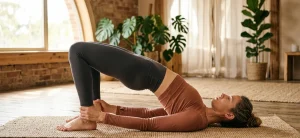
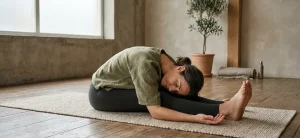
Some yoga poses help as preparation. In balasana (child’s pose) the forehead rests on the floor. Meditation postures such as padmasana stabilize the body. Inversions such as sirsasana only with experience and no neck, eye or blood pressure problems.
What do you feel and see when you open your third eye?
When meditating on the space between the eyebrows, the most common experiences are a gentle pressure, warmth or tingling in the forehead, seeing points of light or colors with your eyes closed and, above all, a quieter mind. Those lights are normal visual phenomena (phosphenes), not visions; there’s no need to chase them.
In the tradition, “seeing with the third eye” means seeing clearly: understanding a situation without the fog of fear or hurry. It is about intuition and discernment, not supernatural sight. No study has shown that meditation lets you see spirits or predict the future.
Opening your third eye: consequences, good or bad?
For most people, meditating on the space between the eyebrows is safe and pleasant. But it isn’t harmless for everyone: a 2020 systematic review (Farias and colleagues) found that about 8% of participants in meditation studies reported some adverse effect, mainly anxiety or low mood.
That’s why it’s wise to start with short sessions and build up gradually. If you have a history of psychosis, trauma or severe anxiety, talk to your mental health professional before doing long or intensive practices. The same rule applies to everyone:
- Stop if you get a headache, dizziness, distress or a sense of unreality that doesn’t go away when you finish.
- Don’t force your eyes or your breath, and don’t hold your breath without a teacher.
- Don’t combine these practices with substances to “speed up” the opening.
- If an experience unsettles you, go back to basics: calm breathing, your body and the ground.
The tradition puts it in its own way: the third eye isn’t forced open, and it’s best to work on the lower centers first, which provide stability. The underlying teaching is the same: without a firm foundation, intense practice destabilizes.
The third eye and the pineal gland: what science says
The pineal gland is a tiny organ, weighing less than 0.2 grams, in the center of the brain. Its main function is to produce melatonin at night, the hormone that tells the body it’s time to sleep. The idea that the Ajna chakra “is” the pineal gland is a modern correspondence, not something the classical yoga texts say.
The pineal gland has fascinated people for centuries. In the 17th century, Descartes considered it the principal seat of the soul, the place where body and mind met. Today we know there is no anatomical basis for that idea, although it partly explains why it is still linked to spirituality.
Why is it called the third eye?
There is a real biological reason. In lampreys, frogs, the tuatara and many lizards, a structure related to the pineal gland, the parietal eye, has photoreceptor cells and senses light through a small opening in the skull. In mammals that eye disappeared, and our pineal gland doesn’t detect light directly.
It receives it indirectly: the eyes inform the brain’s internal clock, which tells the pineal gland when to make melatonin. That’s why artificial light at night delays it. In a 2011 study, ordinary room light before bedtime shortened the melatonin production period by about 90 minutes.
DMT, calcification and fluoride: myths and facts
It is often claimed that the pineal gland produces DMT, a psychedelic, and so causes mystical experiences. DMT has been measured in the brains of rats, including rats without a pineal gland; in humans only trace amounts have been detected. In 2018, pharmacologist David Nichols calculated that the pineal gland could not produce anywhere near enough for psychedelic effects.
Pineal calcification is very common: it affects more than half of people and increases with age. A 2001 study of eleven cadavers of elderly people found fluoride accumulated in the gland, without showing that it affects its function. There is no evidence that any diet, supplement or meditation “decalcifies” the pineal gland.
So what is good for the pineal gland? What science supports is unspectacular: natural light during the day, darkness and screens off at night, and regular sleep times. The pineal gland doesn’t need to be “activated”: it works every night. If you often sleep badly, see a doctor.
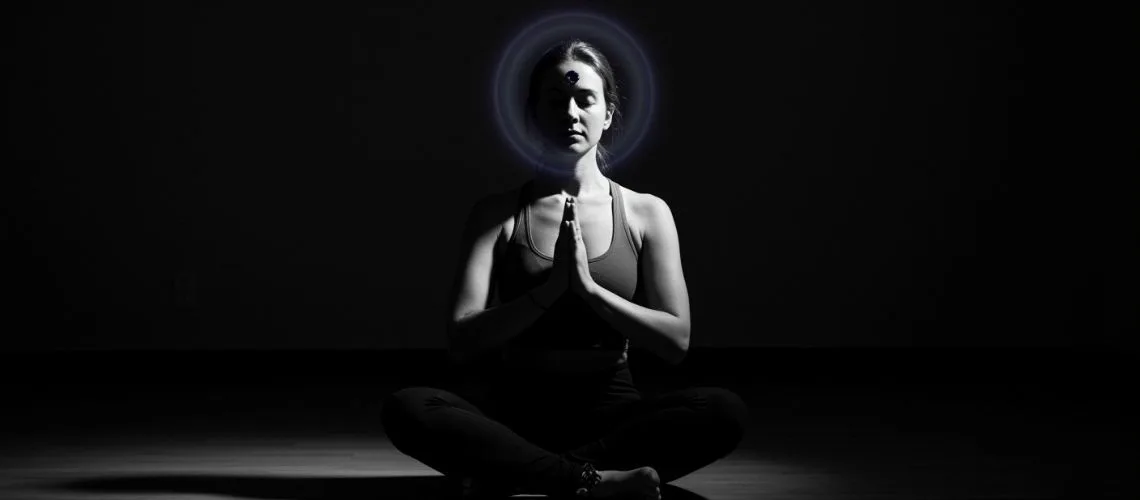
Signs of a balanced or blocked third eye according to the tradition
In the yogic tradition, a balanced Ajna shows up as mental clarity, ease in concentrating and making decisions, trust in your own intuition and a lively imagination. A “blocked” Ajna is described as confusion, scattered attention, rigid thinking or difficulty hearing your inner voice.
These are symbolic descriptions, useful for observing yourself, not a diagnosis. Some books attribute headaches, vision problems or insomnia to a blocked chakra: if you have them, the answer lies in a medical consultation, not in the chakra. Practice can support, never replace.
Foods, affirmations and other aids
Modern correspondences associate Ajna with purple or dark blue foods, such as blueberries, blackberries or red cabbage. This is color symbolism, not a proven effect on the pineal gland or on intuition. What does help is a varied diet and cutting back on caffeine in the afternoon.
Affirmations are another simple aid: phrases such as “I trust my intuition” or “I see my path clearly”, repeated at the end of meditation, help set an intention. A mantra repeated with attention can do the same.
Frequently asked questions about the third eye
How long does it take to open your third eye?
There is no fixed timeline. With 10-15 minutes of daily practice, many people notice more calm and concentration within a few weeks; the mental stability the tradition associates with an awakened Ajna takes years.
Be wary of promises to open it in minutes: what you notice in such a short time is relaxation, which is already a lot. What matters is consistency, not intensity.
What does the third eye mean in the Bible?
The Bible doesn’t mention the third eye. Some spiritual readings link it to Matthew 6:22, which the King James Version renders as “The light of the body is the eye: if therefore thine eye be single, thy whole body shall be full of light”, but that is a modern interpretation.
In the Gospel, the passage is about the integrity of one’s inner gaze. It resembles the yogic idea of “seeing clearly”, but Christianity has no doctrine of the third eye.
Does the third eye exist?
As an organ, no. What does exist is the pineal gland, with its curious evolutionary past, and the space between the eyebrows as a point of concentration, which has real effects on attention and calm.
As a concept, the third eye is a very old and effective way of naming inner vision. Practicing it doesn’t require you to believe in anything: just sit, breathe and observe what changes.
Working with the third eye wisely, separating tradition from evidence and knowing the precautions for each technique, is best learned with guidance. Our online yoga teacher training includes meditation, pranayama and yoga philosophy with teachers who specialize in each subject.