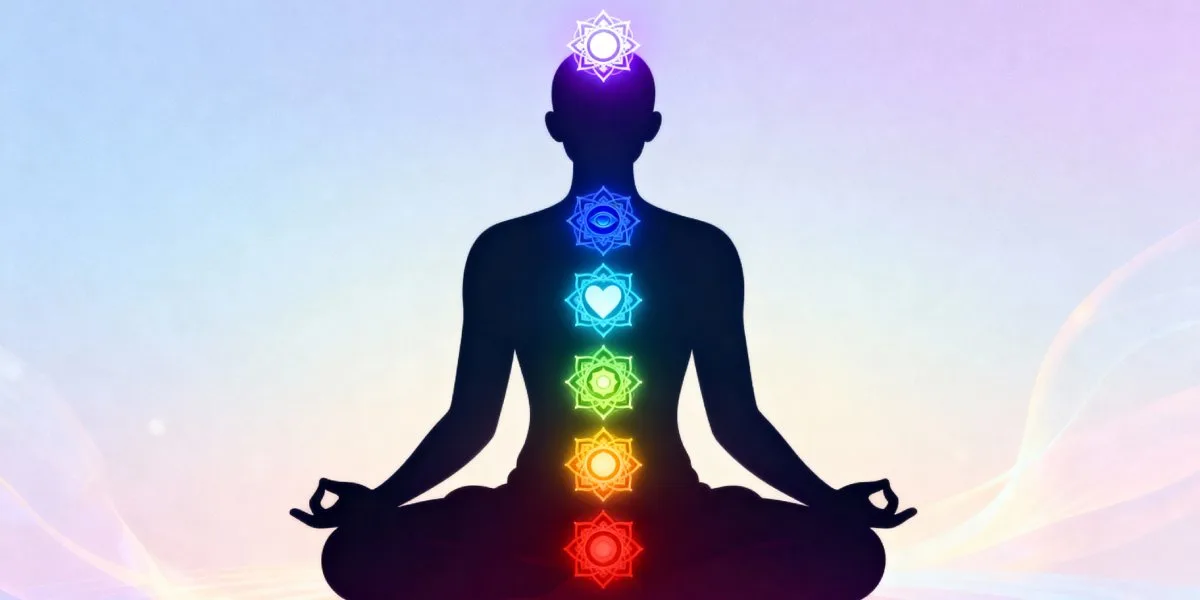
The colors of the 7 chakras, from bottom to top, follow the order of the rainbow: red, orange, yellow, green, blue, indigo and violet. They run from the base of the spine to the crown of the head, and each one has its Sanskrit name, its element and its seed mantra.
Here you have the complete table to check at a glance, the meaning of each color and something almost nobody mentions: where this color system comes from and which colors the classical yoga texts actually describe. If you’re not familiar with the basics yet, start with what the chakras are.
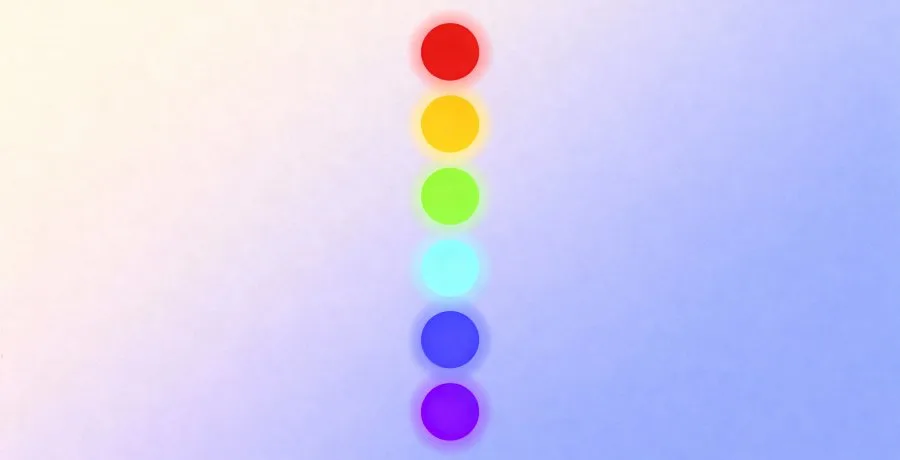
The 7 chakra colors in order
| No. | Chakra | English name | Color | Location | Element | Seed mantra |
|---|---|---|---|---|---|---|
| 1 | Muladhara | Root | Red | Base of the spine (perineum) | Earth | LAM |
| 2 | Svadhisthana | Sacral | Orange | Lower abdomen, root of the genitals | Water | VAM |
| 3 | Manipura | Solar plexus | Yellow | Navel and solar plexus | Fire | RAM |
| 4 | Anahata | Heart | Green (sometimes pink) | Center of the chest | Air | YAM |
| 5 | Vishuddha | Throat | Blue | Throat | Ether (space) | HAM |
| 6 | Ajna | Third eye | Indigo | Between the eyebrows | Mind (beyond the five elements) | OM |
| 7 | Sahasrara | Crown | Violet or white | Crown of the head | Beyond the elements | Silence (sometimes OM) |
To remember the order, picture a vertical rainbow. Red, the color with the longest wavelength, sits at the base; violet, the one with the shortest, at the crown. When someone talks about the “purple chakra” or “violet chakra”, they almost always mean the crown chakra, Sahasrara.
The first five chakras are associated with the five great elements of the Indian tradition (earth, water, fire, air and ether). The two upper ones are no longer tied to any element: Ajna is the seat of the mind and Sahasrara represents what lies beyond it.
Where the chakra colors come from
This is the part most guides leave out. The chakras do have colors in the tantric texts of India, but they are not the colors of the rainbow. The system of seven colors in spectral order is a 20th-century Western contribution.
The key text is the Ṣaṭ-cakra-nirūpaṇa (“description of the six centers”), written by Pūrṇānanda in 1577 and introduced to the West through Arthur Avalon’s (John Woodroffe’s) translation in The Serpent Power (1919). It describes each chakra as a lotus with a certain number of petals and a color of its own.
In that translation, the Muladhara lotus is red, with a yellow square representing earth; Svadhisthana’s is vermilion; Manipura’s, the color of rain clouds; Anahata’s, red like the bandhuka flower; Vishuddha’s, smoky purple; Ajna’s and Sahasrara’s, white.
The link with the rainbow took shape in 20th-century Theosophy and color therapies. According to historian Kurt Leland (Rainbow Body, 2016), the current version, with the colors of the spectrum and their psychological qualities, crystallized in 1977 with Ken Dychtwald’s Bodymind.
Does this mean the modern colors are useless? No. They are a helpful teaching tool and have become a tradition in their own right. It’s simply worth knowing that they are a contemporary reading, not an age-old teaching, and that the wisdom of yoga doesn’t depend on them.
1. Root chakra (Muladhara): red
Muladhara means “root support”. It sits at the base of the spine, at the level of the perineum. Its element is earth and its seed mantra is LAM. In the modern system it is shown in red, the color of strength and primal energy.
It symbolizes stability, security, a sense of belonging and connection with the body. In yoga practice it is worked on with standing and grounding poses, which invite you to feel the support of your feet and pelvis.

2. Sacral chakra (Svadhisthana): orange
Svadhisthana translates as “one’s own abode”. It is located in the lower abdomen, at the root of the genitals according to the classical texts. Its element is water and its mantra is VAM. It is shown in orange.
Orange blends the energy of red with the brightness of yellow. That’s why it is associated with creativity, pleasure, sexuality and emotional fluidity, the ability to let emotions flow like water without stagnating.
3. Solar plexus chakra (Manipura): yellow
Manipura means “city of jewels”. It is in the area of the navel and solar plexus. Its element is fire and its mantra is RAM. Its modern color is yellow, like an inner sun.
It is associated with willpower, self-esteem and the ability to decide and act. The fire of Manipura is also linked to digestion, both literally and figuratively: assimilating what you eat and what you experience.

4. Heart chakra (Anahata): green
Anahata means “unstruck”, referring to the inner sound that does not arise from two objects striking each other. It sits in the center of the chest. Its element is air and its mantra is YAM. It is shown in green and, in some modern schools, in pink.
It is the midpoint between the three lower and the three upper chakras. It is associated with love, compassion, empathy and forgiveness: toward others and toward yourself. That’s why searches for “pink chakra” usually refer to this center.
5. Throat chakra (Vishuddha): blue
Vishuddha means “especially pure” or “purification”. It is located in the throat. Its element is ether, or space, and its mantra is HAM. It is shown in light blue or turquoise.
It is associated with communication, authentic expression and listening. Working with breath and sound, from pranayama to mantra chanting, is the classic way to direct attention to this area.

6. Third eye chakra (Ajna): indigo
Ajna means “command” or “authority”, and is sometimes interpreted as “to perceive”. It sits between the eyebrows. It is no longer associated with an element: it is the seat of the mind. Its mantra is OM and its modern color is indigo, a deep blue.
It is associated with intuition, mental clarity and inner vision. It is the point where the inner gaze is usually fixed during concentration. We cover it in depth in our guide to the Ajna chakra.
7. Crown chakra (Sahasrara): violet or white
Sahasrara means “thousand-petaled”. It sits at the crown of the head or just above it. It has no element and, strictly speaking, no seed mantra: it is associated with silence, although many schools use OM. Its modern color is violet; its classical color, white.
It represents transcendence and the union of individual consciousness with the whole. In the yogic tradition it is the destination of the awakening of energy and is linked to the state of samadhi, complete absorption in meditation.

The 7 chakras and their seed mantras
Each chakra has a bija mantra, or seed mantra, a syllable considered to be the sound vibration of its element. If you want to understand how the repetition of sounds works, read our guide to what a mantra is. In order, from bottom to top, they are:
- Muladhara: LAM (earth)
- Svadhisthana: VAM (water)
- Manipura: RAM (fire)
- Anahata: YAM (air)
- Vishuddha: HAM (ether)
- Ajna: OM
- Sahasrara: silence, or OM in some schools
A simple practice is to chant each syllable several times, slowly and drawn out, while bringing your attention to the area of the corresponding chakra and visualizing it in its color. You move from bottom to top and finish in silence.
How to use chakra colors in your practice
The most common way is to visualize them while meditating. Sit in a stable posture, such as lotus pose or a simpler variation, close your eyes and bring your attention to each chakra, imagining its color as a soft light. The color serves as an anchor for concentration.
You can combine it with your breath: inhale while feeling the area of the chakra and exhale while chanting its mantra. This is the basis of many sequences in Kundalini Yoga, which works with energy along the spine, from the root to the crown.
Other popular customs, such as wearing a certain color, decorating your space or choosing stones and foods by their hue, are part of modern chakra culture. They can serve as a reminder of the day’s intention, but they are not traditional yogic practices.
It’s worth being clear: color therapy, the idea that certain colors cure specific ailments, has no scientific backing. Working with the chakras is a practice of attention and self-knowledge, not a medical treatment. If you have a health problem, consult a professional.
Colors are a gateway to the chakras, but behind them lies a yogic map that is worth studying methodically and with good sources. If you want to explore it fully and learn to pass it on, our yoga teacher training course covers it from both theory and practice.