In yoga, we tend to admire the most spectacular poses: inversions, arm balances, impossible bends. However, one of the most valuable is also the simplest. Sukhasana, the easy pose, reminds us that sitting cross-legged can be a profound practice.
Its apparent simplicity hides a real challenge: finding comfort, stability, and presence without tension. It is the seat from which we breathe, meditate, and return to ourselves, on and off the mat.
In this guide, you will see what Sukhasana means, how to align it step by step, which errors to avoid, its real benefits, its variations, and how to make it the foundation of your meditation practice.
What is Sukhasana and what its name means
Sukhasana is one of the most basic and accessible seated poses in yoga. The name comes from Sanskrit: sukha means comfort, ease, or well-being, and asana translates as pose. Together they literally describe the comfortable pose.
The word sukha holds more than meets the eye. In yogic philosophy, it is opposed to duhkha, suffering or dissatisfaction. Sitting in sukha is inhabiting a pleasant space within the body, a state where stillness stops being a burden and starts to sustain us.
That is why Sukhasana is not just a way of crossing your legs. It is the traditional seat for meditation, pranayama, and moments of reflection at the beginning and end of a Hatha Yoga practice. In many schools, it is the first pose taught, because it teaches how to simply be.
How to practice Sukhasana step by step
Even if it seems obvious, sitting properly has its technique. A good entry makes the difference between a pose that is held calmly for minutes and one that quickly generates discomfort in the knees or back.
Preparation and entry
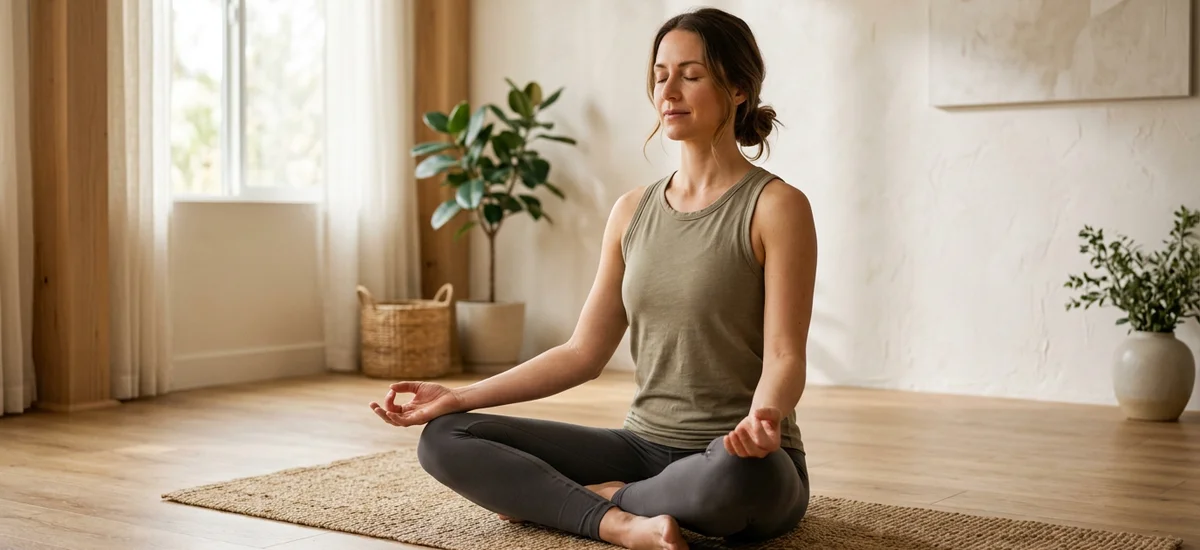
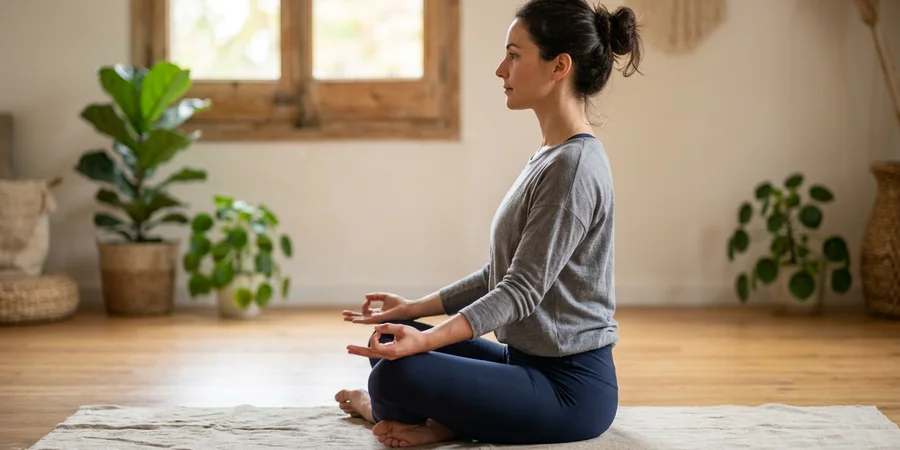
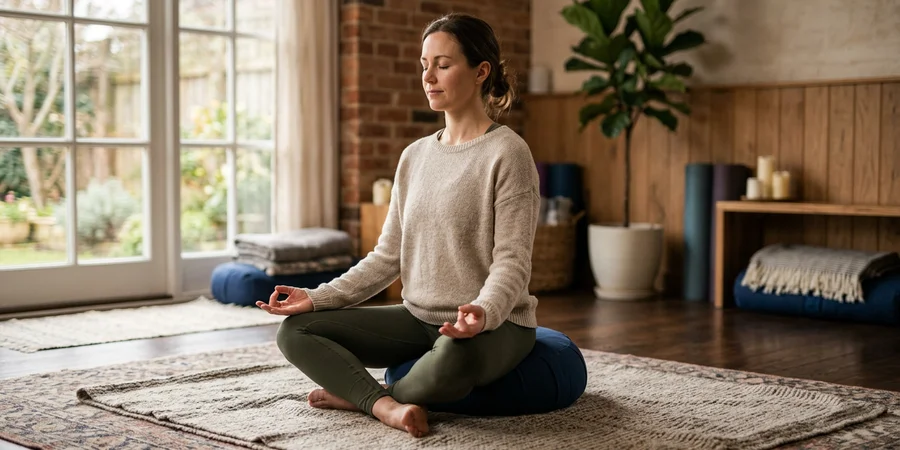
Sit on the floor and cross your legs naturally, placing each foot under the opposite knee. Do not look for a deep cross or force your hips; prioritize a wide and stable base on the sit bones, the bones on which the pelvis rests.
If you notice that your knees are higher than your hips, elevate the pelvis by sitting on a firm cushion, a block, or a folded blanket. This small gesture completely changes the comfort of the pose and protects the lower back.
Spine alignment
Imagine a thread pulling gently from the crown of the head toward the ceiling. The spine lengthens, the vertebrae stack one on top of the other, and the chest opens without needing to stick out the ribs. The pelvis remains neutral, neither tilted backward nor overly arched.
Relax the shoulders, bringing them away from the ears, and let the weight descend toward the base. The idea is to sustain yourself with the least effort possible: firmness below, lightness above. An aligned spine is much less tiring than a slumped spine.
Hands, gaze, and breath
Rest your hands on your knees or in your lap, with palms facing up for a receptive attitude or downward for grounding. You can adopt a simple mudra, such as joining the thumb and index finger, if it helps you concentrate.
Close your eyes or soften your gaze toward a fixed point on the floor. Soften the jaw, the tongue, and the brow, and bring your attention to a slow and complete breath. From here, the pose begins to work by itself.
To check that you are well-positioned, review these signs of a good Sukhasana:
- Sit bones well-supported and the pelvis neutral or slightly elevated.
- Long spine, without rounding the lower back or arching it excessively.
- Knees at hip level or below.
- Shoulders relaxed and away from the ears.
- Full, fluid, and effortless breathing.
Common errors in Sukhasana
The most frequent is rounding the back. When sitting on the floor without elevation, the pelvis tilts backward and the spine curves forward. The solution is almost always simple: a cushion under the sit bones to reposition the pelvis.
Another common mistake is forcing the crossing of the legs searching for an ideal image. Each person’s hips are different, and demanding a deep cross can strain the knees and ankles. Comfort must always come before aesthetics.
It is also advisable not to stay too long with the same leg in front. Alternate the cross between sessions, or even halfway through a long practice, to avoid creating imbalances in the hips and lower back.
Finally, avoid tensing the shoulders and neck without realizing it. Check every now and then that the face remains relaxed: a comfortable pose should not leave marks of effort on the face.
Benefits of Sukhasana
Despite its simplicity, Sukhasana offers benefits that are distributed across the body, mind, and the more subtle level of practice. They do not appear all at once, but are built with the consistency of returning to the cushion day after day.
Physical benefits
It gently opens the hips and groin, stretches the knees and ankles, and strengthens the deep back muscles that support an upright spine. Over time, that discreet strength improves posture outside the mat as well.
By aligning the torso, Sukhasana leaves room for the diaphragm and facilitates a fuller and more conscious breath. That is why it is the ideal seat for any practice of pranayama breathing techniques, where freedom of the abdomen and chest is essential.
Mental and emotional benefits
Sitting still and comfortably invites the nervous system to slow down. Sukhasana promotes calm, mindfulness, and a sense of presence that anchors the mind when it tends to scatter in a thousand directions.
Practiced regularly, it cultivates patience and acceptance. It becomes a small refuge to return to when we need to stop, breathe, and observe what happens inside without reacting immediately.
Energetic benefits
In tradition, seated poses with a vertical spine favor grounding and the free rise of energy. The firm base connects with the earth while the crown of the head is oriented upward, opening a central channel of stillness.
That polarity between root and summit is exactly the state we seek for meditation: stable like a mountain and, at the same time, light like the sky. The body quietens so that attention can become refined and sustained.
Variants and modifications of Sukhasana
The most useful variation for most practitioners is the elevated pose: sitting on one or more meditation cushions. It raises the pelvis, relaxes the groins, and allows the back to remain straight for much longer without fatigue.
If the knees bother you, place a support under each one so they do not hang suspended in the air. And if the back gets tired during long sessions, sit with your back against the wall: you will receive support without losing vertical alignment.
As the hips gain openness, Sukhasana opens the door to more demanding seated poses, such as Siddhasana or the lotus pose (Padmasana). There is no rush to get there: each hip has its own rhythm and its own moment.
Sukhasana vs other seated poses
Sukhasana is the entry point, but not the only option for sitting to meditate. Knowing its alternatives helps in choosing the most suitable one for your body and for each moment of the practice.
Vajrasana, the thunderbolt pose, is performed kneeling on the heels and is very stable for those with little hip opening. It is a good alternative when crossing the legs is uncomfortable, and it can even be held after eating.
Siddhasana, the adept’s pose, intensifies hip work and is considered ideal for prolonged meditation. The lotus pose, on the other hand, is the most demanding of all and should be reserved for when the hips are truly prepared.
Compared to all of them, Sukhasana stands out for its accessibility: it offers almost all the meditative benefits with a fraction of the joint demand. That is why it remains, for many practitioners, the seat for every day.
Contraindications and precautions
Sukhasana is one of the safest poses in yoga, but it is wise to listen to the body. If you have knee or hip injuries, elevate the pelvis well and reduce the holding time; you should never feel sharp joint pain.
In case of lower back discomfort, support under the sit bones and, if necessary, against the wall, is usually enough to practice comfortably. During pregnancy, it is a pleasant pose, always with good elevation and without compressing the abdomen.
As in any yoga asana, the rule is the same as the name given to the pose: comfort and stability in equal parts. If one of the two is missing, adjust the supports before continuing.
Sukhasana as a foundation for meditation and breathing
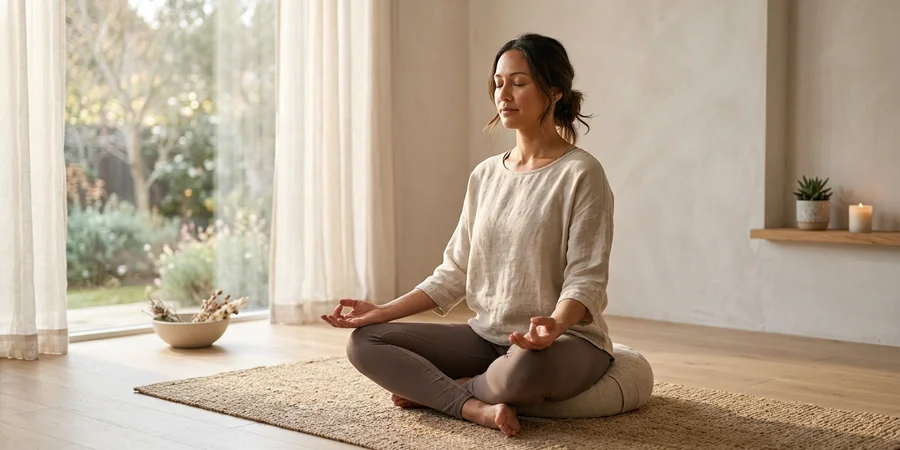
The true value of Sukhasana appears when it stops being an end in itself and becomes a starting point. It is one of the best poses for meditation precisely because it allows one to forget the body and dedicate all attention to the mind and breath.
Start with a few minutes at the beginning or end of your asana session, focusing on the natural rhythm of the air entering and leaving. Gradually you will be able to lengthen the time and use the pose as a stable seat for daily meditation.
If this simple pose awakens in you the desire to understand the practice and philosophy of yoga from within, an online yoga teacher training is the natural path to discover why, so many times, the simplest thing is precisely the most essential.