If Warrior Pose I is the explosion of the warrior emerging from the earth, Warrior Pose II is the moment that follows: the warrior pauses, opens the arms, and fixes the gaze on the target. Not a step more, not a step less. Just presence.
The Warrior Pose II is one of the most iconic asanas of yoga. And one of the most demanding. Legs open, arms extended, chest wide, and a gaze that does not move. The whole body works to maintain a stillness that burns from within.
Here you will discover how it differs from Warrior I, how to execute it with precision, the mistakes you need to correct, and why this pose can teach you so much about both patience and strength.
Meaning and Connection to Warrior I
The name Virabhadrasana II shares the same Sanskrit root as its sister: vira (वीर), “hero”; bhadra (भद्र), “auspicious”; and asana (आसन), “pose”. It refers to the same mythical warrior: Virabhadra, born from the anger of Shiva.
If Warrior I represents the moment when Virabhadra emerges from the earth with swords held high, the Warrior II captures the following instant: the warrior is already standing, extending the arms to the sides and fixing the gaze on Daksha, their target. There is no rush. There is determination.
This mythological difference translates into a deep bodily difference. In Warrior I, the pelvis and chest face forward, the hips “close,” and the arms rise to the sky.
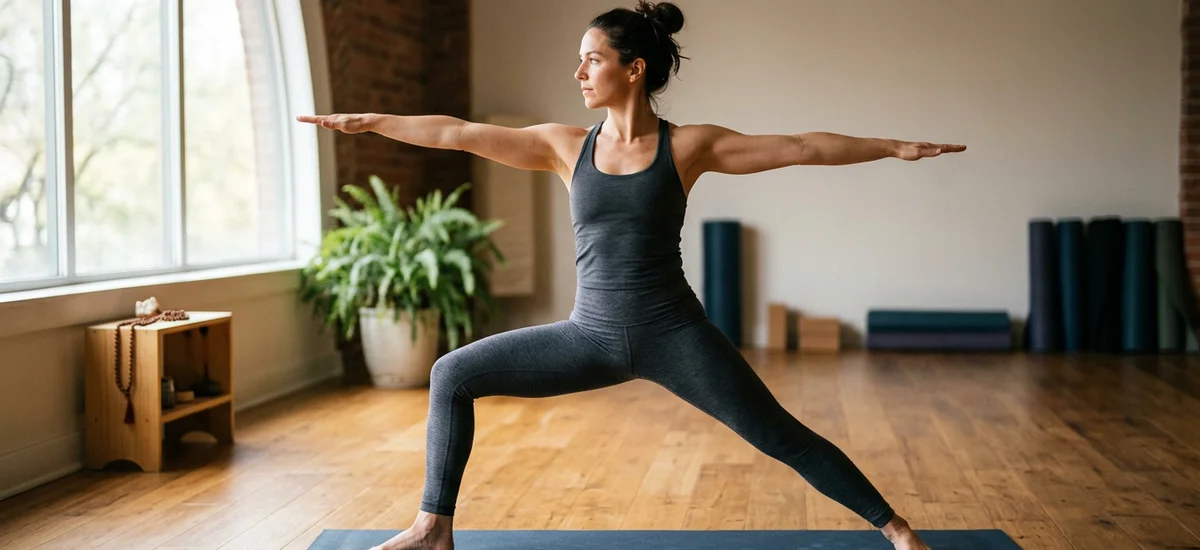
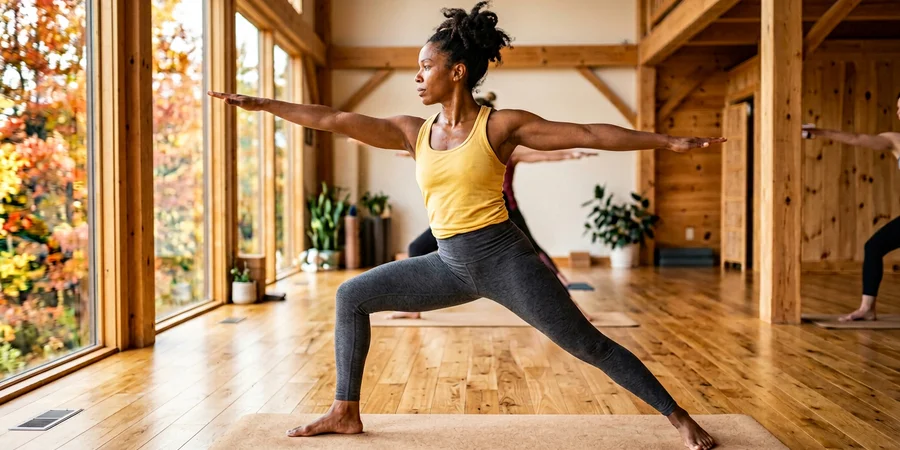
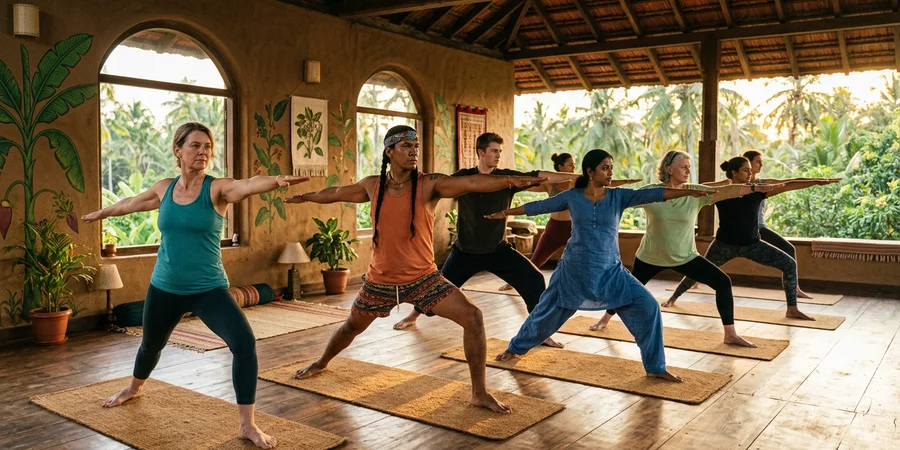
In Warrior II, the body opens laterally: the pelvis faces the long side of the mat, the arms extend in opposite directions, and the gaze goes over the fingers of the front hand.
Closed Hips vs. Open Hips
This is the fundamental anatomical distinction between both poses. In Warrior I, the back hip internally rotates to orient the pelvis forward: it is a “closed hips” pose.
In Warrior II, the front hip externally rotates and the pelvis opens to the side: it is an “open hips” pose. The configuration is completely different.
This external rotation activates the deep rotators of the femur (piriformis, obturators, gemelli, and quadratus femoris) and stretches the thigh adductors. It works different muscles and generates different sensations.
For this reason, although they share a name and mythology, Warrior I and Warrior II are complementary postures, not versions of one another. Together they form a natural thematic cluster: what one closes, the other opens.
How to do Virabhadrasana II step by step
Follow these instructions to practice the Warrior 2 pose with safe and effective alignment:
- Spread your legs. From standing, take a long step to the side. The distance between your feet should be approximately one and a half meters: enough so that when bending the front knee, the thigh is parallel to the ground without the knee crossing the ankle.
- Turn the front foot. Rotate the right foot 90 degrees outward so that it points toward the short edge of the mat. The right heel should be aligned with the arch of the left foot.
- Adjust the back foot. Slightly turn the left foot inward (about 15-30 degrees). Firmly press the outer edge of the left foot and the heel against the ground.
- Flex the front knee. Bend the right knee until the thigh is nearly horizontal. The knee should be directly over the ankle and point towards the second and third toes. Do not let it collapse inward.
- Orient the pelvis to the side. Both iliac crests face the long side of the mat. The pelvis does not rotate forward as in Warrior I: it remains open, neutral, without tilting forward or backward.
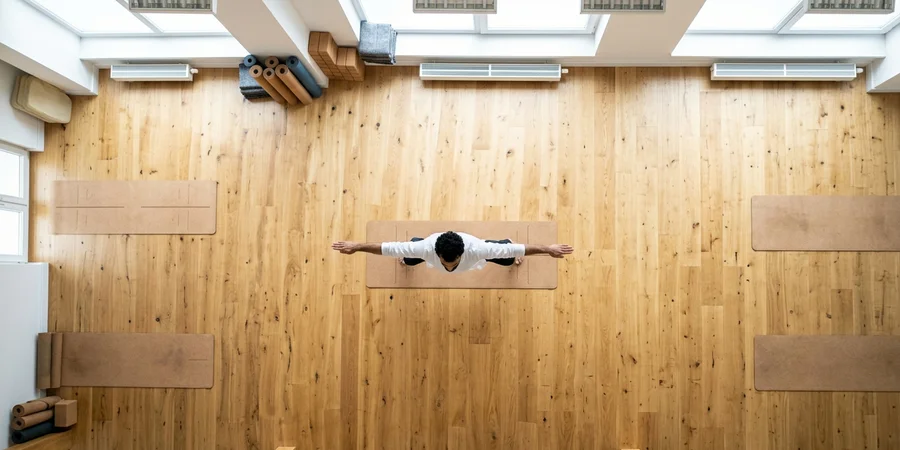
- Extend the arms. Raise the arms to shoulder height, parallel to the ground, with palms facing down. Fully extend the elbows and actively stretch the fingers as if you want to touch both walls of the studio at the same time.
- Align the torso. The trunk rises vertically from the pelvis, without leaning towards the front leg or the back leg. Imagine you have a wall behind your back: shoulders, shoulder blades, and sacrum touch it.
- Direct your gaze. Turn your head to the right and fix your eyes on the fingers of the front hand. The gaze is steady and serene, directed towards the horizon. In the tradition of Ashtanga Yoga, this point of focus is called parsva drishti.
- Inhale and hold. Stay for 5 to 10 deep breaths. Feel how the legs are working, the arms are extending, and your breath is supporting you. Then, repeat on the other side.
Correct alignment: common errors and how to fix them
Virabhadrasana II seems simple because there is no twisting, inversion, or balance on one leg. But holding it with precision quickly reveals where the body compensates. These are the most frequent errors.
Legs and hips
The most dangerous error is that the front knee collapses inward (valgus). This creates shear force on the medial collateral ligament and the inner meniscus. The cause: weakness of the gluteus medius or lack of activation of the external rotators.
To correct it, think about pushing the knee toward the little toe of the foot. The signal that it is correct is being able to see the toes of the front foot when looking over the knee. If you can’t see them, the knee has gone too far.
Another common mistake is that the hips rotate forward, turning the pose into a degraded Warrior I. The hips should face the long side of the mat. If you notice the chest rotating, place your hands on the iliac crests to feel their orientation.
It is also common to carry too much weight on the front leg and leave the back leg passive. The distribution should be balanced: both feet rooted, both legs active. Deliberately press the back heel into the ground to activate the entire posterior chain of that leg.
Torso and Arms
The torso leaning towards the front leg is one of the most subtle mistakes. As fatigue increases, the body shifts weight forward. The correction: make sure that the back wrist stays over the back ankle. If it’s in front, the torso has moved.
The arms falling below shoulder height lose the horizontal line that defines the posture. The middle deltoids fatigue quickly in sustained isometric contraction: this is normal. The instruction “extend your fingers towards the walls” reactivates the arms without generating tension.
Lastly, the shoulders that rise towards the ears compress the neck and the upper trapezius. Exhale, lower the shoulder blades and feel how the collarbones widen. The arms should feel like an extension of the chest, not as an isolated effort.
Benefits of Virabhadrasana II
Physical Benefits
The quadriceps of the front leg maintain a prolonged eccentric contraction that generates a functional strength in the legs difficult to match. The gluteus medius, external rotators, and adductors work simultaneously to keep the knee aligned and the pelvis stable.
The position of arms extended at shoulder height is an exercise of endurance for the deltoids that few yoga postures can match. Unlike Chaturanga, which works pure strength, Virabhadrasana II trains the ability to sustain moderate effort over an extended period of time.
The lateral opening of the pelvis with external rotation stretches the adductors (inner thighs) and progressively improves hip mobility. This especially benefits those who spend many hours sitting, as the sedentary position stiffens the rotators.
Furthermore, the extended arms and retracted shoulder blades open the chest and stretch the pectorals, countering thoracic kyphosis and the commonly rounded shoulder posture seen in desk work.
Energetic and Mental Benefits
The wide base and weight distributed on both feet connect with Muladhara (root chakra): the ability to remain grounded when life challenges. It is a posture that teaches stability not as rigidity, but as grounded presence.
The open chest and expanded arms stimulate Anahata (heart chakra). There is something paradoxical and beautiful in this posture: you are a warrior and at the same time you are completely exposed. Strength without closing yourself off. Power without hardening yourself.
On a mental level, holding the drishti fixed on the fingertips trains dharana, the sustained concentration that Patanjali describes as the sixth step of yoga. The legs burn, the arms feel heavy, the mind seeks to escape. Staying breath-focused is the real practice.
Variations and Modifications
Virabhadrasana II is a central pose that provides access to many others. It can also be easily adapted to different levels of practice.
For Beginners
Shorter lunge and less bent knee. Reducing the distance between the feet and not bringing the knee to 90 degrees decreases the load on the quadriceps and knee. The pose retains its essential form; only the intensity changes.
Back against the wall. Practicing with your back, shoulder blades, and sacrum touching the wall provides immediate feedback on torso alignment. If the torso leans forward, you will feel it right away by losing contact with the wall.
Hands on hips. Removing arm extension reduces shoulder fatigue and allows you to focus all attention on the alignment of hips, knees, and feet. It is the best option when there are shoulder or rotator cuff injuries.
To deepen
Viparita Virabhadrasana (Reversed Warrior). From Virabhadrasana II, the front arm lifts towards the ceiling while the back hand slides down the back leg. The spine extends in a lateral arch that opens the intercostals. The legs do not change: it is the same base with a different expression.
Transition to Trikonasana. Extend the front leg and lower the torso laterally. The organization of the hip is identical in both postures, which makes the transition fluid. Warrior II is, in many sequences, the gateway to Triangle.
Transition to Parsvakonasana (Extended Side Angle). The forearm descends over the front thigh and the back arm extends overhead, creating a continuous line from the back foot to the fingertips. The legs remain the same as in Warrior II.
Contraindications
Virabhadrasana II is accessible to the vast majority of practitioners, but there are situations that require modification or caution.
If you have knee injuries (meniscus, ligaments, patellofemoral syndrome), reduce the forward knee bend to 45 degrees instead of 90. Make sure that the knee always points towards the toes and never collapses inward.
In the case of hip problems such as femoroacetabular impingement or recent prosthesis, the combination of abduction and external rotation may exceed the safe range. Work with a smaller opening and respect the limits that your joint indicates.
If you have high blood pressure, the sustained isometric contraction of legs and arms can temporarily elevate pressure. Practice with shorter holds or with your hands on your hips.
In case of cervical discomfort, do not turn your head towards the front hand. Keep your gaze forward, in the same direction as your chest, until your neck allows it.
During advanced pregnancy, widen your base if necessary and reduce the depth of the bend. A nearby support (wall or chair) can help with balance.
The warrior who observes: presence before action
What makes Virabhadrasana II special is not its technical difficulty, but what it demands of your attention. The legs tremble, the arms are heavy, the drishti is maintained. Every breath is a choice to stay.
In mythology, this is the moment when Virabhadra observes before acting. He does not rush. He does not close his eyes. He looks straight ahead, clearly, and then decides. That quality of presence is what the pose invites you to practice every time you hold it.
Virabhadrasana II is also a “gateway” pose: from it, you can access Trikonasana, Parsvakonasana, Ardha Chandrasana, and the Inverted Warrior. Mastering it opens the door to an entire family of asanas that share the same foundation of open hips and grounded feet.
If you want to learn how to sequence these poses with anatomical reasoning, our yoga teacher training course dedicates entire modules to the analysis and practice of the fundamental yoga poses.