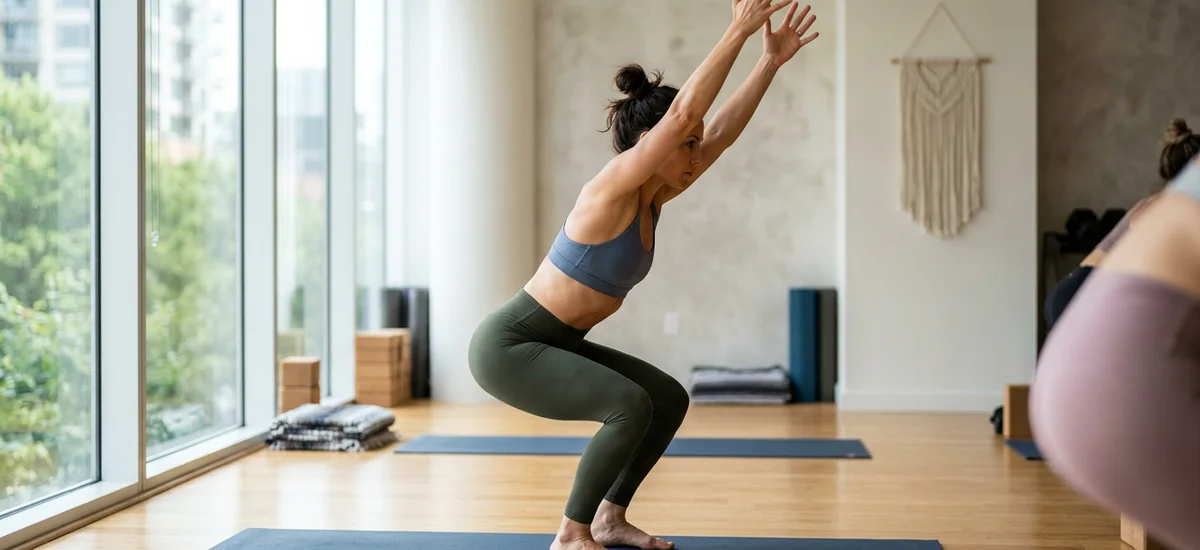
It translates as “chair pose,” but the name is misleading. In Sanskrit, utkata means “ferocious,” “powerful,” “intense.” It is not a chair where one settles: it is an invisible seat that demands, burns, and forces you to stay.
Anyone who has been practicing yoga for a few months knows this well. Utkatasana appears in almost every class, in the third movement of Sun Salutation B, in Vinyasa transitions, in strength sequences. And each time it surprises again: in just a few breaths, the legs tremble.
In this article, we will see what its name really means, how to execute it without straining the knees or lower back, why it is one of the most effective poses for building strength in yoga, and how to adapt it to different levels.
Meaning: more “powerful pose” than “chair pose”
The word Utkatasana comes from Sanskrit utkata (उत्कट), which translates to “fierce,” “intense,” or “violent,” and asana (आसन), “pose.” The literal translation would be “fierce pose” or “powerful pose.”
The western adaptation renamed it as chair pose because, seen from the outside, the practitioner seems to be sitting on an invisible chair. That image is useful for learning but loses the essential nuance of the original name.
It’s not about sitting. It’s about maintaining an intense force in your own body, without external support, for an extended period. That’s why classical texts describe it as a pose that cultivates virya, the inner vigor that allows one to sustain the practice.
In the tradition of Ashtanga Yoga, Utkatasana opens the standing series. It appears in the third movement of the Surya Namaskar B, right after downward-facing dog. It’s no coincidence: it’s the pose that activates the legs, warms the body, and prepares the muscles for everything that comes next.
Utkatasana in the classic sequences
In Vinyasa, Utkatasana is used as a “bridge pose” between bends and standing poses. In classical Hatha, it is held for a longer time and with less knee flexion, emphasizing alignment over intensity. In Iyengar, it is used to teach the simultaneous activation of legs and long spine.
The difference between styles is useful: there is not just one correct Utkatasana. There are more dynamic versions and more sustained versions. The essentials are the same in all: strong legs, neutral pelvis, long spine, and continuous breathing under effort.
How to do Utkatasana step by step
The following sequence describes the classic version with the feet together. If you have knee discomfort or balance issues, separate your feet to hip-width: the pose remains fully valid.
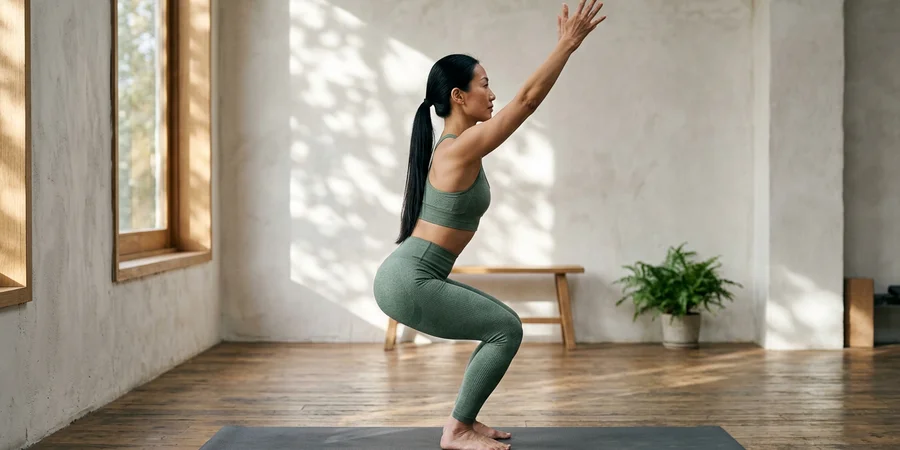
- Part of Tadasana. Stand with your feet together, toes touching and heels slightly apart. Activate your quadriceps, lift your kneecaps, and root the four corners of your feet into the ground.
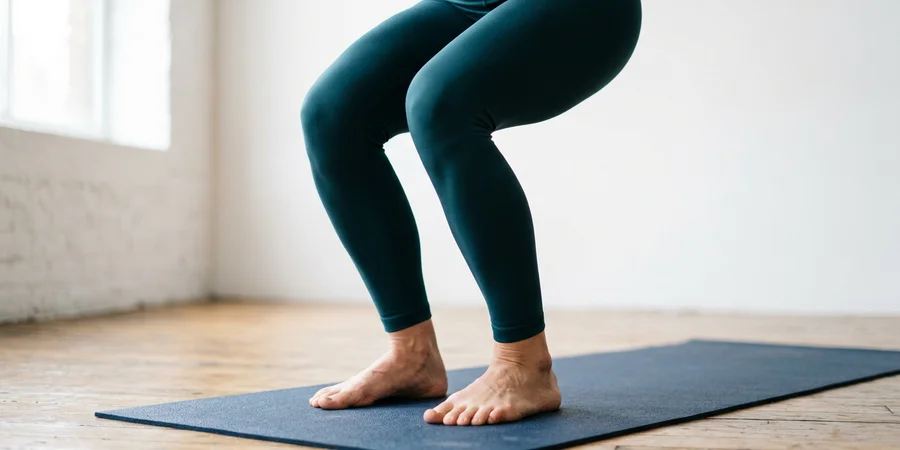
- Bend your knees and hips at the same time. As you exhale, begin the descent. The knees bend while the pelvis moves back, as if you are looking to sit on a chair behind you. The movement is simultaneous, not sequential.
- Shift your weight to your heels. The most common mistake is shifting the weight toward the toes. Deliberately press your heels into the ground. You should be able to move your toes without losing balance.
- Descend to your range. The knees flex between 45 and 90 degrees, depending on your strength and mobility. You don’t need to reach the maximum: a Utkatasana with less bending and good alignment is worth more than a forced one.
- Align the torso. The trunk leans slightly forward, keeping the spine long and neutral. Do not round the lower back or excessively arch the lumbar area. The pelvis remains neutral.
- Activate the abdomen. Gently pull the navel towards the spine and direct the pubis forward. This action protects the lower back and transmits force from the legs to the spine without compression.
- Raise your arms. Bring your arms out to the sides until you extend them above your head. The palms can face each other or come together, depending on your shoulder mobility. The biceps remain close to the ears.
- Lengthen the spine upwards. From strong legs, project the center of the chest and the crown of the head towards the ceiling. The gaze is forward or slightly up, without compressing the neck.
- Breathe and hold. Stay for 5 to 10 complete breaths. Upon exhaling, slightly intensify the pose by descending another millimeter. To exit, inhale, stretch your legs, and return to Tadasana.
Proper alignment: protect the knees and lower back
Utkatasana is accessible, but the combination of deep knee flexion and prolonged load can cause discomfort if alignment is neglected. These are the points that make the difference between a nourishing pose and one that punishes.
Knees and feet
The classic mistake is allowing the knees to go past the toes. This movement increases the shear force on the joint. The correction consists of moving the pelvis back, as if you were trying to sit, instead of projecting the knees forward.
To check, look down: if you cannot see your toes because the knees are blocking them, they have gone too far. Shift your weight to your heels and your pelvis back until your toes become visible again.
Another mistake is allowing the knees to come together or fall inward, especially when the feet are glued together. This puts stress on the medial collateral ligament. Keep the knees aligned with the second and third toes, actively pushing them out to the sides.
Pelvis and lower back
Many people excessively arch the lower back when raising their arms, especially if their shoulders are closed. This shifts all the tension to the lower back. The solution: engage the lower abdomen and slightly pull the lower ribs inwards.
It is also common to have the opposite compensation: collapse the lower back and round the spine when bending the torso. In this case, the pelvis tilts backward and the force from the legs does not reach the torso. Reorganize from the pelvis: pubis forward, crown upwards.
If the shoulders do not allow extending the arms overhead without arching the lower back, separate your hands to shoulder width or face the palms instead of bringing them together. The posture does not lose value and the spine is protected.
Benefits of Utkatasana
Few postures offer so much work in such a short time. Utkatasana strengthens, stretches, and concentrates, all at once. Its benefits are tangible even after just a few regular sessions.
Physical Benefits
The pose strengthens the legs comprehensively. Quadriceps, glutes, hamstrings, and calves work in sustained isometric contraction. It is one of the best yoga exercises for building functional strength without joint impact.
The action of shifting weight to the heels activates the arch of the foot and the muscles of the foot. For people with flat feet or plantar weakness, Utkatasana practiced regularly improves the ability to support one’s own weight more efficiently.
The deep abdomen works to protect the lower back and maintain a neutral pelvis. This activation of the transverse abdomen and multifidus strengthens the core in a way that few trunk bends can match.
At a cardiovascular level, holding Utkatasana for several breaths raises the heart rate and generates internal heat. That’s why it’s a key pose in warming sequences and in the transitions of Sun Salutation B.
Energetic and mental benefits
In the yoga tradition, Utkatasana cultivates tapas, the “inner fire” that allows you to maintain discipline in the face of the resistance of the body and mind. Each breath in the pose is a micro-practice of tapas: staying when everything asks you to leave.
Practitioners often experience a sense of determination and focus after Utkatasana. The posture activates the sympathetic system in a controlled manner and leaves the body with a feeling of calm alertness, useful at the beginning of a practice or a demanding day.
On an energetic level, the combination of grounding and upward projection simultaneously works the Muladhara (root) and Manipura (solar plexus) chakras. It is a posture that builds self-confidence from the direct experience of one’s own strength.
Variations and Modifications
Utkatasana allows for many versions depending on the level, limitations, and goal. These are the most useful and common.
For Beginners or Those with Discomfort
With feet hip-width apart. It is the simplest and most effective adaptation. Separating the feet reduces the demand for balance and distributes the load better on the knees. It is the recommended version for beginners or those with joint sensitivity.
With the back against the wall. Placing the back against a wall (as if it were an invisible chair) eliminates the balance work and allows focusing on leg activation and pelvic alignment. It is excellent for strengthening without risk.
With hands in prayer position. Bringing the hands to the center of the chest (Anjali Mudra) instead of extending the arms overhead reduces the load on the shoulders and lower back. The posture retains all its power in the legs and is much more accessible.
To deepen
Parivrtta Utkatasana (twisted chair). From the classic pose, bring your hands to the center of your chest and twist your torso to one side, bringing the opposite elbow outside the opposite thigh. Add a deep twist to the base of strength. It requires prior stability in the basic pose.
Utkatasana on the tips of the toes. Once holding the classic pose, lifting the heels and maintaining balance on the tips of the toes adds a considerable challenge for the calves, balance, and concentration. It is a typical advanced variation in Hot Yoga and certain Vinyasa classes.
Transition to Virabhadrasana I or jumps in Vinyasa. In dynamic sequences, Utkatasana serves as a bridge to other standing postures. This ability to be a “transitional pose” makes it a key piece of fluid sequences.
Contraindications
Utkatasana is generally safe, but there are some situations that require special attention.
If you have knee injuries (meniscus, cruciate ligaments, chondromalacia), limit the bend to 45 degrees and always practice with your feet hip-width apart. If pain occurs, reduce the depth or use the wall version.
In case of lower back issues or a herniated disc, make sure to keep the pelvis neutral and engage the abdomen. Avoid the version with arms overhead if you cannot do it without arching the lower back. Hands in Anjali Mudra are the safe option.
With low blood pressure, getting out of the pose quickly can cause dizziness. Return to Tadasana smoothly, passing through a slight intermediate bend before standing up completely.
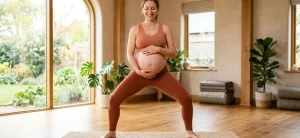
During pregnancy, spread your feet wider and don’t lower as deeply. Avoid the twisted version, which compresses the abdomen. A nearby support can help with balance in the later trimesters.
If you suffer from chronic shoulder pain or limitation in arm flexion, do not force the extension above your head. Hands facing shoulder-width apart or in prayer are perfectly valid alternatives.
The chair that teaches to hold the fire
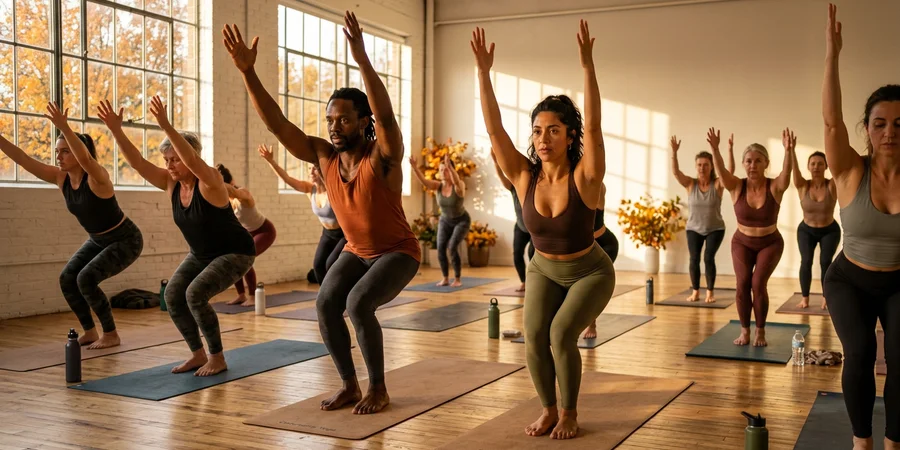
Utkatasana is a strict teacher. In just a few breaths, it places the practitioner face to face with themselves: the mind wanting to escape, the legs trembling, the breath quickening. And yet, there is still time for one more breath. And another.
This ability to hold the fire without rigidity or collapse is, in the end, what the posture cultivates. It’s not about clenching the teeth. It’s about breathing into the intensity, finding an active stillness that does not break when the body protests.
That is why it is a pose that appears so early in almost all practices: because it sets the tone. Those who learn to hold Utkatasana with long breaths and a calm spine have access to a resource that will be useful later in inversions, balances, and complex sustained poses.
If you want to learn to sequence these poses thoughtfully and integrate them confidently into your classes, our 200h Yoga Teacher Training Course includes complete modules on biomechanical analysis and pedagogy applied to the study of essential yoga poses.