Tadasana seems to be the simplest yoga pose: just standing. But if you have ever held it with full awareness for several minutes, you will know that it hides much more than it appears.
The mountain pose is the foundation upon which all standing poses and, indeed, your entire yoga practice is built.
Here you will discover why Tadasana is much more than “just standing still,” how to perform it step by step, and why the great masters of India consider it one of the most important asanas.
Meaning and origin of Tadasana
The name Tadasana comes from Sanskrit: tada (तद) means “mountain” and asana (आसन) means “posture.” It evokes the nature of a mountain: stable, immovable, rooted in the earth and rising toward the sky.
In the tradition of Ashtanga Yoga, this posture is known as Samasthiti (sama = equal; sthiti = to stand). While Tadasana emphasizes the firmness of the mountain, Samasthiti underscores the symmetry and bilateral balance of the body.
It does not appear in the classical medieval texts such as the Hatha Yoga Pradipika (15th century), which focused on seated postures for meditation and pranayama.
It was systematized in the 20th century by T. Krishnamacharya, considered the father of modern yoga. Trained in the yogic traditions of southern India, he made it the base posture for all his vinyasa sequences.
Your direct disciples, B.K.S. Iyengar and Pattabhi Jois, popularized it globally. Today, Tadasana is the starting and returning point in the Sun Salutation and in any sequence of standing postures.
How to do Tadasana step by step
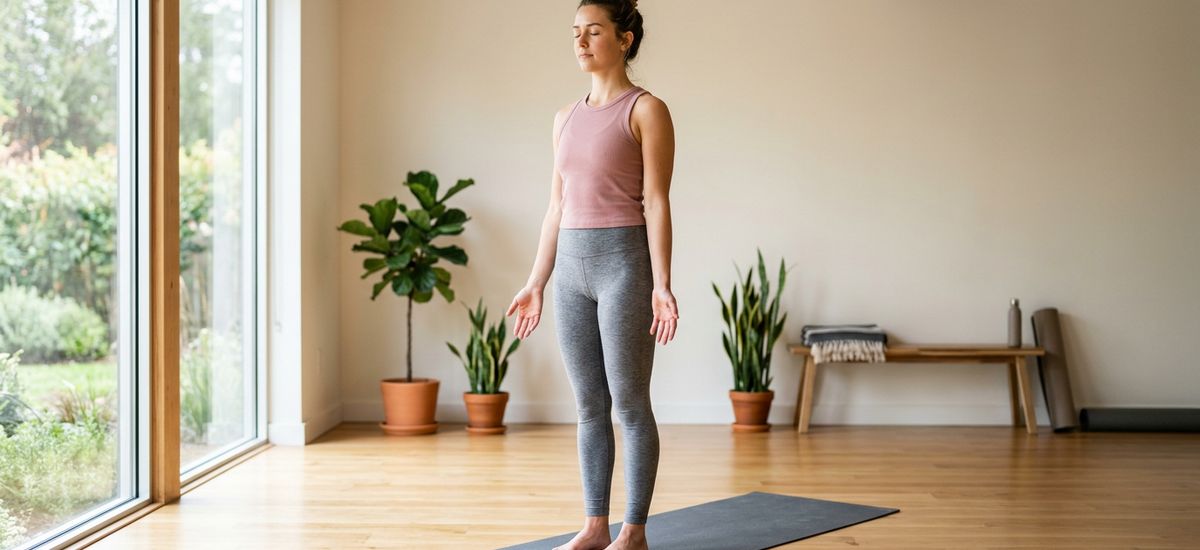
Follow these instructions to practice the mountain pose with correct alignment:
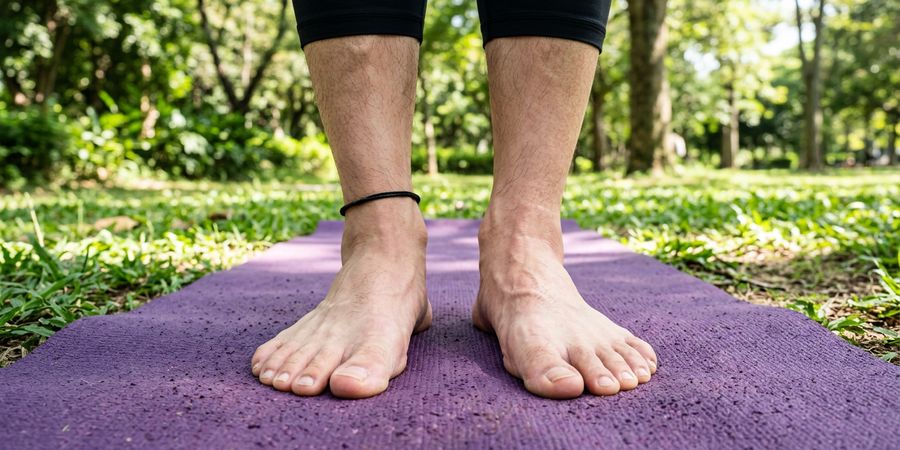
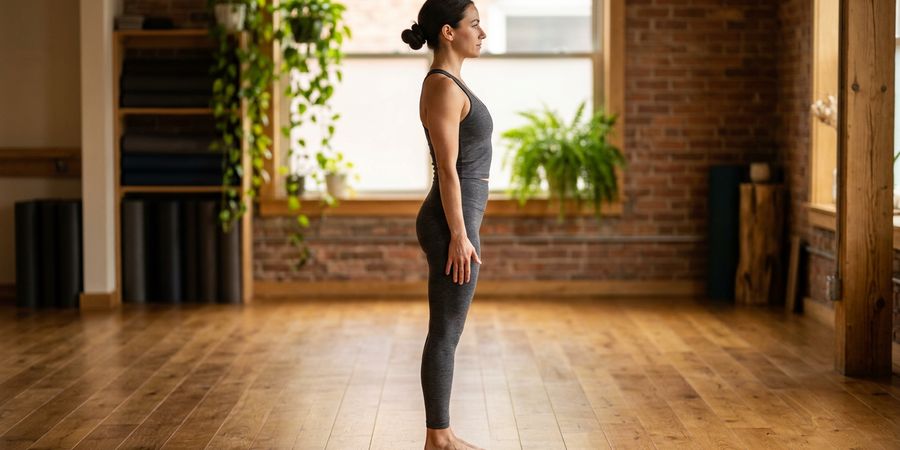
- Place your feet. Bring your feet together with the inner edges touching. If you are a beginner or have balance issues, separate them hip-width apart. Extend your toes over the mat.
- Distribute the weight. Spread the load among the four points of support of each foot: the base of the big toe, the base of the little toe, the inner heel, and the outer heel. Feel the arch naturally lift.
- Activate the legs. Lightly lift the kneecaps by contracting the quadriceps, without locking the knees. Keeping a micro-bend protects the joint. The thighs gently rotate inward.
- Find the neutral pelvis. Imagine a bowl full of water: it doesn’t spill forward or backward. To find this position, tilt the pelvis in both directions and stay at the midpoint.
- Lengthen the spine. From the sacrum to the crown, grow toward the ceiling as if an invisible thread were pulling you upward. Lift the sternum without flaring the lower ribs.
- Position shoulders and arms. The shoulder blades descend towards the waist, away from the ears. The arms hang at the sides with the palms facing the thighs or slightly forward.
- Align the head. Chin parallel to the ground, ears over the shoulders. The gaze (drishti) is soft, forward, at eye level with the horizon.
- Breathe. Close your eyes if you wish. Breathe deeply through your nose, observing how your body stabilizes with each exhalation. Stay for between 30 seconds and 2 minutes.
Correct alignment: common mistakes and how to fix them
Teachers of the Iyengar tradition call Tadasana the “flat pose” (blueprint pose). Everything you learn here transfers to Vrikshasana, Trikonasana, Virabhadrasana, and the rest of the standing poses.
From the waist down
The most common error is knee hyperextension: fully locking them back generates excessive stress on the posterior ligaments. To correct it, maintain a micro-bend by engaging the quadriceps without pushing the knees back.
Another classic is anterior pelvis tilt. Tilting the pelvis forward exaggerates the lumbar curve and compresses the L4-L5 vertebrae. The correction consists of engaging the deep abdominals and lengthening the tailbone towards the floor.
It is also common to place too much weight on the heels. The body leans back, the arches collapse, and the calves work excessively. Redistribute the weight towards the four points of support that we described in the step-by-step.
From the waist up
The shoulders raised towards the ears create chronic tension in the upper trapezius and neck. Exhale and actively lower the shoulder blades, as if you were putting them in the back pockets of your pants.
The head projected forward is very common in people who work many hours in front of a computer. Bring your ears over your shoulders and elongate the crown of your head towards the ceiling.
Finally, opening the ribs by excessively pushing the chest forward disrupts the neutral alignment of the torso. Gently draw in the lower ribs while keeping the core active.
Benefits of Tadasana
Physical Benefits
Tadasana aligns the spine in its natural curvature, correcting patterns of kyphosis (rounded shoulders) and exaggerated lordosis. Regular practice transforms the way you hold yourself throughout the day, not just on the mat.
Quadriceps, hamstrings, glutes, and deep abdominal muscles work in sustained isometric contraction. Electromyographic (EMG) studies confirm that the rectus femoris and lumbar spinal erectors show the highest activation in this posture.
The conscious activation of the posterior tibialis and the intrinsic muscles of the foot strengthens the medial arch. With continued practice, this can help correct flat feet and improve proprioception.
Additionally, the elevated sternum and lowered shoulders expand the chest cavity. This allows for deeper, more complete, and efficient breaths.
Energetic and Mental Benefits
Tadasana stimulates the Muladhara chakra (root chakra), related to stability, security, and a sense of belonging. The stillness activates and the attention to the body develop a full and conscious presence.
As tradition says: “in stillness we are active, aware, and alive.” By calming the nervous system through the upright posture and conscious breathing, it acts as a “reset” for body and mind.
Practicing it regularly teaches you to recognize your habitual postural patterns. That body awareness translates into your day-to-day life, correcting the way you sit, walk, and hold yourself.
Variations and Modifications of Tadasana
The beauty of Tadasana lies in its adaptability. You can explore it in many ways according to your level and needs.
For beginners
With your back against the wall. Practice with the occiput, thoracic spine, sacrum, and heels touching the wall. This sensory feedback helps you understand the neutral alignment of your body.
If you feel unsteady with your feet together, separate them to hip-width. This provides a wider base of support and greater stability.
To deepen
Tadasana with a block between the thighs. Place a yoga block between your upper thighs and press it actively. Activate the adductors, stabilize the pelvis, and correct the tendency to separate the thighs.
Urdhva Hastasana (arms raised). From Tadasana, inhale and raise your arms overhead with palms facing each other or together. It is the second pose of Sun Salutation and intensifies the lateral elongation.
With closed eyes. Removing visual reference turns Tadasana into a powerful exercise of proprioception and balance. Try to hold it for 60 seconds without opening your eyes.
Contraindications
Tadasana is a very safe pose, but it is advisable to keep in mind a few considerations.
If you have low blood pressure, prolonged standing can cause dizziness. Practice for short durations or with wall support.
In case of dizziness or migraines, static holding may worsen the symptoms. Use the wall variant and reduce the time.
During advanced pregnancy, the change in the center of gravity affects balance. Widen the base by separating your feet and stay close to a wall or a chair.
In case of recent injuries to ankles, knees, or hips, wait to regain joint stability. In the meantime, you can work on alignment in a supine position.
Tadasana: the foundation of your entire practice
If there is something that defines Tadasana, it is its role as a reference posture. Everything you learn here transfers to the rest of your practice.
The activation of the feet that you develop in this posture will be used in Trikonasana, Virabhadrasana, and all standing poses. The neutral pelvis that you find here is the same one you need in Warrior I and II.
The extension of the spine is applied in each pose, from Adho Mukha Svanasana (downward-facing dog) to Bhujangasana (cobra).
For this reason, in teacher training programs like our yoga teacher course, we dedicate time to breaking down Tadasana with anatomical precision. Those who master the mountain, master the ground on which everything else is built.