There are asanas that look simple, and they are. There are others that look simple, and they are not simple at all. Paschimottanasana belongs to the second category. Sitting with your legs extended and bending forward seems easy. Doing it correctly is the work of many years.
The seated forward bend is one of the oldest and most cited forward bends in classical yoga texts. The Hatha Yoga Pradipika dedicates specific verses to it. It is a posture that runs throughout the entire body, from the heels to the crown of the head, and teaches something essential: the goal is not to touch your toes.
In this article we will see what its name means, how to perform it without forcing the back, why it is such a profoundly calming posture, and how to adapt it when the hamstrings don’t want to cooperate.
Meaning: “the intense stretch of the west”
The word Paschimottanasana is formed with three Sanskrit roots: paschima (पश्चिम), “west”; uttana (उत्तान), “intense stretch”; and asana (आसन), “posture”. The literal translation is “the posture of the intense stretch of the west”.
In Indian tradition, the practice was oriented towards dawn, facing east. Therefore, the back and the entire posterior muscle chain of the body were oriented towards the west. This is why the “west” of the body is, in yogic language, the entire dorsal area: from the heels and calves to the nape of the neck.
This nomenclature is not decorative. It reveals the deep intention of the posture: to completely stretch the posterior chain, that network of fascia and muscles that is rarely worked in an integrated way in modern sedentary life.
Paschimottanasana in classical texts
The Hatha Yoga Pradipika (15th century) mentions it as one of the four main asanas. Swami Svatmarama states that “of the asanas, Paschimottanasana is the most excellent.” The reason: he believes it activates the digestive fire, releases the prana through the spine, and prepares the practitioner for meditation techniques.
The Gheranda Samhita describes it as a posture that extends the vital air (apana) upward and rejuvenates the body. In the tradition of Ashtanga Yoga, Paschimottanasana opens the primary series of seated asanas, right after the standing postures.
Therefore, it is not a “closing” or “relaxation” pose. It is a foundational pose that marks the beginning of introspective work. Its calming capacity does not arise from being gentle, but from being deeply integrative.
How to do Paschimottanasana step by step
The following sequence describes the full version. Remember: if your hamstrings are tight, the essential thing is not to reach for your feet but to maintain a long spine during the forward fold.
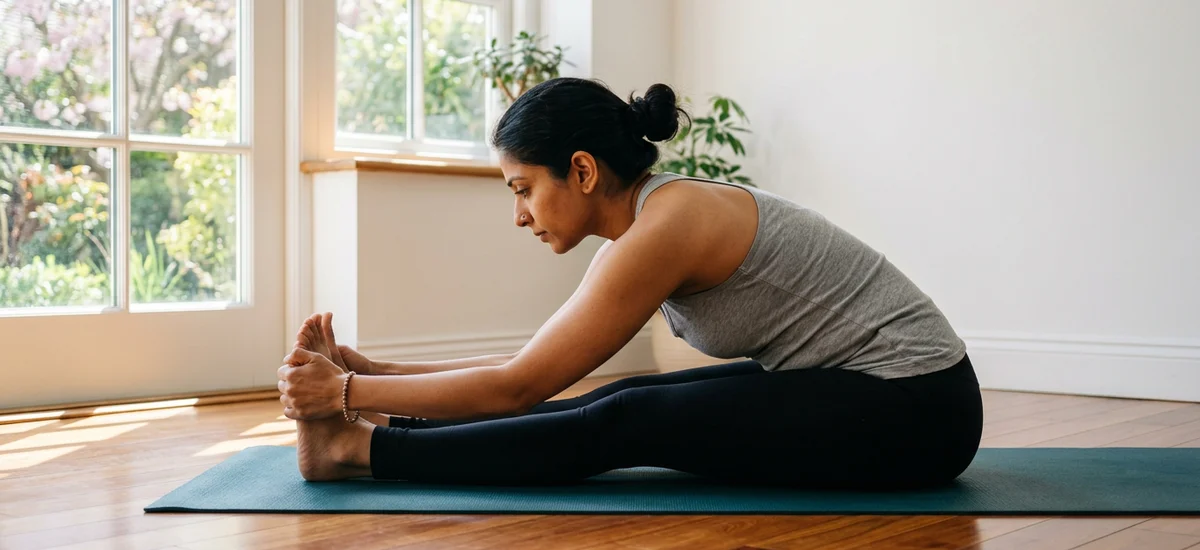
- Sit in Dandasana. Sit on the mat with your legs extended forward, together and active. The heels push outward, the toes point to the ceiling, and the quadriceps lift the kneecaps. The spine remains vertical.
- Adjust the pelvic base. If you notice that the pelvis tilts back and the lower spine rounds, sit on the edge of a folded blanket. Elevating the hip allows the pelvis to tilt forward, which is the foundation of the entire posture.
- Lengthen the spine upwards. Inhale deeply and grow from the crown of your head. Separate the ribs from the abdomen, open the chest, and root the sit bones into the ground. This initial extension is the inversion that allows the backbend to be safe.
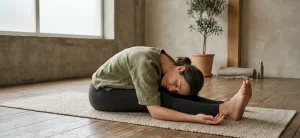
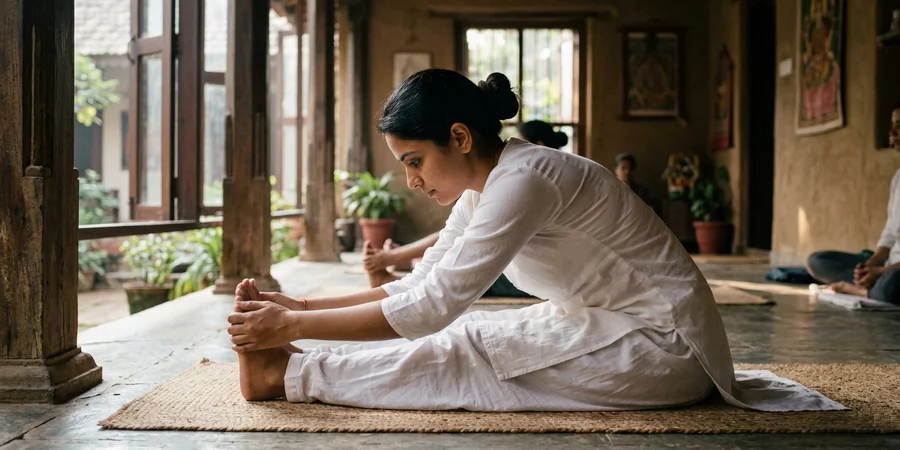
- Initiate the movement from the hip. As you exhale, tilt the pelvis forward and accompany that movement with the trunk. The flexion originates from the hip joint, not from the spine. The back remains long, it does not round.
- Descend to your range. Descend only as far as you can maintain the elongated spine. The hands can reach the calves, ankles, or feet. Depth does not matter: what matters is that the flexion originates from the hip.
- Release the neck. Relax the head without forcing it. If you can rest it on your legs, great. If not, let it hang without tension. The neck follows the natural line of the spine, it does not seek to reach any destination.
- Keep the feet active. Although the trunk is resting, the feet remain active. The toes point towards the ceiling, the heels push forward. This activation maintains the stretch in the posterior chain and prevents passive collapse.
- Breathe into the back space. With each inhalation, feel how the back expands upwards and outwards. With each exhalation, release one more layer of tension without forcing more depth. The posture works on its own.
- Stay between 1 and 5 minutes. Paschimottanasana gains depth over time. A short hold prepares; a long one transforms. To exit, inhale, lengthen the spine, and rise with the pelvis, not the back.
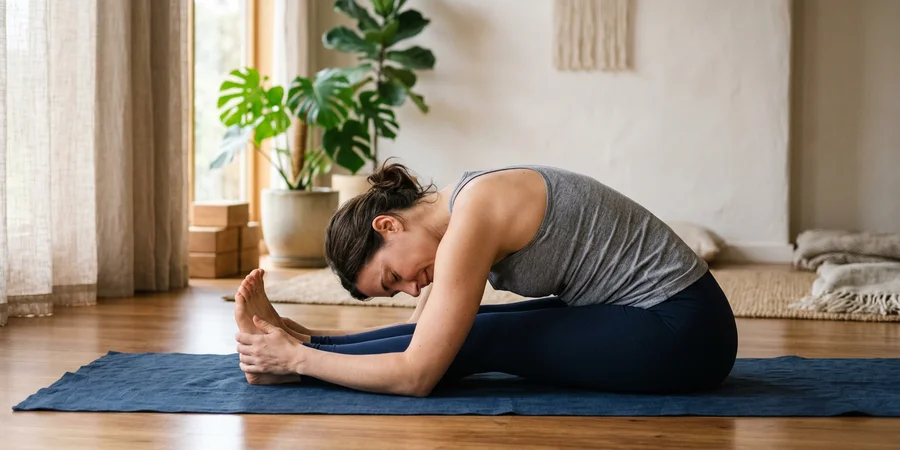
Correct alignment: it is not a pose to touch your toes
The great misunderstanding of Paschimottanasana is thinking that the goal is to reach the toes with the hands. This idea leads thousands of practitioners to round their backs, strain their necks, and turn a calming pose into a source of injuries.
Paschimottanasana is not a measure of flexibility. It is an invitation to stretch the posterior chain with a long spine. That difference is what separates a nourishing practice from a frustrating one.
The bend originates from the hip, not from the back
The key to this pose is the movement in the hip joint. The pelvis should tilt forward like a wheel turning on the ischium. If the hamstrings are tight, the pelvis does not tilt, and the only option to “reach” is to round the spine.
Sustained rounding of the lumbar spine subjects the intervertebral disc to significant anterior pressure. That’s why the rule is clear: longer rather than lower. Prefer a pose with less bend and an extended spine to a deep bend with a curved back.
To train the pelvic scale, imagine that a thread is pulling your coccyx backward while the pubis moves forward. That micro-adjustment reorients the entire posture and mobilizes the posterior chain from where it should move.
Ischiums, knees, and feet
Always sit on the ischiums, not on the sacrum. If you notice that the ischiums are not making good contact with the ground or that the pelvis is tilting backward, elevate the hips with a blanket or a low block. This elevation is by far the most useful modification and the least used.
The knees should remain active but not hyperextended. If you have joint hypermobility, bend your knees very slightly to protect the ligaments. The pose does not lose value, and the joints appreciate it.
The feet are more important than they seem. Keep them active, with the toes pointing toward the ceiling. This push activates the plantar fascia, the calves, and the hamstrings, integrating the entire posterior chain into an even stretch.
Benefits of Paschimottanasana
Few postures gather as many physical and energetic benefits. Their ability to act simultaneously on the body and the nervous system makes them one of the most valuable asanas in the entire tradition.
Physical Benefits
Paschimottanasana stretches the entire posterior chain: plantar fascia, calves, hamstrings, glutes, spinal erectors, and para-spinal muscles. It is one of the most integral and profound stretches that exist in yoga.
The gentle compression of the abdomen against the thighs massages the visceral organs, especially the digestive system. That’s why classic texts link it to the improvement of agni, the digestive fire. In practice, it helps with slow digestion, abdominal bloating, and regularity.
At the level of the spine, the sustained stretch hydrates the intervertebral discs and mobilizes the lumbar vertebrae. Practiced with a long spine (not rounded), it is one of the most effective postures for keeping the back healthy in sedentary individuals.
The posture also regulates blood pressure in individuals with mild high tension, as long as it is practiced with patience and without force. The position with the head lowered activates the parasympathetic system and promotes vasodilation.
Energy and Mental Benefits
In tradition, Paschimottanasana stimulates Sushumna Nadi, the central energy channel that runs along the spine. By elongating the posterior chain with attention, prana flows more freely through this channel, preparing the body for techniques such as pranayama and meditation.
At a mental level, the posture induces a state of deep introspection. The head below the heart, the body folded over itself, and slow breathing activate the vagus nerve and reduce the activity of the sympathetic system. It is a posture that calms without numbing.
For this reason, it is common in closing practices, before Savasana, and as preparation for seated meditation. Holding it for a few minutes leaves the mind in a state of silent contemplation that is difficult to achieve by other means.
Variations and modifications
This is a pose where modifications are not only valid: they are necessary. The intelligent use of props transforms Paschimottanasana into a practice accessible to any body.
For bodies with tight hamstrings
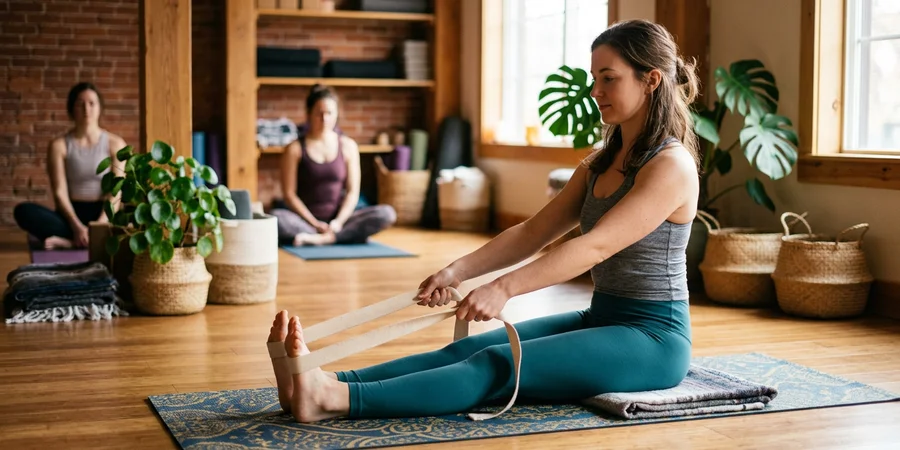
Sit on a folded blanket. Elevating the hips by 5 to 15 centimeters allows the pelvis to tilt forward even when the hamstrings limit the range. It is the most effective modification and should be the default option for most bodies.
Use a belt around your feet. Loop a yoga belt around the soles of your feet and hold the ends with your hands. This allows you to keep the spine lengthened and descend only as far as the back remains long. It is the accessory that deserves the most respect in this pose.
Flex your knees slightly. If the hamstrings are pulling too hard and the pelvis is not tilting, bend your knees a little. The pelvic tilt recovers, the stretch reaches the right spot, and the spine remains protected.
To deepen the practice
Sustained Paschimottanasana (Yin version). Staying for 3 to 5 minutes with a blanket under the forehead or a cushion over the legs transforms the pose into a deep yin practice. The fascia and connective tissues need time to release, and this long hold is where real transformation happens.
Janu Sirsasana as preparation. Practicing Janu Sirsasana (one-legged forward bend) before Paschimottanasana releases asymmetries and prepares the hip and lower back. It is a classic sequence in Ashtanga and Iyengar for its effectiveness.
Urdhva Mukha Paschimottanasana. An advanced variation where the practitioner lies on their back, elevates the legs, and brings the feet towards the head, inverting the posture. It requires advanced flexibility of the hips and spine. It is practiced after consolidating the classic version.
Contraindications and precautions
Paschimottanasana is a safe posture when practiced carefully, but there are situations where it requires modification or avoidance.
If you have lumbar disc herniation or active disc protrusion, avoid bending with a rounded back. Only practice the variant with a long spine and reduced depth, or temporarily substitute it with Supta Padangusthasana (leg raised lying on your back).
In case of acute hamstring injury, allow the tissue to heal before returning to the posture. During rehabilitation, use the strap and lower very little. Intense stretching on an injured tendon delays recovery.
With active sciatica, Paschimottanasana may worsen symptoms if the pelvis does not tilt correctly. Bend the knees generously, raise the hips, and descend with great moderation. In the acute phase, it’s better to avoid it.
During the second and third trimesters of pregnancy, abdominal compression is not advisable. Substitute with Upavistha Konasana (seated pose with legs apart) or by bending over an elevated support.
If you suffer from acute diarrhea or intense abdominal discomfort, skip this pose until the symptoms resolve. Visceral compression may increase irritation.
The forward bend that teaches letting go without falling
Paschimottanasana is a pose of active surrender. You do not enter forcefully or in a hurry. You enter by breathing, lengthening, releasing one layer and then another. Progress is not measured in centimeters: it is measured in the quality of the inner silence that the pose produces.
That is why it is so different from Utkatasana or other active strength poses. If the chair teaches us to hold the fire, the forward bend teaches us to hold the pause. Both are necessary. Both cultivate a complementary quality in the practitioner.
In a balanced practice, forward bends like Paschimottanasana alternate with extensions like Bhujangasana and with neutral postures that integrate both movements. The spine needs this alternation to stay healthy in the long term.
If you want to learn how to sequence forward bends with anatomical reasoning, to use props accurately, and to adapt this family of poses to different bodies, our 200h Yoga Teacher Training Course includes complete modules on anatomy applied to the study of classical yoga postures.