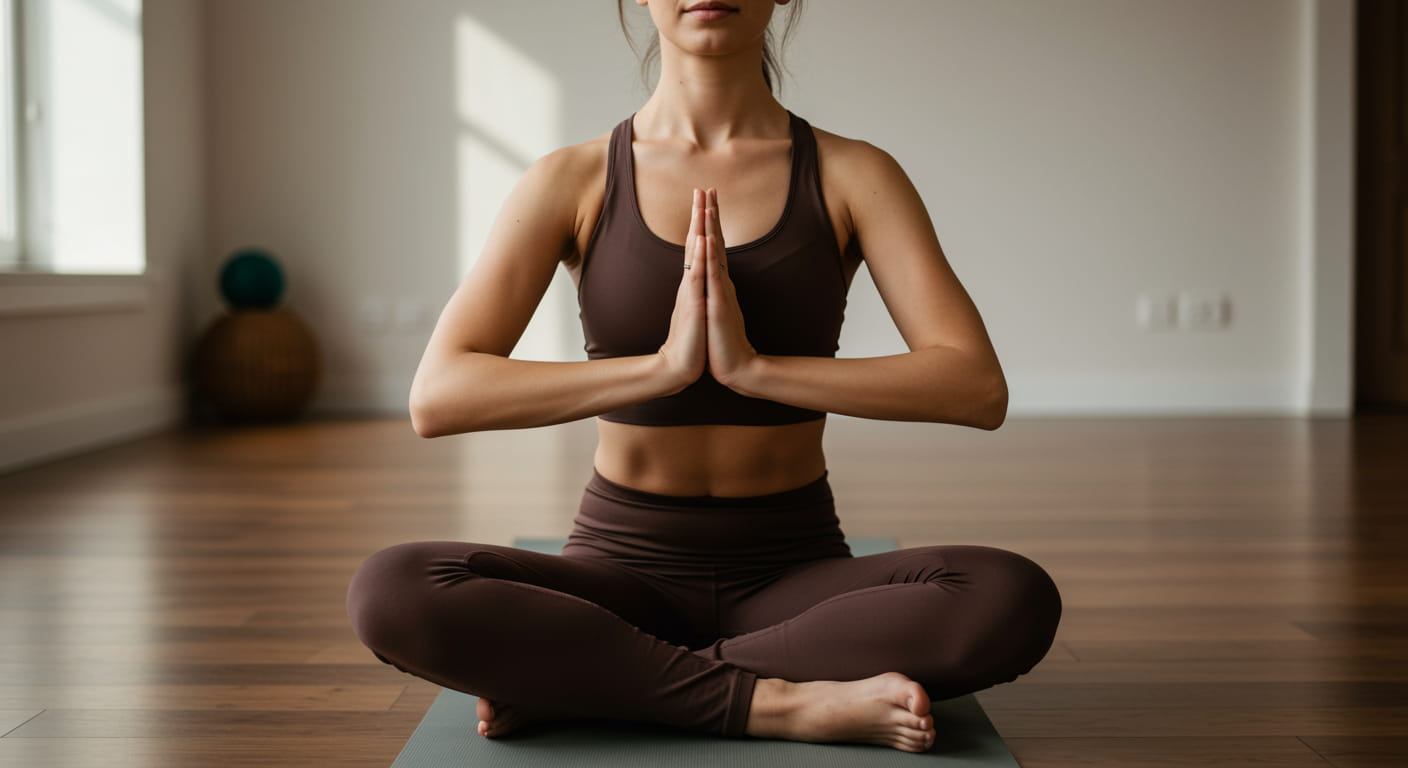
We often hear the word Namaste at the end of a yoga class. We say it with our hands in prayer in front of the chest, sometimes with a slight bow. But what does it really mean? Behind this simple gesture lies a deep message of respect, connection and gratitude.
In this article we explain the meaning of Namaste, what language it comes from, how it is translated, why it is sometimes written “namaste” and sometimes “namasté”, and how to carry its spirit beyond the mat. Because when we understand what lies behind this greeting, every class —and every human encounter— takes on new meaning.
What does Namaste mean?
Namaste means “I bow to you” or “I greet you with reverence”. It is a respectful greeting of Indian origin that recognises the light or divine essence that lives in the other person. It is accompanied by the gesture of joining the palms in front of the heart and slightly bowing the head.
The word comes from Sanskrit and is made up of two parts: namaḥ, which means reverence, bow or greeting, and te, which means to you. Hence its literal translation: “reverence to you”.
However, the meaning of Namaste goes far beyond a simple formula of courtesy. It is a recognition that, beyond our outer differences, we all share a common essence. When we say Namaste we honour the light, the spirit or the divine that dwells in each person. In every greeting we affirm: “the best in me greets the best in you”.

Namaste or namasté: how it is written and where it comes from
Both forms are valid. The original Sanskrit is transliterated as namaste, without an accent, and this is the most common spelling in English. The variant namasté, with an accent, is sometimes used to reflect the pronunciation, which stresses the final syllable: “na-mas-TÉ”. Neither is a mistake: one keeps the faithful transliteration, the other marks the sound.
The language of origin is Sanskrit, one of the oldest languages of India and the vehicle of the sacred texts of yoga. It is not a modern Hindi word invented for classes: it is a classical term that has been used for centuries as a respectful greeting across much of the Indian subcontinent.
As for its translation, the most faithful is “I bow to you”. Other common versions are “I greet you with respect”, “I honour the divine in you” or, in its most spiritual reading, “the light in me recognises the light in you”. They all share the same root: the gesture of reverence towards the other.
The spiritual meaning of Namaste
Beyond its literal translation, Namaste holds a deeply spiritual message. It is a recognition that within every human being there is a divine spark, an inner light that connects us with others and with the universe. When we say it, we honour that sacred dimension in the other.
In many traditions of yoga and Indian philosophy it is understood that we all share one and the same universal consciousness. When we say Namaste we are saying: “I see in you what is also in me”. It is a reminder of our essential unity, beyond our differences.
This sense connects with other sacred sounds and symbols of yoga. Just as the Om symbol represents the primordial vibration of the universe, Namaste translates that same idea of unity into an everyday gesture between people. The greeting thus becomes a small practice of humility and compassion.
The gesture of Namaste: the mudra of the hands
The gesture that accompanies Namaste has its own name: Anjali Mudra or the greeting seal. It consists of joining the palms of the hands with the fingers pointing up, at the height of the heart. It is not a decorative movement: it symbolises the union of opposites —body and mind, logic and intuition, you and I— in a single central point.
Placing the hands in front of the chest, and not in front of the face, is not by chance. The centre of the heart is, in the yogic tradition, the seat of compassion and affection. Bringing the hands there while we bow the head moves the intention of the greeting from the mind towards feeling.
This language of the hands is very rich in Indian culture. If you are interested, you can explore mudras and their meaning or go deeper into the positions of Buddha and their meaning, where each hand position conveys a different message.

Namaste in yoga practice
In a yoga class it is very common to close the practice with a Namaste gesture: hands in prayer position in front of the heart, a slight bow of the head and the word spoken in a soft voice. This simple ritual is a way of honouring the space shared between teacher and students.
At the end of the practice we are in a state of greater presence, openness and connection. Saying Namaste at that moment is not a formality, but a recognition of the experience lived together and of the energy created in the room. It is a way of giving thanks and closing with awareness, just as the Sun Salutation sequence opens many practices with intention.
Namaste reminds us that yoga is not just a physical activity, but a path towards inner harmony and a more compassionate relationship with the world. That same spirit of respect for the tradition is what we care for in our online yoga teacher training, where philosophy goes hand in hand with technique from day one.
Beyond the mat: living Namaste
The true power of Namaste is not limited to the mat. We can bring its spirit of respect, connection and humility to every aspect of our lives. In doing so we cultivate more conscious relationships and a more open attitude towards those around us.
Living Namaste means remembering that every person we meet —friends, family, colleagues, strangers— has their own inner light. It invites us to act with empathy, patience and gratitude, even in the most challenging moments. Every time we listen attentively, offer a kind word or act from compassion, we embody the spirit of this greeting.
In this way, yoga stops being just a practice on the mat and becomes a way of living with more awareness. There is no need to wait for the next class to live from that attitude: every day offers us new occasions to practise it.
Frequently asked questions about Namaste
What does Namaste mean in English? It means “I bow to you” or “I greet you with reverence”. It is a greeting of respect that recognises the inner light of the other person.
What language is the word Namaste from? From Sanskrit, the classical language of India in which the foundational texts of yoga were written. It is formed from namaḥ (“reverence”) and te (“to you”).
Is it written namaste or namasté? Both forms are valid. “Namaste” is the faithful transliteration of the Sanskrit; “namasté” adds the accent to mark the stressed pronunciation.
When is Namaste said? Traditionally, as a respectful greeting when meeting or saying goodbye. In yoga it is usually spoken at the close of the class, accompanied by the gesture of the hands in front of the heart.
Does Namaste have a religious meaning? Its root is spiritual, not religious. It recognises the sacred or essential in each person, an idea present in yoga and in much of Indian philosophy, but compatible with any belief or none.